
Why Does My Knee Feel Pressure When I Bend Down?
Understanding Knee Health To Maintain Knee Mechanics Throughout Your Lifespan
The Healthy Movement Podcast
“Knee pressure is easy to dismiss because it is not constant. It shows up only in a deep bend, and most of us are not down on the floor very often.” Kim Nartker
By Kim Nartker
Read time: about 8 minutes
In this episode Kim takes apart a knee signal almost nobody pays attention to. Your knee is not a hinge. It locks and unlocks through a rotation you have no voluntary control over, and when that mechanism stops working there is exactly one movement in an ordinary day that will tell you, because walking uses less than two thirds of the bend you have. She walks through what the research actually measured, what she finds when she tests above and below the knee, and the order that activities signal you as you lose key available motion in your joint capsule. Then she introduces three real women in their thirties, fifties and seventies who are not three different conditions but three people standing at different points on the same predictable movement decline path.
A note on the research: what Kim states as established is tied to the published literature and named in the episode. Where she goes beyond what the research has tested, including her working explanation for how hip and foot restriction connects to the knee, she says so plainly. She does not diagnose, treat, cure, or prevent any medical condition.
Subscribe on: APPLE PODCASTS I SPOTIFY I IHEART I RSS
The Signal Almost Nobody Pays Attention To, And What It Is Actually Telling You
You walk every day. You take the stairs. You get in and out of a chair without a second thought. Your knee feels completely fine with all of these activities.
Then you go down to the floor to pick something up or to play with a child, and you feel a pressure deep in the knee. Not quite pain, but enough to make you stop bending down on that knee.
Most people blame this deep knee pressure as a normal part of aging.
We are taught to believe that aging is the typical reason, but I have found aging to be not the reason behind this pressure at all.
That pressure is a signal, and it is showing up in exactly one position for a reason that is measurable. Your knee has a lock and unlock mechanism that is completely outside your voluntary control. When that mechanism stops working the way it was built to work, when you bend down into a deep knee bend you will feel this pressure which is a signal most of you ignore.
A woman in her mid thirties came to my studio with no pain at all. She did not have pain with walking. She could do stairs with no problem. The only time she felt anything was going down to the floor to play with her young child. She had already decided it was knee pain and that she was getting older.
She is not overweight. She had no injury. She is in her thirties. She wanted answers and asked if she should be concerned with the pressure in her knee with bending.
She scheduled a Unlock Healthy Joint Mobility Session to learn about her experience and this is what I found when I tested the joints in her lower body during her introductory session.
Both hips were restricted in every plane of joint movement. The hip on the side of the knee that she reported pressure in was found to be restricted into all planes of motion. Her foot on that same side was also found to have greater joint restrictions in her ankle, her forefoot, her midfoot, and her rearfoot. The opposite hip and forefoot had similar restrictions that were just as limiting. Her knee that she reported pressure with the deep bend had lost its unlock mechanism.
So when she went down to the floor to play with her child, the pressure in her knee caused her to get off that knee pretty fast. When she went down quickly, she noticed it and said out loud, my knee is getting old.
Why We All Ignore This
We are trained to believe our movement health is fine until something hurts.
Pain is a late signal. By the time you feel it, you either have a diagnosable condition or you are close to having one. Waiting for pain is not a strategy for anyone who wants to still be moving well in the second half of life.
And knee pressure is easy to dismiss because it is not constant. It shows up only in a deep bend, and most of us are not down on the floor very often.
Here is what makes that dangerous, and it is measurable.
Researchers put sensors on the knees of twenty healthy older adults and measured how much knee bend ordinary activities actually require.
Walking on flat or sloped surfaces required less than ninety degrees. Stairs and rising from a chair required ninety to one hundred and twenty degrees. Getting into a bath tub required about one hundred and thirty five degrees.
Getting down to the floor was not even on their list.
A healthy knee bends to roughly one hundred and thirty five degrees. So walking uses less than two thirds of what you have.
You could lose a large amount of your available bend and never notice it walking. The floor is the only thing in your ordinary day that asks for all of it.
And no, this is not aging. Researchers measuring hip and knee range of motion across age groups found differences of only three to five degrees between the youngest and the oldest person tested, and concluded that at least to age seventy four, any substantial loss of joint mobility should be viewed as abnormal and not attributable to aging.
We have been taught that we are in control of our joint mobility. We have been instructed to move, stretch, eat well and use recovery tools after we exercise. But what we have not been educated on is this fact: Our joint capsules lose accessory motion through a restriction that is out of our voluntary control. We do not get a signal of pain when this motion is lost, our muscles tighten and hold around that restricted joint. In this case this thirty year old Mom, has already started losing key mobility in her hips, 1 knee, feet and ankles and this loss has nothing to do with her age.
Your Knee Is Not A Hinge
Everyone calls it one. The anatomy texts do not. They call it a modified hinge joint, and that word modified is where this whole story lives.
Your knee bends and straightens like a hinge. It also rotates. And that rotation is built into the function of the bone and the joint.
At the bottom of your thigh bone are two rounded knuckles called condyles, one on the inside of the knee and one on the outside. They are not the same size. The one on the inside has a longer surface.
So as you straighten your leg, the shorter one runs out of room first while the longer one keeps traveling. When one side stops and the other keeps going, the joint has no choice. It rotates.
In the last twenty degrees of straightening, your shin bone rotates outward about fifteen degrees. That is called the screw home mechanism, and it locks your knee. The surfaces seat into each other. The ligaments wind tight. Your knee parks itself, which is why you can stand around with straight legs and almost no muscular effort.
If rotation locks the knee, rotation has to reverse before you can bend it again. You cannot stretch out of a locked knee. It has to unlock to bend.
There is a small triangular muscle deep behind your knee called the popliteus. The anatomy texts call it the key that unlocks the knee. Its only job is to reverse that rotation so bending can begin. When you lose the knee joint accessory motion, this deep muscle loses key activation in the process of the restriction.
So what happens when a knee cannot fully unlock?
You would not feel it walking. You would not feel it when getting up or down from a chair. Both of those activities do not require end range joint mobility.
You would feel it going down to the floor. Because this activity requires the knee to fully unlock. For this mom, she had a hip restriction and ankle foot restrictions that did not allow this lock out mechanism to unlock completely. Her joint was restricted and still in a locked position due to the multiple joint restrictions at the knee, above and below the knee joint.
So when she went into that deep position, she felt a pressure that alarmed her. That is the feeling that I am hoping I can teach to people to help them gain awareness of their body when it moves.
The Restriction Is Not Only Found In The Knee
When I test people who describe this, here is what I find.
The shin bone sitting in external rotation, which is the locked position. The knee restricted in its accessory motion, meaning those small movements between joint surfaces that you cannot produce on your own are restricted from moving. And above and below it, the same thing. Hips restricted in rotation and in accessory motion. Midfoot, rearfoot, ankle, great toe. Some of them or all of them restricted from moving.
That is not a research finding. That is what I find when I test, and I find it often enough that when someone tells me about knee pressure, I go looking above and below the area of the pressure feeling but also look at the joints of the opposite side.
Here is why that makes sense mechanically. When your foot is planted, to unlock the knee requires the thigh bone to rotate outward on the fixed shin. That rotation has to come from somewhere, and the joint above it is the hip. A hip that is restricted from moving does not allow that knee to unlock fully, so it stays stuck in the locked position.
Below the knee, the foot and ankle are what let the shin find the ground and adapt to it. Researchers took thirty healthy people with no history of injury and artificially restricted their ankle motion during a squat. The knee bent less, traveled inward more, and the muscle work shifted to a different muscle group in this study. When the ankle is restricted from moving the knee has to do something different. So the ankle, knee and hip all need the accessory motion in the joints to work properly to be positioned correctly with a deep knee bend position.
The Predictable Movement Decline Path
I have been working in the healthy movement space for over 30 years. I have found predictabilities that occur in every person that walks through my doors. The body tests the same predictable way and it does send us feelings or signals, but we have never been taught to understand what our bodies are telling us.
Here is where we lose accessory motion in our joints 1st as it relates to our knees.
Kneeling down to the floor requires the most joint mobility approx. 135 degrees is needed. We lose this motion in the capsule of the knee when the screw home mechanism and that deep muscle are no longer healthy and are restricted in movement.
We lose more motion over time through restriction and muscle inhibition making sitting on lower surfaces more difficult.
The next activity that you will feel the knee joint restriction is descending stairs as this requires more motion loss than the previous activities.
When you have lost more motion you will feel that loss when sitting in a chair, many people will start automatically compensating during this time, to avoid that loss of movement or pressure feeling.
You won’t feel the restriction in the knee with walking until you have lost more than 90 degrees of motion.
Which means by the time somebody notices it walking, an enormous amount of joint mobility and joint function are already lost to a restriction and decline.
The larger problem that we have is that when we lose this motion, we adapt, we compensate or modify our positions to avoid the loss of motion. We stop sitting on lower surfaces, we start using our hands and stepping down 1 step when we go down stairs, we avoid positions that require that motion.
So as you can see. Our bodies adapt and we adapt and accept this loss every day. Mostly because we can still move without pain.
Pain is a late signal. And by the time you experience pain, you will already have a diagnosable condition.
I have watched this movement decline in people at every stage of life. A woman in her thirties with restricted movement that can still perform activities without pain. A woman in her late fifties with those same restrictions, plus muscle inhibition and a movement system that is overworking everyday to allow her to move with symptoms that waver from day to day due to these restrictions and other factors. A woman in her seventies with all of that, plus established structural change diagnosed as Osteoarthritis, giving her joints stability while stealing the mobility in her toe, foot and midfoot joints placing her knee in a locked position at all times limiting her movement.
Those are not three different conditions. They are not only age related. They are the same signals we have learned to ignore because we can move and we don’t have pain. This is the predictable movement decline path.
And the woman in her thirties has forty years to go to reach the woman in her 70’s about to have a knee replacement surgery.
What The Research Has And Has Not Looked At
There is a study from the year two thousand that I keep coming back to. Researchers randomised eighty three people with knee osteoarthritis. Half received manual therapy plus supervised exercise, twice a week for four weeks. And the manual therapy was applied to the knee as well as to the lumbar spine, the hip and the ankle as required. The other half received a subtherapeutic ultrasound that was doing nothing.
At eight weeks the treated group had improved their walking distance and their symptom scores substantially, and at one year they still had those gains. At one year, twenty percent of the placebo group had undergone a knee replacement, against five percent of the treated group.
What I love about this study is that these people saw improvements with PT treatment and those gains lasted at least 1 year. I would love to see a study done on people that are addressing joint restrictions in every joint of their body for life to see if we can see real changes in the surgical statistics, musculoskeletal disease statistics and mobility decline statistics that causes many of you to lose mobility in the last half of your life. I may be dreaming here, but we don’t know until everyone steps up to learn more about joint restrictions and keeping the joints unlocked first then building key strength through our fitness system after.
That study is twenty six years old. As far as I can tell, no one has done another one of these studies. In my opinion this is overdue.
Where This Leaves You
The pressure you feel in a deep bend is telling you something has changed in your movement system.
That is all it is telling you. It is not telling you how much change, or where the joint restrictions are, or how long it has been going on, or whether the muscles that support the joint are still doing their job. That is what my hope is. That you will see this movement decline path and see that just because you can move, and you don’t have pain, it does not mean your movement system is not working in a healthy, efficient way.
With this data, I speculate that just like car maintenance, dentistry, and longevity testing, you will see that testing the health of your movement system is as important as any other preventative test, and you take action to test your healthy movement system today.
As you can see in this article, your body restricts the bones moving inside the joint capsule to control and stabilize your joint. Once the body starts this process it is outside your voluntary control. This process continues to run throughout your life, but it can be identified through specific testing. I see that as good news. We track our cholesterol levels, our blood pressure levels and we should track our movement health in that same way.
What nobody can tell you yet is what happens over twenty years if you identify the joint restrictions with testing, open up that accessory motion in the restricted joints, then restore the health of the 5 drivers of healthy movement. That study has not been done. One day I hope to see that it will.
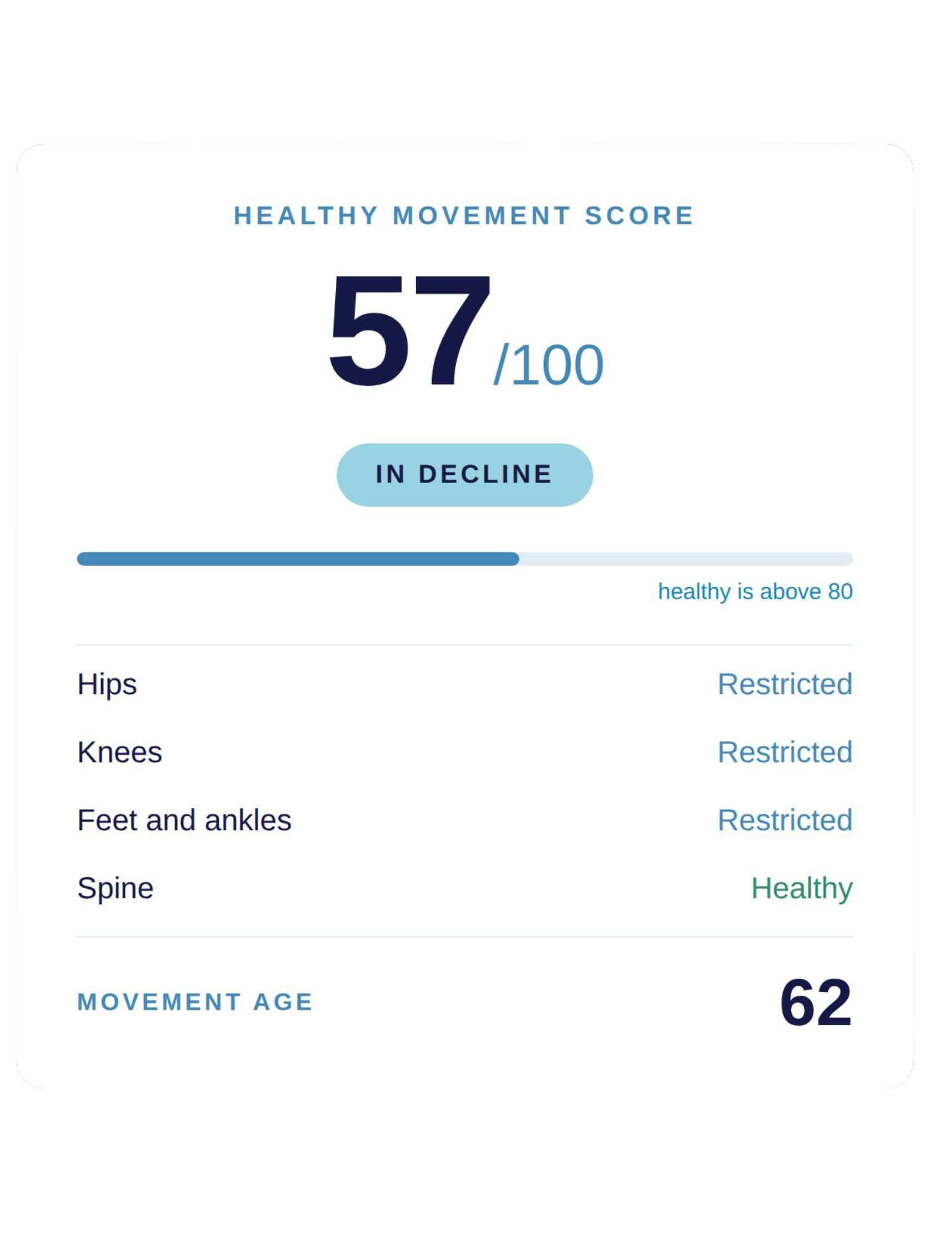
I have created a test that identifies these joint restrictions. I test clients in the Beckett Ridge area and provide them with a healthy movement score and movement age that allows them to track their movement health throughout their lifespan.
If you want to know what your joints are actually doing rather than guessing from how they feel, that is what Healthy Movement Testing is for.
Once you identify the joint restrictions, you can restore and open that accessory space up and keep it open through routine sessions for life. This coaching model is not a race it is built to help you move well throughout your life and do everything you want to do without limitations of lost mobility. See you in the studio.
Movement health, measured
Every joint, tested by hand, in a single visit. Baseline once, retest as you go.
Healthy Movement Score Whole body
Movement Age Against your years
Your Blueprint Your plan
In studio at Beckett Ridge, West Chester OH
Not near West Chester. Start with the virtual Healthy Joint Mobility intro and get your Mobility Health Score for one area.