Healthy Movement 101: What You Can Control, What’s Stealing Your Movement, and the Gap Between Them
The Healthy Movement Podcast
“You can do everything right, for years — and the deeper muscular layer can still be losing motion, because the tools you’re using were never able to reach it.” —Kim Nartker
By Kim Nartker
Read time: about 8 minutes
In this foundational episode, Kim lays out the whole Healthy Movement framework in one place — the one to start with, and the one to share when someone asks what this work is about. She separates the two things people call movement (how much you move vs. how well), walks through what you can actually control and what the research says each thing does, then turns to what quietly steals movement underneath all of it: the Silent Shutdown Cycle, her name for what the research calls arthrogenic muscle inhibition. She closes on the gap — the layer where decline begins is one none of the things you control can reach.
A note on the research: what Kim states as established is tied to the published literature and named in the episode. Where she goes beyond what the research has tested — that this cycle can begin early and silently, before pain — she says so plainly. She does not treat, cure, or prevent any medical condition.
We discuss:
The two kinds of movement: how much vs. how well [00:00];
Why “how well you move” is the dimension no one tracks [04:00];
Capacity to Move and Function to Move Well, defined [07:00];
The two paths: predictable decline, or protected movement [10:00];
What you can control — why stillness, not sitting, is the problem [13:00];
Strength: the PURE study and why strength travels with health [22:00];
What stretching and mobility work actually change [29:00];
Sleep, stress, and nutrition — staying in the right lane [34:00];
Accessory motion: the layer you cannot control [40:00];
The Silent Shutdown Cycle, and what the research calls it [45:00];
Why you feel it as tightness, and why stretching never holds [50:00];
Where the path leads — the decades, the diagnoses, the 12.4 years [55:00];
The gap: why none of the things you control can reach it [1:05:00];
The question this episode leaves you with [1:12:00].
The two kinds of movement [00:00]
- Two different things get called “movement,” and most people treat them as one
- How much you move — steps, workouts, activity; easy to count, tracked by your watch; real research behind moving more
- How well you move — the quality: whether the joint travels right, whether the deep muscles support it, whether motion is real or borrowed (compensation)
- We’ve been taught to watch only the muscle layer; the layer that decides how well you move is deeper, and it’s the one no one tracks
Capacity to Move and Function to Move Well [07:00]
- Capacity to Move — the accessory motion deep in the joint capsule; the space for the bone to glide, roll, spin; involuntary, not under your direct control
- Function to Move Well — whether the muscular system supports and sequences that motion correctly
- Both can be lost silently, without you ever feeling it happen
The two paths [10:00]
- Predictable decline — how well you move erodes quietly; aging, past injuries, genetics, disease all play a role, with the Silent Shutdown Cycle underneath; the default path most people are on
- Healthy Movement Path — one you work to stay on, with a guide, because the system controlling how well you move isn’t under your voluntary control
What you can control — stillness, not sitting [13:00]
- It’s not sitting that harms you; it’s stillness — sustained, unchanging load on a held position
- Ligaments and capsule are viscoelastic (part spring, part slow fluid); under sustained load they “creep” — fluid shifts, fibers stretch, support drops
- McGill & Brown documented this in the spine at ~20 minutes; Solomonow showed creep also dulls the joint’s sensors, which quiets the reflex to the deep stabilizing muscles
- Honest limit: the 20-min figure is spine data, some foundational work in animal models — the number belongs to the spine, the principle generalizes
- Do this: don’t hold any one position for long stretches; change position / stand / walk every 20–30 min. The best posture is your next one
Strength [22:00]
- PURE study (The Lancet, 2015; ~140,000 people, 17 countries): every 5 kg drop in grip strength ~16% higher all-cause mortality — a stronger predictor than blood pressure
- Grip strength is a marker, not magic — a window into total strength, muscle mass, and neural drive; it travels with health rather than causing it
- Muscle protects the joint underneath, keeping it centered so load lands where it should; that protection thins as muscle declines
- Honest limit: the same study found no clear link between grip strength and fall/fracture protection — this is not a claim that strength prevents falls
- If you commit to one demanding thing, build strength and keep it
What stretching actually changes [29:00]
- Belief: tight = short muscle, so stretch to lengthen it. Not what the research shows
- Weppler & Magnusson: most flexibility gains are sensory (tolerance), not structural — your nervous system allows more range, the tissue isn’t permanently longer
- Lauersen: strength training meaningfully reduces injury risk; stretching, on its own, essentially doesn’t
- Keep stretching and mobility work — they help how you feel and move; just be accurate that they reach the muscle and your tolerance, the layer you can control
Sleep, stress, and nutrition [34:00]
- Kim stays general here on purpose — movement coach, not physician/dietitian/sleep specialist
- Sleep — when the body repairs and the nervous system settles; chronic short sleep = less recovery, more bracing
- Stress — keeps the nervous system elevated and muscles guarding, the same guarding the movement system produces when a joint loses support; it feeds the cycle
- Nutrition — the system is built from what you eat; protein is the building block; specifics belong to a dietitian
Accessory motion — the layer you can’t control [40:00]
- Deep in the joint, the bone must glide, roll, and spin; that internal motion is accessory motion
- Established: it is not under voluntary control — you can’t produce, isolate, or train it; it occurs only in response to force
- This is the line between the layer you can reach (muscle, felt range) and the one you can’t; none of the “what you can control” tools reach it
- It’s also the layer that fails first — restriction can begin before any visible loss of range, and long before pain
The Silent Shutdown Cycle [45:00]
- When a joint loses motion (injury, inflammation, wear, or no clear cause), the nervous system turns down the muscles that stabilize it
- The research calls this arthrogenic muscle inhibition (Hopkins & Ingersoll, 2000; documented for decades at the knee, growing evidence at hip and elsewhere); Kim calls it the Silent Shutdown Cycle
- Two layers: deep stabilizers inhibited (joint loses its base) ? larger muscles brace and guard ? that guarding is the tightness you feel
- Why stretching doesn’t hold: you’re pulling a muscle the nervous system is holding on purpose; relief fades because the reason wasn’t addressed
- Boundary stated plainly: AMI is documented after surgery/injury/pain; that it begins early and silently, before pain, is Kim’s observation from her studio, not settled science
Where the path leads [55:00]
- 50s–early 60s: often the shoulder — rotator cuff repair is one of the fastest-growing surgeries in that group
- 60s–70s: knee and hip — osteoarthritis and joint replacement cluster here
- 70s+: falls — ~1 in 4 adults over 65 falls yearly; for thinned bones, a fracture can begin a decline many never fully recover from
- Muscle loss accelerates after 60; tendinitis, bursitis, and bone spurs are described as the body’s response to abnormal loading over time
- Boundaries: not all from the cycle alone (aging, bone health, genetics, life); Kim does not treat, cure, or prevent these conditions
- Scale: ~12.4 years lived at end of life burdened by disability (Garmany & Terzic, JAMA Network Open 2024) — widest in the world, ~2.4 years wider for women; association, not proven cause
The gap [1:05:00]
- Everything you can control acts on the layer you can reach — muscles and felt range
- The decline begins in the layer you can’t reach — accessory motion, involuntary by definition
- The two don’t fully overlap; it’s not a gap in effort — you can do everything right for years while the deeper layer keeps losing motion
- The better question isn’t “am I doing enough?” — it’s “is anyone actually looking at the layer I can’t see?”
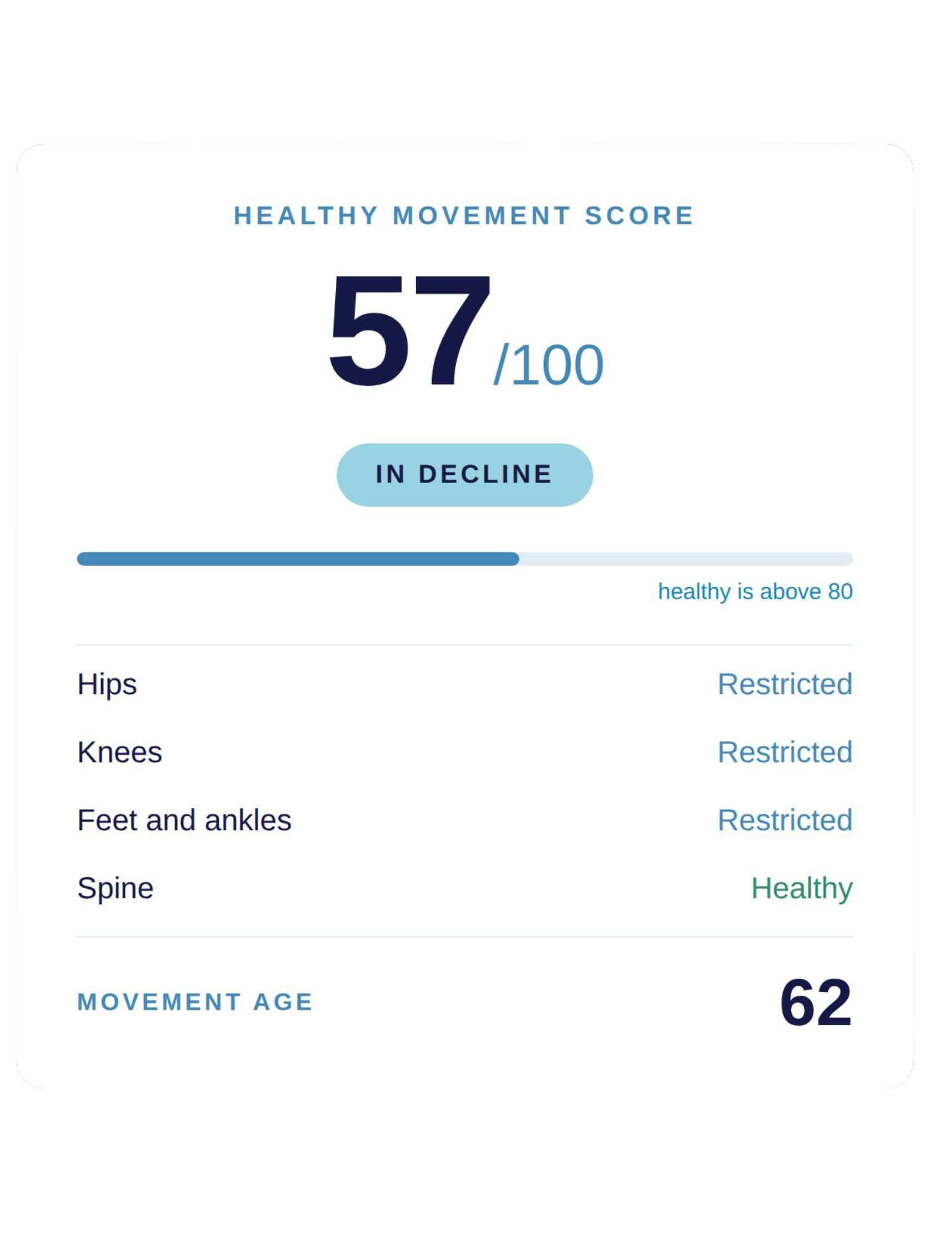
Movement health, measured
Every joint, tested by hand, in a single visit. Baseline once, retest as you go.
Healthy Movement Score Whole body
Movement Age Against your years
Your Blueprint Your plan
In studio at Beckett Ridge, West Chester OH
Not near West Chester. Start with the virtual Healthy Joint Mobility intro and get your Mobility Health Score for one area.