Is Sitting Really What Makes Your Hips Tight?
Understanding what sitting does to your body and what it does not do to your muscles after age 50.
The Healthy Movement Podcast
“Sitting is not the beast we have been told it is.” Kim Nartker
By Kim Nartker
Read time: about 10 minutes
In episode #251 Kim continues the hip series for people over 50 who want to keep their hips mobile and healthy for the rest of their lives. This episode is about sitting and if sitting actually is the cause of your muscle tightness in your hips.
Almost everyone who walks into her studio blames sitting for their tightness. Kim taught that same explanation herself when she worked as a PTA over 14 years ago. Then she went looking for the research behind it and found something she was not expecting.
This episode covers what the studies actually found when they measured muscle length in people who sit for a living. It covers what sitting is doing to you that has nothing to do with muscle length. And it covers what Kim believes is the real driver of the tightness people feel after 40.
A note on the research. Every study named here is real and Kim reports what it found and not what she wishes it had found. Where she is describing what she sees in her own studio or offering her working explanation she says so plainly. She does not diagnose or treat or cure or prevent any medical condition.
Subscribe on: APPLE PODCASTS I SPOTIFYI IHEARTI RSS
The Short Answer Sitting is not shortening your hip muscles. The research does not support it.
Sitting is doing other things to you and some of them are serious. It reduces circulation in your legs and it changes how you handle glucose and insulin. Those are real important health concerns. The fix for both is getting up and moving. The fix is not a stretch.
But the tightness you feel in the front of your hips is not a muscle that got short because you sat on it. That belief has caused an enormous number of people to stretch their hip flexor muscles in hopes that the stretching would improve the length and flexibility of those muscles. This episode teaches what is real based on research and what treatments will not provide you with the outcome you desire.
I taught this the other way for years. I want to show you what changed my mind.
What We Have All Been Taught About Sitting:
Sitting is the new smoking.
Sitting shortens your hip flexors.
Sitting tilts your pelvis and that is why your back hurts.
Buy the ergonomic chair.
Get the standing desk.
Stay in neutral position at all times and avoid movement.
I taught most of that twenty years ago. I now see that movement is the key to longevity and that movement is what we lose when we choose techniques that feel good over techniques that restore what we have lost. Movement restoration and preservation are not the same things as fitness recovery.
Tightness in your muscles and joints happens without your permission. Many of you have range of motion one day and it is gone the next without doing anything to cause it. Tightness has been sold as something you control. That is not completely true and I know that statement will get pushback.
So let me be clear about what you do control. You can move. You can stretch. You can strengthen your larger muscles. Those things help you maintain and make gains in your range of motion and you should do all of them. But range of motion is governed by a layer deeper than the muscle and that layer is outside your voluntary control.
You did not lose range of motion because you failed to stretch.
What The Research Says About Sitting And Muscle Length Here is the first study. Five hundred and eight people between the ages of twenty and sixty five. They were split into a group with chronic low back pain and a group without it. Everyone filled out a questionnaire about their lifestyle and their work setting. Then researchers measured hamstring length and the curve in the low back.
The result. Hamstring length was not affected by work setting or lifestyle. Neither was the curve in the low back. The authors wrote that their findings did not support the assumption that work setting and sedentary lifestyle lead to hamstring tightness.
The second study looked at seventy first year college students. These are people who sit for hours every day between class and study and screens. Researchers measured hamstring and iliopsoas length.
Eighty percent had normal hamstring length. Ninety six percent had normal iliopsoas length. The iliopsoas is the muscle everyone tells you sitting destroys. Nearly all of them measured normal.
And there is a detail in that study worth pausing on. The muscle length finding that tracked with low back pain was increased hamstring length. Not shortened. That is the opposite of what most people are taught.
Two honest notes. The second study is small and descriptive and it did not measure how many hours anybody actually sat. Neither study proves sitting is harmless. What they show is that the specific claim about sitting shortening your hip and hamstring muscles is not holding up when somebody goes and measures it.
So What Is Sitting Actually Doing To You?
Here is what the researchers found:
In one trial twelve healthy young men sat for three hours without moving their legs. Researchers measured how well the artery in the thigh could dilate. At baseline it was normal. One hour of sitting the dilation of the artery had had dropped sharply. That is one hour.
Then they ran the same test three hours again with one change. The men got up and walked on a treadmill for five minutes at a slow pace three times during the sitting. The drop in the artery did not happen at all this time.
The other well documented effect is on glucose and insulin. Uninterrupted sitting makes both worse and breaking it up helps.
So sitting has a cost. The cost is circulatory and metabolic and it arrives within the hour. And the answer to it is not a hip flexor stretch. The answer is standing up and moving for five minutes.
That is a small study of twelve young men and I am giving it to you with that attached. But the direction of it matches everything else in this area.
If It Is Not Sitting And It Is Not Aging Then What Is Happening in Your Muscles and Joints?
Movement is harder for me in my later fifties. When I look around at people in their late fifties some are not walking as well as I am. When I look at people over 60 I see limping and severe muscle loss and fatigue and tightness and stiffness and soreness. A lot of them are in pain.
Sitting is not causing that. Aging alone has not been shown to cause it either. So what is taking your movement away if its not aging and sitting?
Here is my working explanation and I am labeling it as that. I believe the muscle loses its communication with the deeper layers of the joint through a protective response run by the nervous system. And what gets lost is mass. Mass is a function. Function is the force the muscle can produce. The published research has not tested this order of events directly and I am not going to present it as settled.
What is not speculation is that this loss starts much earlier than anyone tells you.
Aerobic capacity is one example. In a long term study of more than eight hundred healthy adults the decline in peak oxygen uptake accelerated from three to six percent per decade in the twenties and thirties to more than twenty percent per decade in the seventies. And it did that regardless of how physically active people said they were.
Muscle is another. In a study of whole vastus lateralis muscle taken from men aged fifteen to eighty three the authors concluded that the aging atrophy of that muscle begins around twenty five years of age and accelerates from there. The vastus lateralis is your outer quad. If you have ever felt IT band tightness that is the neighborhood.
And in the last episode I covered the hip flexor. In an MRI study of two hundred and ten women aged twenty to seventy nine the psoas was at its largest in the twenties and declined steadily from there while the quadriceps held its size until the forties.
So the outer quad starts down at twenty five. The hip flexor starts down in the twenties. Aerobic capacity starts down in the twenties. None of these people were over 50 when it started.
What Atrophy Actually Takes From You When a muscle atrophies it shrinks. Your body is breaking down muscle protein faster than it is building it back.
Here is what leaves with it.
Muscle mass. The size and volume of the tissue itself.
Contractile proteins. The microscopic machinery inside the muscle that makes it shorten and produce force.
Strength. The muscle loses power and ordinary physical tasks get harder.
Mobility. Walking and balance and joint movement all get harder.
Underneath that your cells are degrading protein faster than they are synthesizing new protein. And when a muscle is not receiving load or a healthy nerve signal the body decides it does not need to maintain that tissue. Muscle is expensive to keep. The body stops paying for what it is not using.
There is a metabolic cost too. Muscle burns energy and helps regulate blood sugar. Losing it lowers your metabolic rate.
Rebuilding lost muscle takes years. Keeping the muscle you already have is a far better deal and almost nobody is being told to protect it in their thirties.
Your Hip Flexor Is Not One Muscle This is worth knowing because when people say hip flexor they usually mean one muscle and they are picturing a rope that got short.
The primary hip flexors are five muscles. The psoas which runs from your lower spine to the thigh bone. The iliacus which sits on the inside of the pelvis and joins the psoas to form what is called the iliopsoas. The rectus femoris which is the quad that runs down the front of the thigh from the pelvis to the knee. The sartorius which is the longest muscle in the body and travels diagonally across the front of the thigh to the inner side of the knee. And the pectineus which sits high on the inner front of the thigh.
Then there are the secondary flexors. The tensor fasciae latae. The adductor longus and brevis and the gracilis on the inner thigh. And the front fibers of the deep glutes which assist with bending and rotating the leg.
All of those have to work together. Some of them are already losing size in your thirties. You feel it in your forties and beyond.
You cannot stretch a group of muscles back into working order when what they lost was mass which is function and signal.
What I Am Seeing In The Studio I test joints. That is what I do all day.
I am finding restrictions in people in their late teens who have no atrophy yet. I am finding thirty year olds with restrictions across multiple regions who are already struggling with how they move. Last week a thirty year old former football player came in to see what I do. He had been through multiple knee surgeries and physical therapy. When I tested him I found restrictions well beyond the knee he had been treated for.
That is one person and one session and it is not evidence of anything on its own. I brought him up because he is thirty and nobody had looked at his joints. They are only looking at his hurt knee but he has other problems that are not addressed, so he has been seeking care for everything else.
That is the pattern. The healthcare system looks at the muscle and ROM. We build strength and we stretch muscles and we wait for pain to tell us to look deeper. By the time pain shows up the loss could be advanced to osteoarthritis or a diagnosis because many people don’t experience pain. Pain is when we can enter the healthcare system.
Here is my opinion:
Stop modifying movement out of fear that you will tear something if you leave a neutral position. Your body is remarkable and it knows what to do. But it only knows how to take movement away when it feels unstable. It has no mechanism for handing movement back to you. Only a specialist can do that, but our healthcare training does not teach that.
While we argue about sitting and sell stretching as the solution we are not looking at the two things that matter. How much capacity is left in the joint which is accessory motion and How much function is left in the muscle, which is contractile force and activation. There are other factors at play that I have left out.
If we would test the joints to see if they are restricted then I feel we can help people better restore and preserve our movement system. I would like to see joint testing in the late teens. I am finding restrictions at that age before any atrophy has set in. That is the window where you could actually protect the outer quad and the hip flexor instead of trying to rebuild them at sixty.
Every adult over 40 should have their joints tested. Do not wait for pain. Pain is far too late and is not the best predictor of health.
Our signal for healthy movement should be awareness of movement or lack there of, tightness, or stiffness. Not moving the way you used to move. Feeling either of these after a workout are NOT normal. And stretching is not proven to be a recovery tool.
Tightness, stiffness and achiness out of nowhere, Those are the signals. STOP using pain as the reason to seek professional care for healthy movement.
I am not saying nobody else can do this work. Chiropractors and physical therapists and doctors of osteopathic medicine are trained in these techniques and qualified to deliver them. What is missing is anybody offering it as an ongoing testable service aimed at preserving movement rather than relieving pain. If you have a provider who wants to see what I am finding please connect them with me.
Where This Leaves You
Sitting is not what makes your hips tight. Get up every hour anyway because the circulation and the blood sugar effects are real and they arrive fast.
Stretch if you want to. I consider stretching a form of movement and it will improve your range of motion. It is just not the answer to a joint that is restricted or a muscle that has lost mass.
And stop waiting for pain to give you permission to look. The loss starts in your twenties. The feeling starts in your forties. Between those two decades is the whole opportunity to restore and preserve your healthy movement.
If you are over 20 get your joints tested. That is not a typo.
Next week I continue the hip series. Subscribe so you get it as soon as it drops. And if this episode changed how you think about sitting please send it to somebody who has been blaming their chair.
Research referenced in this episode
Hamstring muscle length and lumbar lordosis in subjects with different lifestyle and work settings. Journal of Back and Musculoskeletal Rehabilitation. 2014.
Is hip muscle flexibility associated with low back pain among first year undergraduate students. Journal of Clinical Medicine. 2024.
Effect of prolonged sitting and breaks in sitting time on endothelial function. Medicine and Science in Sports and Exercise. 2015.
Accelerated longitudinal decline of aerobic capacity in healthy older adults. Circulation. 2005.
What is the cause of the ageing atrophy. Total number and size and proportion of different fiber types studied in whole vastus lateralis muscle from fifteen to eighty three year old men. Journal of the Neurological Sciences. 1988.
Different changes of quantity due to aging in the psoas major and quadriceps femoris muscles in women. Journal of Musculoskeletal and Neuronal Interactions. 2006.
Get Your Healthy Movement Score
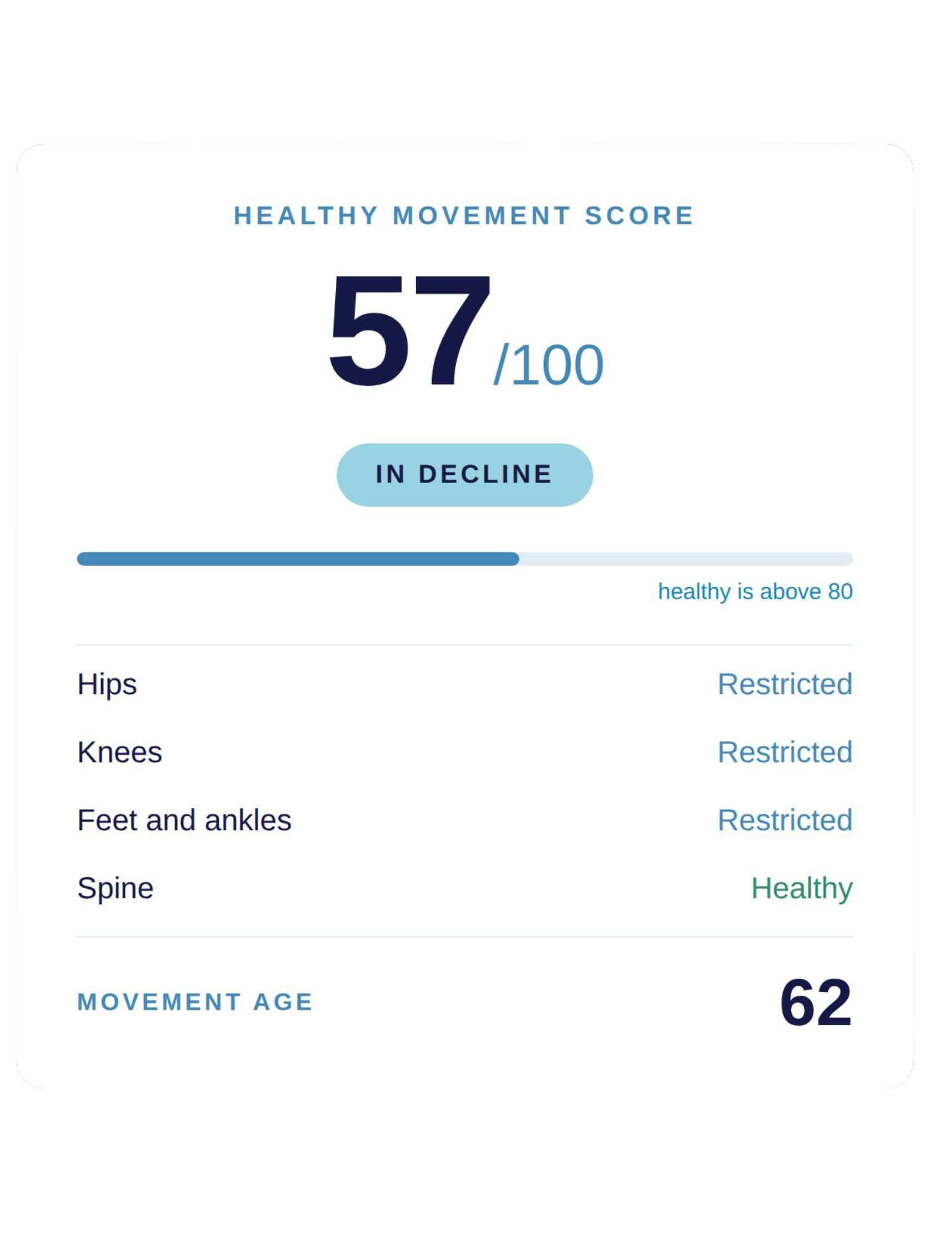
Every joint in your body has an amount of movement available to it and an amount that has been quietly restricted. Testing is the only way to know which is which.
Healthy Movement Testing looks at your whole body and gives you one number and your Movement Age and a Blueprint you can track for the rest of your life. In person at Beckett Ridge in West Chester Ohio.
Not near West Chester. Start with the virtual Healthy Joint Mobility intro and get your Mobility Health Score for one area.
Movement health, measured
Every joint, tested by hand, in a single visit. Baseline once, retest as you go.
Healthy Movement Score Whole body
Movement Age Against your years
Your Blueprint Your plan
In studio at Beckett Ridge, West Chester OH
Not near West Chester. Start with the virtual Healthy Joint Mobility intro and get your Mobility Health Score for one area.