The Silent Shutdown Cycle: Why You Wake Up Stiff, Tight, and Sore — and What It Is Really Telling You
The Stretch Mobility Coaching Show
“At no point in this cycle are you too far along to make gains. You can make gains. You just have to do the work.” — Kim Nartker
By Kim Nartker
Read time: about 12 minutes
In this episode, Kim takes on the stiffness, tightness, and soreness that so many people over 40 start to feel — and quietly write off as aging. She introduces the Silent Shutdown Cycle, her name for a documented process in the research called arthrogenic muscle inhibition, and explains why the tightness you feel is not a short muscle but a signal coming from the joint. She walks through what happens to the two layers of your muscular system when the cycle begins, why stretching never seems to hold, and how the whole thing can run silently for years before pain ever shows up. She then shares three real case studies — three hypermobile women in their late forties and fifties — to show the pattern she keeps seeing in her studio, and closes with what you can actually do about it.
A note on the research: everything Kim states as established fact is tied to the published literature. Where she goes beyond what the research has tested — proposing that this cycle can begin early and silently, before pain — she says so plainly, and separates what is proven from what she is observing in her studio.
Subscribe on: APPLE PODCASTS I SPOTIFYI IHEARTI RSS
In this episode
- Why “just getting older” is only part of what you feel [00:00]
- The belief that keeps people stuck: that tightness comes from the muscle [02:25]
- What a healthy joint is supposed to do — glide, slide, and spin [03:30]
- Where the cycle begins: the joint as the messenger [04:44]
- Arthrogenic muscle inhibition, defined — and where the research stands [05:30]
- The two layers of the muscular system, and how each one fails [07:06]
- Why stretching calms the tightness but never holds it [09:25]
- What is established in the research, and what Kim is proposing [10:00]
- Three case studies: hypermobile women, no injury, real gains [12:30]
- Why a strong, fit person can be in decline and never know it [23:36]
- Pain as the end of the decline, not the beginning [25:56]
- Muscle mass, strength, and function are not the same thing [26:30]
- Why movement health is a lifelong practice, not a treatment [29:00]
- How to find out if the cycle is active in you [32:00]
The question this episode starts with
Do you wake up stiff? Do your ankles, feet, or back take a while to loosen up in the morning when you get out of bed? Do you have tightness that never fully goes away, no matter how much you stretch it — and have you told yourself that this is just what getting older feels like?
Aging is only part of what you are feeling. Underneath it is something deeper than the muscle, something that has a name in the research, and that almost no one has ever explained. There is a cycle that makes us tight, stiff, and sore, and most of us have never been introduced to it. We were only taught to watch for pain — and by the time pain arrives, the cycle has usually been running for a long time.
The belief that keeps people stuck
Most of us were taught that when something feels tight, the tightness is in the muscle, and the fix is to stretch it, foam roll it, or push through it. So we stretch. It feels better for a bit. Then the tightness comes right back, and we assume we just need to stretch more.
But that tightness is not a shortened muscle. It is much more than that. It is a signal — your body responding to something deeper, at the joint, where one bone meets another. The message is coming from the joint capsule and from the movement system underneath.
What a healthy joint is supposed to do
Inside a healthy joint, the bone is supposed to move — to glide, slide, and spin — and the capsule around it is supposed to give it room to do that. This is accessory motion, the movement underneath your range of motion. You cannot feel it or control it directly, but it is the foundation of healthy movement. When a joint loses a little of that motion, the cycle begins.
The joint is the messenger
The joint sends the first signal — often after an injury or inflammation, sometimes for no reason at all. That is the part Kim wants to talk about: the day you wake up tight or sore in a place that felt perfectly fine yesterday. In response, the nervous system does something protective — it turns the muscles down.
In the research, this has a name: arthrogenic muscle inhibition. It was defined in a foundational paper by Hopkins and Ingersoll in the Journal of Sport Rehabilitation in 2000, and has been studied at the knee for decades since, with growing evidence now at the hip and other joints. The muscle is not damaged and it is not weak in the usual sense. It is being turned down — inhibited — by the nervous system. The muscle that should support the joint stops activating, so the support has to come from somewhere else. Kim calls this the Silent Shutdown Cycle, because it shuts the muscle down and does it silently.
The two layers of the muscular system
Your muscular system has two layers. The deep layer is small, these muscles are built to stabilize the joint, hold it steady, and keep the bone centered. The larger layer is the big muscles built to move the joint and build strength.
When the Silent Shutdown Cycle begins, both layers are affected — and they adapt to working in different, unhealthy ways. The deep muscular system, when inhibited, no longer activates and maintains activation, therefore the joint loses its steady base and drifts off center. The larger muscles respond by bracing, falling into a guarded holding pattern to protect a joint that has lost its support underneath. That guarding, that bracing, is the tightness, stiffness, and soreness you feel.
So when you stretch that tight muscle, you are pulling on a muscle the nervous system is asking to hold. The stretch will calm things for a while, but the reason it was tight has not changed — so it comes back. That is why stretching never seems to hold for you. We feel the instant relief and miss that we keep getting tighter over time.
What is established, and what Kim is proposing
Arthrogenic muscle inhibition is well documented — but it is almost always studied after something obvious has happened: after a surgery, an injury, or a joint that already hurts. That part is established.
What she proposes, based on what she sees in her studio, is that the same cycle can begin much earlier and much more silently— from nothing more than a small loss of joint motion, long before there is any pain, often with no nameable trigger at all. That part is not settled science. From there, the cycle follows a cascade — a predictable path through the decades of
Three case studies
Kim shares three real clients — women aged 49, 56, and 57, all hypermobile as children, all with different lives and different symptoms, all having cycled in and out of pain. She is direct that these are real people, that results vary from person to person, and that she is showing the pattern she keeps seeing, not promising an outcome.
The 57-year-old could put her legs behind her head as a child. After 40, things began to tighten in her hips and back, and she spent 17 years in and out of pain — gadgets, pills, physical therapy, chiropractic, specialists, surgeons recommending two total hip replacements. She could not get off the floor, needed a pillow to prop herself at a table because her hips and spine were shifted in opposite directions, and it took an hour of stretching just to move in the morning, just to get out of bed. In testing, her lower back was in accelerated decline, her hips essentially locked down, and her spine showed only a fraction of the accessory motion Kim would expect to see in the low back. Through a healthy movement jumpstart, she stood straighter after the first session, could stand from a 22-inch surface by the second, felt her core re-engage by the third, and by the sixth had moved her spine into a healthy range and could get to the floor — with more work still ahead.
The 56-year-old had spent years chasing the relief of chiropractic pops without ever gaining stability. She came in with a knee locked up and could hardly bear weight, though. Testing showed her lower body in accelerated decline — some motion in the left knee, almost none in the hips and symptomatic knee — and the locked knee traced back to an ankle and foot with no accessory motion and a hip locked down on the same side. A few sessions in, her joints were moving well enough that she could reduce her frequency.
The 49-year-old had fascial bands like vice grips through her hips and thoracic spine and could not remember ever not being tight. She could not bend over to touch her toes, A full-body test showed accelerated decline across more than 80 percent of her joints. Over about six months — a jumpstart, then weekly, now twice a month — her testing moved out of the accelerated, symptom-chasing range into a much better place. Still in a decline, but no longer chasing symptoms.
All three entered menopause or post-menopause, all were hypermobile, and all developed this from no injury — waking one day with pain after feeling fine the day before. Each one followed all the medical and fitness advice available today and lost more ability to move.
Why a strong person can be in decline and never know
Strength hides the silent shutdown cycle. The muscular system is an expert at compensating for this cycle — it will reroute your movement around a restricted joint for years, and you will not feel it doing so. You keep moving, keep functioning, nothing hurts, so you have no reason to think anything is wrong. That is what makes the cycle so aggressive. Pain is not the beginning of the problem. Pain is the end of a long, silent decline — the moment the body finally runs out of ways to compensate. By the time it takes you to the doctor, the cycle has often been running for years and now you will be able to see possible structural changes on imaging.
Mass, strength, and function are not the same
You can maintain muscle mass and muscle strength, but muscle function — whether the muscle activates and fires when it should — is lost differently and comes back more slowly. Wait until pain, and the muscle may already be in an atrophic process, losing strength and mass on top of function. Test and identify early, and you reduce how much function the inhibition takes away. No point in the cycle is too far along to make gains — it just takes identification, work, and time.
Movement health is a lifestyle practice, not a treatment
The cycle can switch on for no reason, and a physical symptom can follow within about two weeks. So caring for the movement system is not a one-time treatment — it is lifelong, like the maintenance schedule for a car, done more often as we age and when symptomatic, less often when things test as healthy. And it means looking at the layer most care never examines: not just strength and range of motion, but the joint’s capacity to move and the muscle’s function underneath.
What you can do
If you have tightness, stiffness, soreness, or achiness that shows up without a real reason and lingers, the Silent Shutdown Cycle may be active — and it may be silently stealing your mobility along a predictable path. Because we tend to equate “no pain” with “fine,” the only way to know is to test: to identify whether the cycle is active, how much function you have lost, and how much capacity remains in the joint to allow movement.
Kim offers virtual and in-person testing sessions to find out whether this cycle is active in your joints and muscles. The goal is simple — that in the last half of your life, you can still do the things you want to do, and not caught off guard one day when your body completely locks down and you think, maybe I should go see a surgeon.
Movement health, measured
Every joint, tested by hand, in a single visit. Baseline once, retest as you go.
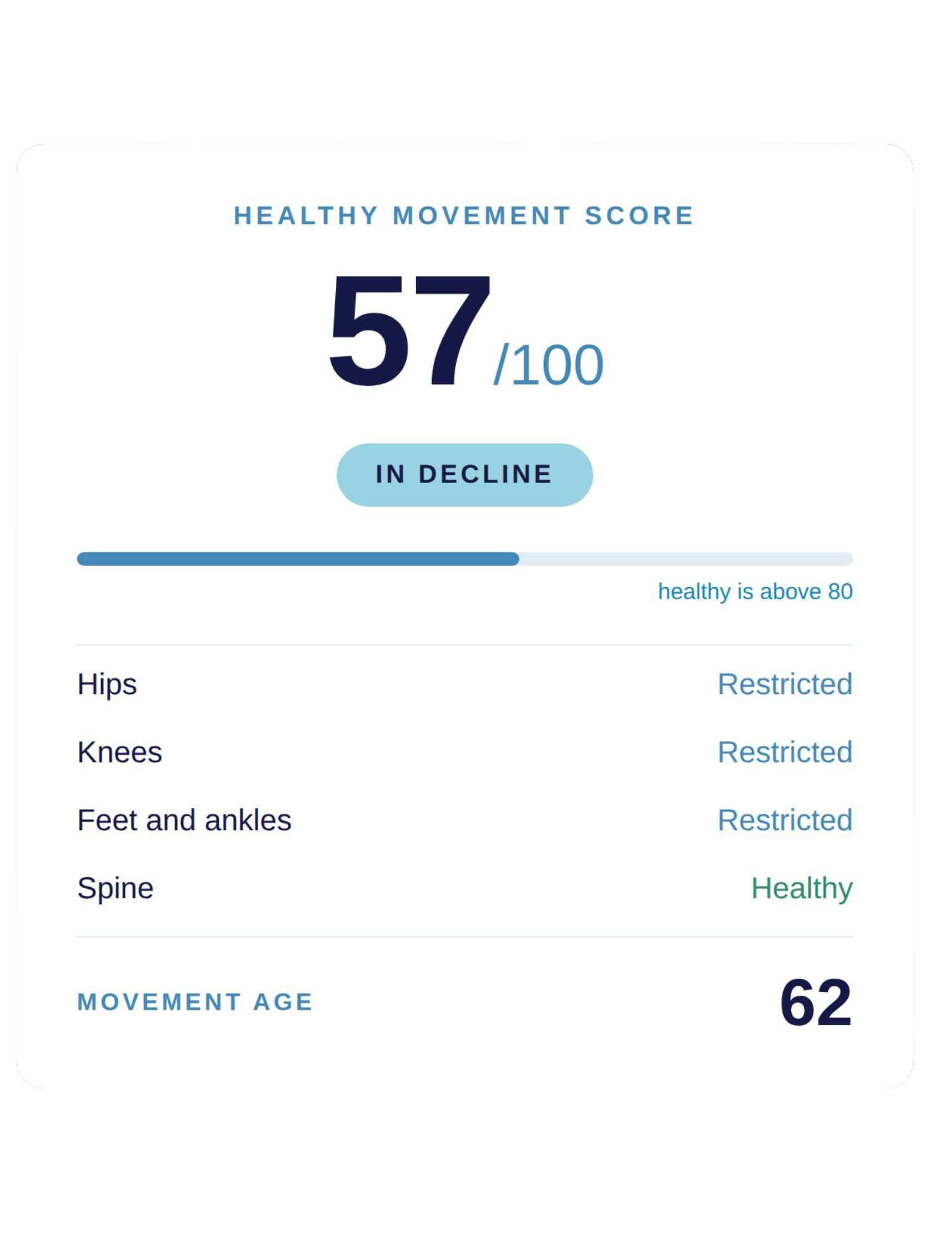
Healthy Movement Score Whole body
Movement Age Against your years
Your Blueprint Your plan
In studio at Beckett Ridge, West Chester OH
Not near West Chester. Start with the virtual Healthy Joint Mobility intro and get your Mobility Health Score for one area.