Your Knee Pain Started Above and Below Your Knee
Why your knee all of the sudden hurts when you haven’t done anything to your knee.
Read time: about 10 minutes
Hi I am Kim Nartker for those of you that are new to the show. I worked in a rehab clinical setting for over 20 years and completely stepped away from the information that I learned in that area, because I wanted to help people improve the health of their movement system and in healthcare when you have a license you are made to comply with insurance based care and standards and I did not find any of the treatments that I provided from those learned to be long lasting or to improve the health of peoples movement. Instead I saw these patients slowly decline until they were a candidate for surgery, then another surgery 1 after the other with the decline seeming to increase faster than in people chose surgery. I wanted to help people avoid that trajectory if possible. I found it to be possible and this is what I teach now.
Today I want to talk about knee pain specifically knee pain that begins for no reason at all. It just shows up one day and you search google for stretches or exercises to relieve the pain, you try those creams, the braces, the gadgets the inserts and some of those things work for a little bit of time then the pain comes back. The route from what my clients tell me is always the same. First you try things on your own. Then you seek help from a professional and for some people the expectation of that help is to not only get rid of the pain but to restore and preserve the health of their knee. Typical treatments are stretching of the knee muscles, Strengthening of the hip and foot muscles. Stretching of the hip muscles and strength training or functional training to build support in the muscular system. Some people see a Chiro, some people get orthotics but from the people that I see later, none of those things resolved the pain and most started to lose mobility in their knees making bending, getting down to the floor, going up stairs and other activities more difficult. These people were told to modify their movements at the gym to avoid the pain so that they can still work out. Is this the answer to the signal we are getting in the knee.
I disagree with all of it and today I want to tell you why.
Subscribe on: APPLE PODCASTS I SPOTIFYI IHEARTI RSS
Today I want to talk about Joint Mobility VS Muscle Weakness
Which of these is the cause of the knee pain that comes out of no where.
Most of the people that come in to see me will say I have been managing the pain in my knees for years and they feel confident in managing their pain.Others feel signals of tightness in their hips or knees for years and accept it as a normal part of aging.
Here is what I see when a client comes in to see me with knee pain that came out of no where.
I first test the joint mobility in the hips, knees, ankle and the entire foot.
When I do that I can find a joint restriction in joints above and below the knee. I typically find different joints restricted in the foot but typically the same pattern in the hips, knees and ankles.
In the hips these people have lost more than 20% of the capacity that allows their hip bone to moves in their hips joints. That means their hip joint is restricted and 20% of that space in their capsule has been taken away. usually is not the only restriction in the hip, but when I do find this restricted I also find several other joint restriction in the hip capsule along with muscle inhibition in the muscles that originate at that particular joint. When I test the ankle these people have lost the capacity for their ankle joint bones to move in both dorsiflexion and plantar flexion. They have also lost some form of mid foot capacity, rear foot and some capacity loss in the forefoot and toes. The knee is typically found in a locked position.
Here is what this testing tells me about the knee pain that came out of no where.
Your knee is a hinge joint like a door hinge, however it also has a rotational component to it. This is lost when the hip above it and the foot and ankle below it has lost the capacity to move inside the joints. The knee stays in a locked position. Your nervous system locks this and continues to lock more joints because that is what it does. It does not unlock the joints.
You will feel this locking with activities that cause you to bend your knee and straighten your knee. Stairs, squatting, standing or sitting down. You don’t typically feel it with walking. Over time this loss of motion in the joints that I refer to as capacity to move in the joint, your body steals more movement from those joints. Your nervous system, joints, and muscles are all no longer working in a healthy way. Your body is forced to compensate.
So now lets look at what the industry standard exam detects. That testing detects a weak hip muscle. Typically the glutes or Glute medius muscle. I ask “What caused that muscle weakness?”
So when we use the industry standard care of strengthening our hips, knees and feet, we know from my previous research in those areas that strength training will not unlock those joints that are restricted. Strength training will not give us this capacity back that the body has taken away. Strength training will build strength in what remains.
This is where it gets really confusing for most people. I know its a lot. Let me try to make this really simple to understand.
Your body takes away your capacity to move without you knowing it. You won’t feel anything when it happens. But when you feel something out of nowhere. That signal whether its pain, stiffness or tightness that signal is your body asking for you to help it. This is what I see everyday in my healthy movement practice.
You have the ability to maintain your movement through stretching, strengthening and through massage. You can manage these movements on your own to a certain degree.
Or someone else can perform assisted stretching on those joints. They can stretch you deeper than what you can stretch yourself, but that stretch does not release a joint restriction. That stretch improves your ROM temporarily.
These treatments are effective ways to manage a symptom. And society teaches us to manage symptoms.
For those people that want to restore what is lost. Stretching, strength training, and massage will not restore joint accessory motion. There are professionals that can measure and test for that, but it is difficult to find those providers at scale. To find them you will have to ask the right questions.
You can get that capacity back that your body took away and here is how you do it.
You will need to get in to see a professional to test whether your knee pain is loss of joint space, ie a restriction or whether it is actual muscle weakness. Many providers will disagree with me.
So which is it. Is it Joint mobility or muscle weakness.
It is the joint. And the reason I say that is not because I work to preserve joints, It is because when I test somebody whose knee started hurting for no reason, the joint restriction is already there, in the hip and the ankle and the foot, before the muscle symptom shows up.
And I am not the only one who has looked at this.
Researchers pulled together eighteen studies that had measured people’s hip strength first, before anything hurt. Four thousand eight hundred people, none of them with knee pain at the time they were tested. Then those people were followed over the next months and years, and four hundred and eighty three of them developed knee pain.
So the researchers went back to the original measurements and compared the two groups. The people who ended up with knee pain had not started out with weaker hips. No hip muscle group was weaker in the group that reported pain in their knee.
And in the teenagers it ran the other direction. The ones with the stronger hip abductors were the ones more likely to develop knee pain.
So we can rule out weakness as the root cause of knee pain.
Now weakness gets felt for two different reasons and they are not the same thing. One is actual strength loss, where the muscle has lost function. The other is a communication loss between the joint and the muscle, which feels exactly like weakness but is not. Only testing tells you which one you have.
What That Means For Your Knee
Your knee did not start hurting because you did something. It started hurting because it ran out of ways to compensate for the many joint restrictions in the hip, knee, foot and ankle. The joints above it and below it were restricted and those joints no longer had the capacity to move. The body restricted the capacity to move.
You cannot feel that happening.
But you can measure it, and you can track it. And that will tell you whether the effort you are putting in is giving you the outcome you want.
I want to tell you what this looks like when nobody tests for a joint restriction for say twenty years.
I watched people go through rehab and walk out without a walker. And then years later I would see them back on one. I used to think that was just a normal part of aging. In fact that is what I was taught to think. And when I pull the research research supports that theory because no one has tested joint restrictions on healthy people.
What I found out later is that the joints above the knee and the joints below it were in a decline the whole time. Nobody tested them. Nobody identified it. And it got blamed on aging.
Here is what the research actually shows. When you follow people out past the seven year mark of a surgery, their function declines and their range of motion declines, and their satisfaction stays high the whole time.
People get worse and still say they are happy, which is why nobody catches is looking at the health of a joint and muscle. No one is asking for this. But they should be. Post knee surgery, takes away joint mobility in the bend or flexion. So pain in the knee, that results in a surgery, gives you a stable knee, but takes away your joint mobility into flexion, eventually you lose more mobility in that knee overtime. But people don’t have pain, so they are accepting of that loss.
We do have studies that I have found that showed that people that went in for a knee surgery, the knee surgery did not fix the joint restrictions in the low back, the hip and the feet and many of the people went on to replace their hips and had low back surgeries.
So as a society there are going to be times we need to have a surgery. Surgeries are mostly elective, but in most cases if we could test the hips, the knees, the back, the foot and the ankle we could find these restrictions restore the capacity inside them and avoid the surgery all together.
We do know from research that everything above and below the knee is declining silently and its getting called aging.
The authors of that 2024 research wrote one sentence about the decline they measure post knee surgery. Although total knee arthroplasty is a successful surgery, it does not prevent aging.
That is what I want you to take away today.
We have research and that is good, but healthy joint function and capacity has not been tested on people with out pain. Pain is the tripwire.
Pain however is not what I would deem a good indicator of health in our joints and muscles.
We came to this world with healthy joints and muscles and we need a way to identify and track the health of our movement system so that we can preserve the health of this system. Our fitness and medical system does not have the capacity to do that.
So let me leave you with a question instead of advice.
Whatever you are doing right now. The stretching, the strength training, the appointments, the managing of your pain. How do you know that what you are doing, that it is working?
Most people answer that with how they feel. They will say that It hurts less or I feel like I can manage it on my own now.
Here is why that is not an answer.
You cannot feel a joint losing it’s capacity to move. That is the whole point of it. So if how you feel is your measurement, your body will take away joint mobility and decline until the day you feel pain. I do want you to know that you can restore and preserve that capacity. And when you experience that, you will be amazed at how much you missed not moving well.
So here are two questions to ask anybody who is working on your knee. A physical therapist, a trainer, a chiropractor. Me too.
Ask them:
What movement should I expect to get back?
And how will we know if I got it?
If the answers to both of those are about how you feel, then nobody in that room knows whether it is working. That is not a shot at the person in front of you. It is just what most of these models were built to measure. The healthcare system measures pain and a decline in pain means what they are doing is working. Pain we have already said is not a predictor of movement health.
Walking is usually the last place you will feel pain when it comes down to your knee. The motions that you will experience a signal that your lower body movement has been taken away from you are: Deep knee bends, Going down stairs without a limp or holding on, using a reciprocal pattern. That is one foot down then the other down to the next step. Or you can get down to the floor do a reverse lunge and see if you can do it without holding on to something. Those are just a few tests.
Signals that you will feel are stiffness, tightness, lack of movement or harder movement when you bend into deep knee bend positions. A word of advice. Don’t start avoiding getting down to your knees, don’t modify it to not bend because that will end in a problem.
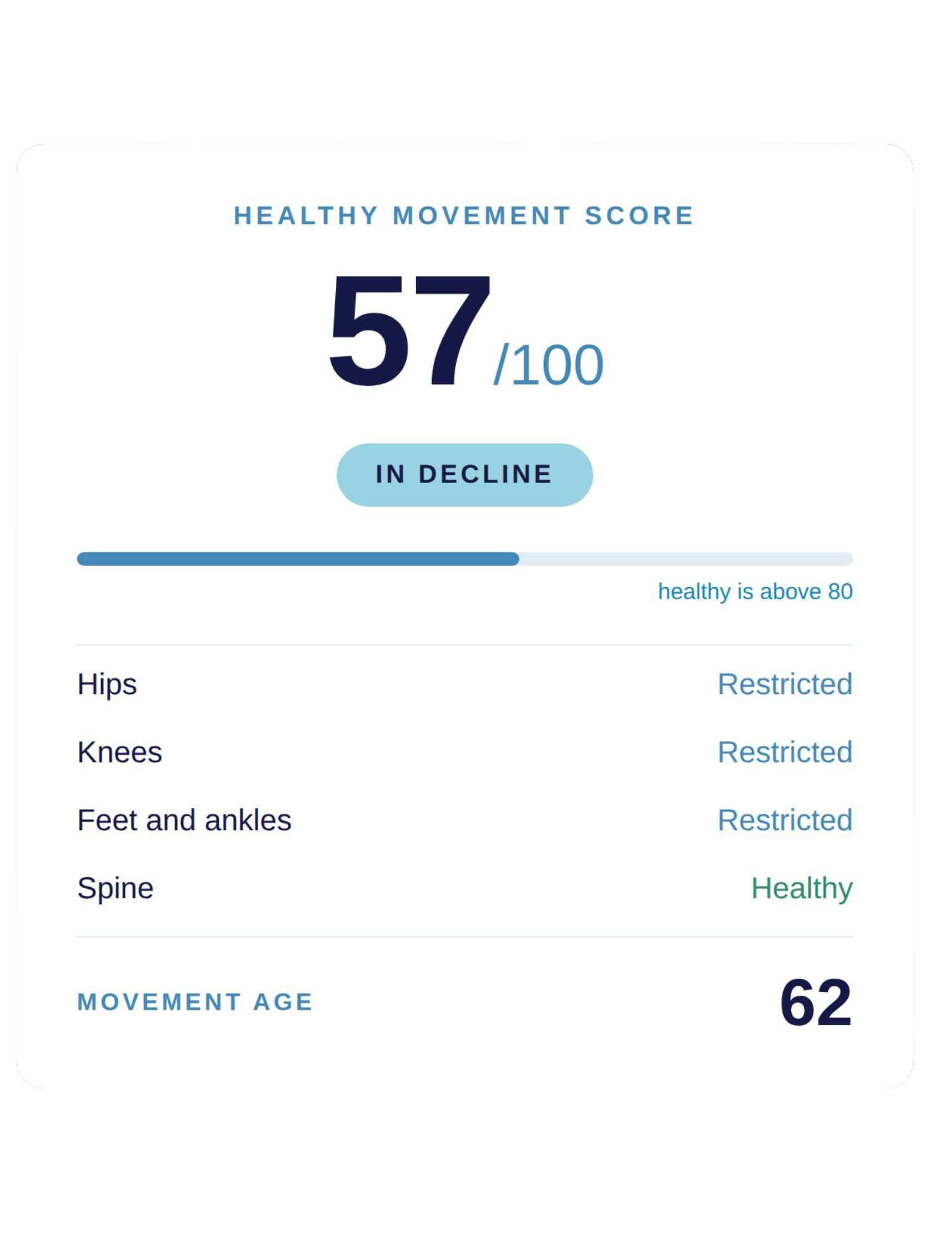
If you are the type of person who wants to keep your movement throughout your entire life, then I recommend that you get your health movement tested. In this test, You get a Healthy Movement Score and a Movement Age, and you can track how well what you do for your knee and whether it is working or not. You can do this for your full body and this metric will help you see if you are improving or declining.
In person here at Beckett Ridge, or if you can’t fly in to see me, I can jump into a virtual call with you and you will leave that with a plan that is proven.
Thanks for joining me today.
Get Your Healthy Movement Score
Every joint in your body has an amount of movement available to it and an amount that has been quietly restricted. Testing is the only way to know which is which.
Healthy Movement Testing looks at your whole body and gives you one number and your Movement Age and a Blueprint you can track for the rest of your life. In person at Beckett Ridge in West Chester Ohio.
Movement health, measured
Movement Age Against your years
Your Blueprint Your plan