Most people treat a tight neck as a muscle problem. That one assumption is the reason behind why your neck stays tight.
The better question is not how do I stretch my neck. The better question is why does it keep coming back day after day.
Before you treat anything you should be able to answer one thing. Can you measure whether the treatment you are choosing is actually working? Most people never ask that about their neck. They just chase the feeling of relief.
Why stretching feels good but never lasts
People stretch their neck for years. It feels better the moment so they think the treatment works. So they keep stretching to chase that relief. Relief strategies are proven to be short lived based on the research.
That temporary feeling of relief becomes the way we judge whether the stretching or other treatment worked. Feeling looser for an hour is not the same as fixing the problem. You need to measure the outcome of the treatment in order to effectively fix the underlying cause of the neck tightness.
We measure everything except the thing that matters
We measure blood pressure. We measure cholesterol. We do it because the cost of not measuring can change your life. Yet almost no one measures neck tightness. And the numbers on the neck disability are not small.
WHAT THE RESEARCH SHOWS
203 million people were affected by neck pain worldwide in 2020.
269 million is the projected number by 2050. That is an increase of about 32 percent.
Ages 45 to 74 is where neck pain peaks. It affects women more than men.
Source: Institute for Health Metrics and Evaluation and the Global Burden of Disease study. Neck pain is one of the leading causes of disability worldwide.
Notice one thing about all of that research. It measures neck pain. Not neck tightness. And tightness comes first.
Tightness comes before pain
Here is the order that matters. Neck tightness comes before neck pain. Neck pain comes before neck disability.
In office workers the strongest physical predictor of future neck pain was self perceived muscle tension. That tension carried up to nearly three times the risk. And it showed up before the pain did.
Source: International Archives of Occupational and Environmental Health.
People are spending more than ever chasing neck pain. The numbers keep climbing. Because everyone is chasing the symptom and no one is looking upstream at how it started.
What neck tightness really is
Most people believe the tightness is a muscle problem. It feels exactly like a muscle problem. So they stretch the muscle.
But the tightness does not start in the muscle. It starts in the nervous system and the joint. Your nervous system restricts how the bone glides inside the cervical joints. The muscle tightness you feel is secondary to that joint restriction.
You stretch the muscle. You feel looser for a moment. Then the day goes on and the tightness returns. The source was never the muscle.
It is not your posture the way you were told
Most people blame sitting posture. The research does not support that the way you have been led to believe. The evidence for posture and ergonomics as a direct cause is weak and conflicting.
What matters more is that the position was static. Held still over time while your nervous system quietly holds you up. Posture is one piece of it. It is not the whole story.
Source: International Archives of Occupational and Environmental Health.
The Silent Shutdown Cycle
In the research this process is called Arthrogenic Muscle Inhibition or AMI. I coined a clearer name for it. I call it the Silent Shutdown Cycle.
Here is how it works. The nervous system restricts the joint. The bone can no longer move freely inside the capsule. The deep muscles that stabilize that joint get switched off. Not weakened. Switched off. Like a light the nervous system turned off.
When the deep stabilizers shut down the large muscles go into a holding pattern.They were built to move your neck. Now they are bracing it to support the joints. That constant guarding is the tightness you feel.
These are the large muscles that take over when the deeper muscles have been inhibited through AMI. They are the ones people grab when they say their neck is tight.
- The upper trapezius across the back of the neck and tops of the shoulders
- The levator scapulae from the upper neck to the shoulder blade
- The sternocleidomastoid down the front and side of the neck
- The deeper splenius and semispinalis muscles at the back of the neck
- The scalenes along the side of the neck
They hold the cervical joints so they stay restricted. That guarding is what you feel. When you stretch them you get relief in the moment. But the nervous system decides whether they tighten right back up. This inhibitory process tightens the muscles and restricts movement in the joints as a protective measure. This protective measure is a destructive pattern that leads to uneven loading in your cervical spine. Uneven loading causes bone spurring and degenerative changes in the cervical spine.
Your tightness comes from three places at once
- The surface. The large muscles guarding and bracing. This is what you feel and reach for.
- The joint. The nervous system restricting the bone from gliding through its normal space across the cervical thoracic and shoulder systems.
- The deep muscles. The stabilizers that are inhibited and no longer being recruited.
All three talk to each other through your nervous system your joint capsule and your muscles. Stretching only ever reaches the first one.
Why every common treatment only touches the surface
Look at where treatments actually address. Stretching. A massage gun. Dry needling. A TENS unit. Creams. Heat and ice. Strengthening the big muscles. Almost all of it works on the large surface muscles only.
Even joint focused care like manipulation shows only short term relief in the research. The literature calls the effect short term and notes the evidence is weak. And most of that care does not begin until pain is already present.
The real problem lives upstream. It lives at the joint and across the whole upper body movement system. Stretching changes muscle length for a short window. It does not restore joint motion. It does not switch the stabilizers back on. The silent shutdown cycle continues deeper causing a level of arthritic changes due to uneven loading.
Where this goes if you ignore it
Tightness is a signal. It is your body pointing at a path. Left unaddressed the joint keeps loading unevenly. The disc thins. The cartilage wears. Bone remodels where the load concentrates. Bone spurs form. The joint space narrows. Those are the changes that show up as osteoarthritis on a scan.
I do not diagnose that. I point at where the road leads and I work upstream of it. That is the whole idea. Catch it early while it is still just tightness.
Pain is a late warning signal. Tightness and soreness and stiffness come first. Those early signals are what you should use as a recognition that silent shutdown, ie: AMI is affecting your movement system
We need a way to measure tightness
If our best treatments give short term relief for pain. And tightness comes before pain. We need to catch and measure tightness before it ever becomes pain.
We need a number. A number you can use to track whether the care you pay for is actually working. Something better than how you feel at the moment.
I have developed a way to identify the silent decline in your movement system. I developed it as a way to help you better identify this decline before you ever experience pain. When you do experience pain you still have a way to take back control of your movement system by restoring the 5 drivers of healthy movement.
The test is:
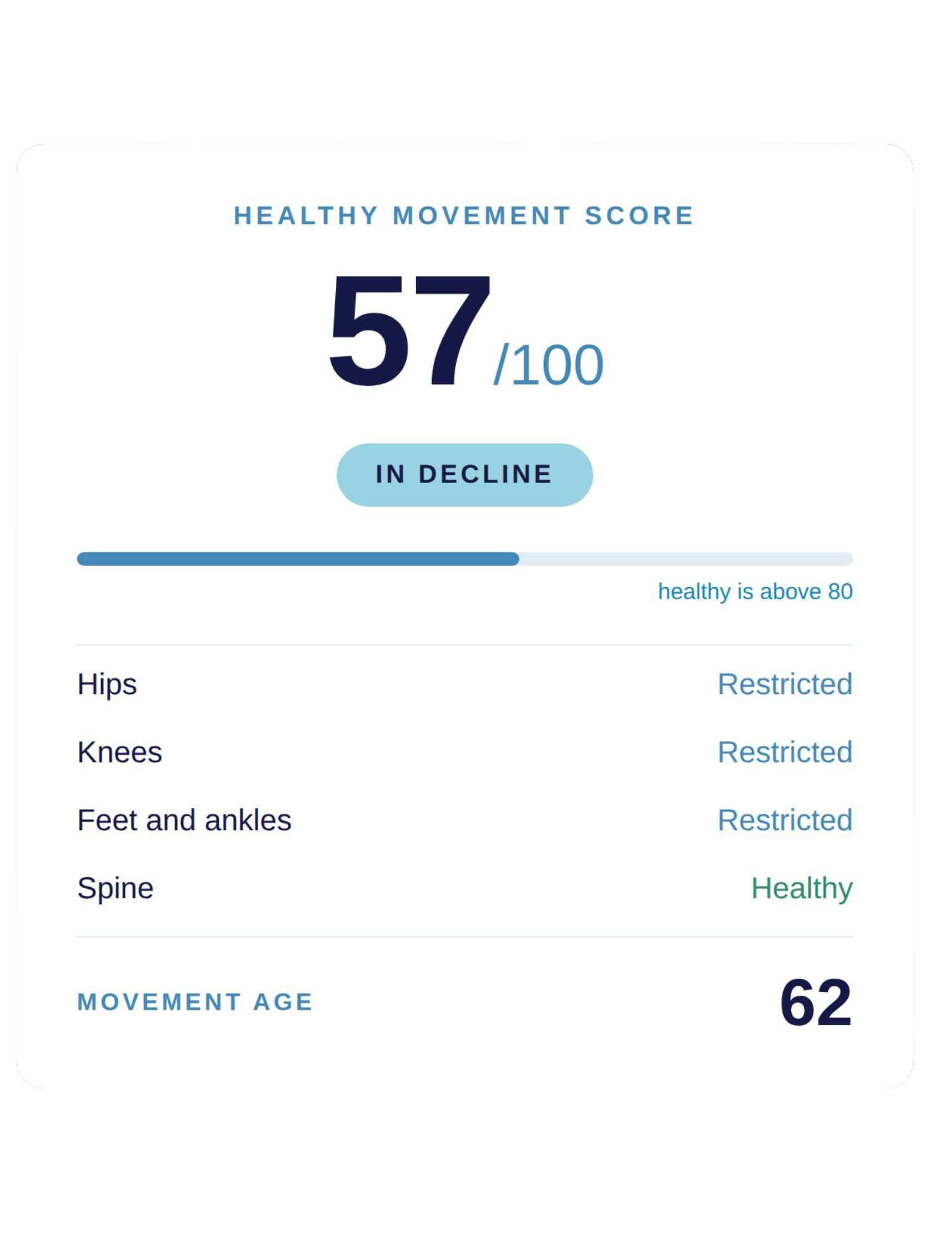
The Healthy Movement Score and your Movement Age
This is the biomarker for your tightness. It looks at how your joints move through different planes. It shows the compensation patterns. Then it looks at each joint and grades how much of its normal movement is restricted.
It gives you a score. The score shows which joints are restricted and how much functional space is lost. It also gives you a Movement Age. That is a clear comparison between how your body moves and your actual age. It turns a feeling into a number you can act on.
How I work
My sessions are not treatments. They are non medical. Medical care does not begin until pain is present. I look upstream of pain at tightness, stiffness or soreness. I would rather help you identify this cycle and teach you how to restore and preserve your healthy movement so that you can avoid the downstream effects of pain, tightness, stiffness and soreness.
Here is how I help people. I offer in person and virtual sessions.
Each session starts with testing your joints to see the decline that is present. I look at the joints in the areas you feel symptoms. I find the muscles that are inhibited and holding. I restore movement in the joint with gentle hands on techniques so the bone can move again without the restriction. Then I activate the deep muscles connected to those joints. I then teach you how to control this cycle.
This is how I help people identify and restore and preserve the health of their movement system for life.
Your one takeaway
Your tightness is a symptom of something bigger than you were taught. We were told to wait for pain before we seek care. But pain is the late signal. Tightness is the early one. And the early one is where you still have all the power to change the outcome. Even if you are experiencing pain currently I can help you identify this cycle and restore all the movement you can restore.
Movement health, measured
Every joint, tested by hand, in a single visit. Baseline once, retest as you go.
Healthy Movement Score Whole body
Movement Age Against your years
Your Blueprint Your plan
In studio at Beckett Ridge, West Chester OH
Not near West Chester. Start with the virtual Healthy Joint Mobility intro and get your Mobility Health Score for one area.