Healthy Hips After 50: What Is Actually Happening To Your Hips?
Healthy Hips After 50: What Is Actually Happening To Your Hips?
Understanding what you have lost, why you could not feel it happening, and what you can still do about it after age 50.
“What you have lost, you can’t risk losing more of.” Kim Nartker
The Healthy Movement Podcast
Read time: about 10 minutes
In this episode Kim continues the hip series with the episode people over 50 keep asking for. Why do my hips feel like this when I did not do anything to cause it. She breaks down the four parts that make a hip healthy, what you could do as a child that you can no longer do, and what has actually been lost by the time you reach 50. She explains why walking, stretching, mobility drills and strength training help you maintain but never restore what has been taken away, and what she found in 14 years of testing people who were tight, stiff, sore and frustrated.
A note on this episode. Kim reports what she finds in her own practice and says so plainly when she is describing her own testing and observation rather than published research. She does not diagnose or treat or cure or prevent any medical condition.
Subscribe on: APPLE PODCASTS I SPOTIFYI IHEARTI RSS
In this episode
- Why people think their hips are healthy, and what that belief is based on [00:02]
- The predictable pattern Kim sees every day in her practice [01:00]
- Where we are right now. More tracking than ever, and surgeries still going up [01:40]
- By 50, many people have lost over 50 percent of their hip mobility [03:00]
- The four parts that make a hip healthy [03:20]
- The six ways your hip moves, and the motion you had as a child [04:20]
- What you could do then and what you do now [05:30]
- What you have lost by 50 beyond the mobility itself [06:30]
- What actually makes a hip unhealthy [07:30]
- Why DIY feels like progress when it is compensation [08:20]
- Why no pain does not mean healthy [09:20]
- What 14 years of testing and development produced [10:00]
- Why testing should start at puberty and continue for life [11:40]
- The surgical table, and the trajectory Kim wants to change [12:20]
The Short Answer
Most people think their hips are healthy because they can move. Or because nothing hurts when they move. Or because they can do what they need to do and it is not limiting them in their day.
The fact is that our hips lose movement silently throughout our lifespan, every decade. And we have not been taught how to protect ourselves from that loss until we wake up one morning with achy hips, tight hips or painful hips and think, what did I do to cause this?
Most of you are shocked, because the day before you felt nothing. You felt great. Maybe you accomplished something really big the day before, and you are completely left to wonder what happened.
This is a predictable pattern, and it plays out every day in my practice.
The pattern I see, and when people finally come in
I do not see a client in my practice until they have exhausted traditional care and are shocked that this has not resolved on its own like it did when they were younger.
Everybody always goes back to the same thing. Well, the last time this happened to me it went away.
Things change after 50. Everything in your body has changed from your 20s and your 30s and your 40s.
Where we are right now
We have more ways to track our health than we have ever had. We are living longer than we have ever lived.
Yet surgeries are going up. The last 12 years of our lives are spent not able to move well at all. Many people end up in assisted living centers and require assistance to move without an assistive device.
I speak to coaches who say their children are in pain playing sports every day.
This has got to be stopped and we need to do something about this, because it is not changing. We are building more assisted living centers. Our hospitals are filling up their beds. And everybody is saying this is aging, it is the baby boomers.
It is way more complex than that.
Everybody turns to the same thing. Stretching. Strength training. Massage. PT. Longevity. Recovery.
The children I see are already way down a path of loss in movement, and some have no pain but they can no longer move naturally.
By the age of 50, for many people, we have lost over 50 percent of our hip mobility. Yet people are still surprised when pain shows up.
What makes a hip healthy
There are actually four parts to this equation. The joint. The muscle. The nervous system. And the cell inside that muscle.
A healthy hip is all four of these things, and all four of these things do what they do in a moment’s notice without you feeling anything.
Starting with your hip joint. There is a ball that moves freely inside the socket, and it rolls, it glides, and it spins. And it does all of that automatically, outside of your control.
That rolling and that gliding has a name, and I broke that down for you in my hip flexor muscle episode. If you have not heard that one, I would advise you to go back and listen to it, because I break the mechanism down in that episode. For today you only need to know that it happens without you knowing, and that when it is taken it steals your ability for your bones to move inside your hip joint.
The six ways your hip moves
Your hip moves six ways. Forward and back. Out to the side. Across your body. And it rotates in and out.
When you have all of these motions, you can swing your leg around in a high circular motion like you see in the sport of taekwondo.
In childhood you have this motion, but you start losing it at various stages through life.
If I could stand people up in a row from youth to 90 years of age and have everyone move their hip naturally in different directions, you would see the loss between those people over each decade of life.
Once you are in your 50s, it is more work to get that motion back. Not because of any one thing that you did or did not do, but because you have lost way more than the motion your body took away.
And while we are busy living life, we also lose key mobility that gives us the ability to live our life to the fullest.
You don’t know what you’ve lost until it’s gone
When we were children we could kick up forward, sidekick, back kick. We jumped off the back of a moving vehicle. You jumped off a high surface. You stood up and put your pants on, then maybe you sprinted into a fast walk or a run without falling. And if you did fall, you got up, you shook it off, and you ran.
Now you hesitate going down the steps, making sure you watch each step. Some of you are having to hold on to a railing, or take one step at a time. You cautiously get off a high surface, making sure that you are holding on. You sit down to put your socks on. You get up from the floor, but it is harder to do without holding on to furniture.
And many of us are joking about that.
This is what you have lost. And what you have lost, you can’t risk losing more of.
We need to protect our mobility. For those of you who want to protect your mobility after 50, what can you do that you are not already doing?
What has been lost by 50, beyond the mobility
After age 50 we have not only lost the mobility. We have also lost the healthy way our movement system communicates between our joint and our muscle.
We have lost mass, function, cellular health, along with strength and power that we used to have at our disposal.
Pain starts because your joints no longer have the support and the stability they used to have.
Your body has been compensating and declining for over 30 years. So what function does remain is not the same as the function you had when you were 20, 30 or even 40 years of age.
What makes our hips unhealthy
The loss of accessory motion. This is a joint restriction.
Then the deep muscles lose activation through a process called inhibition. Then the larger muscles hold, and they will not allow you to move through your entire range of motion.
What you are going to feel is stiffness, soreness, pain, achiness, tightness, or like something in your joint is off.
Or you are not going to feel anything at all. Because you are going to go about your normal routine and not get into challenging positions that go to the end range of what that motion tolerates.
We pretty much stay in a seated position or a standing position. We do not typically walk sideways or rotate our hips very much unless we are reaching for something. And we try not to do those things when we are getting older.
Why DIY feels like it is working
When you experience tightness, stiffness, soreness or pain, most people turn to DIY advice. You start a walking program. You start stretching. You start doing mobility drills. You start doing CARs. You start strength training as a way to prevent more loss.
The problem with this is that your body is so good at pulling movement from other areas of the body that you will feel like you are making progress, but in reality you are just compensating.
Then you start modifying your routine to avoid something that is hurting. And through this process you stop going into positions that you used to go into, for fear of breaking or tearing something.
Pain is going to creep in, and it feels like it happens in a single moment. But the pain is a signal that gets your attention.
We now have a medical system that can help us with pain. It helps us to manage pain. So we go that route, we do what they tell us to do, and we feel like we are doing well managing our pain through exercise.
And no pain means healthy, right?
Here is where the misconception is that we are taught to believe.
The reality is that you have lost motion because that motion lies outside your control. Your walking, your stretching, your strength training, your mobility drills and your CARs help you maintain. But they do nothing for restoring motion inside the joint. Ever.
You can’t DIY yourself into more joint accessory motion.
What I found, and what it took
I found a way, through research and through testing people who were tight, stiff and sore and frustrated with this loss of movement, to restore what the body has taken away.
This has taken me 14 years to develop.
My work restores what you have lost so that you can preserve it now and stop the continued decline. This gives us the ability to restore, and then protect, our motion for our 60s, our 70s, and each decade beyond that.
Age, weight gain, not stretching and sitting are not the only reasons you are losing mobility in your hip joints.
At 50 you have lost a lot more than your mobility. You have lost your muscles, because they have been in decline. Your cells in your muscles are also not functioning in a healthy manner.
What I find when I test
I developed testing to test our joints, and I have found that everyone who walks into my practice, whether they have pain, tightness, stiffness, soreness, or they are just not moving like they think they should, I find restrictions throughout their bodies limiting their ability to move.
Most people are completely surprised by how much they have lost, because our normal activities do not pull them into those positions very often.
I also restore what is lost in the hips so that your body stops taking the movement away from you. My work lies mostly in testing, and in building programs for people who are looking to protect how well their hips can move.
The mixed messages
At 50, when you feel like your body is falling apart, you get mixed messages blaming this hip mobility loss on hormones, lack of stretching, too much sitting, or the crazy things you did as a child.
Although these are associated with your loss, they are not the root of what is causing the problem.
Where This Leaves You
I have found the only way to get ahead of this loss is to restore, then protect, our joints to keep them healthy. And this is to test annually starting at puberty.
Test throughout your life so that you can find all the loss, and build your fitness regimen around what you need to preserve that motion.
The key after 50 is to restore all that you can for your 60s and beyond.
Currently I see people at your age doing things that do not work to restore the loss. I also see these people ending up on a surgical table begging for a new joint. Most of these people are very happy they got the new joint and wish they would have done the joint replacement sooner.
I wish to change that trajectory, with your help.
Please share this episode with your friends and family. Help me to educate people about this loss, and about the fact that we need to restore and protect the health of our hips earlier than when we feel things in our 50s.
If you are in your 50s now and you feel like you are falling apart, there is more going on than what you feel. It is way more complex than what you are going to figure out, and you are going to be left guessing.
I would love to jump on a call with you to discuss your options in preserving your hip movement.
Next week I am talking about hip replacement surgery. What you gain with that surgery, and what you lose with that surgery. Subscribe so you get it as soon as it drops.
Get Your Healthy Movement Score
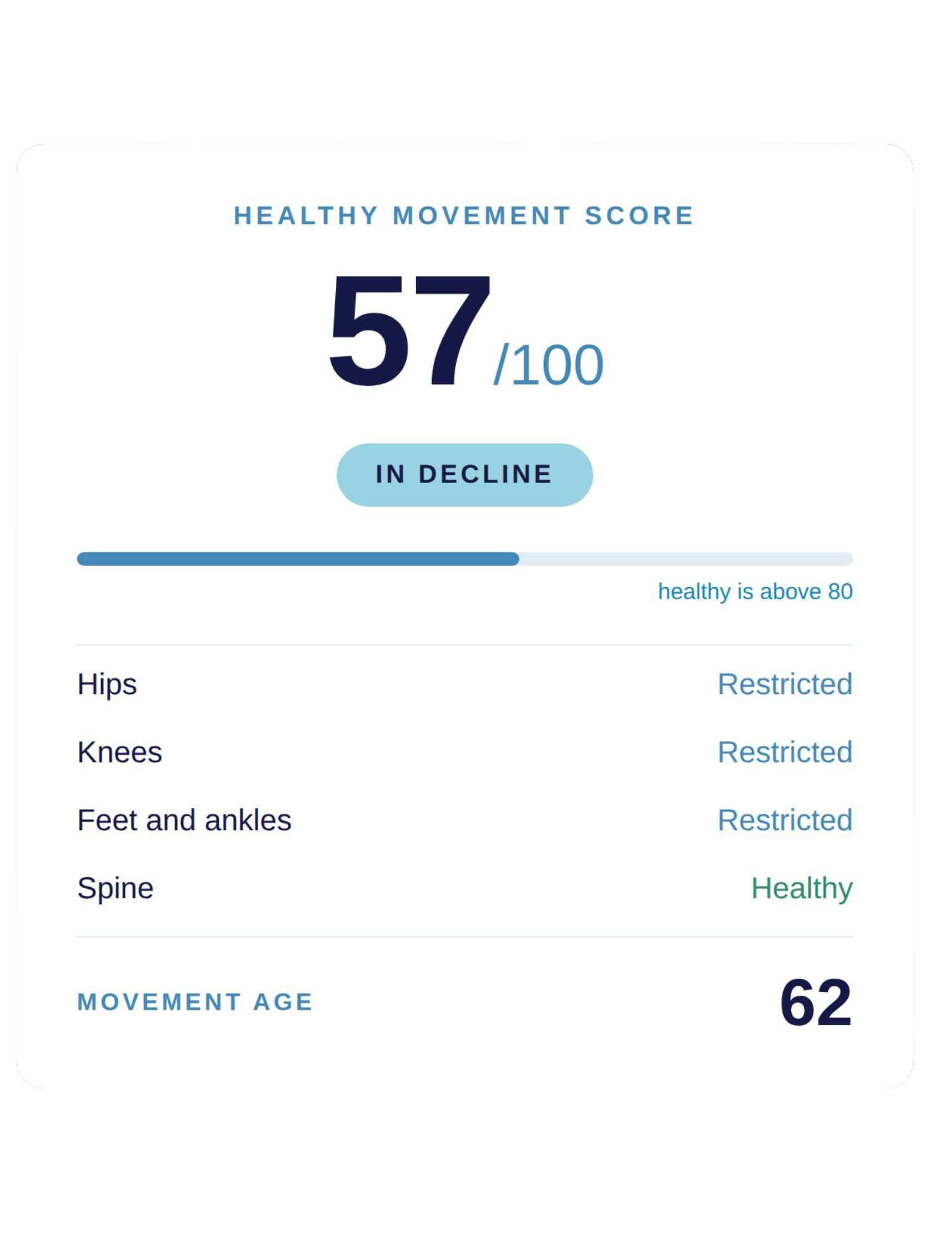
Every joint in your body has an amount of movement available to it and an amount that has been quietly restricted. Testing is the only way to know which is which.
Healthy Movement Testing looks at your whole body and gives you one number and your Movement Age and a Blueprint you can track for the rest of your life. In person at Beckett Ridge in West Chester Ohio.
Movement health, measured
Movement Age Against your years
Your Blueprint Your plan