The Movement Health Score: The Test That Predicts How Well You Live And Move

The Movement Health Score: The Test That Predicts How Well You Live And Move

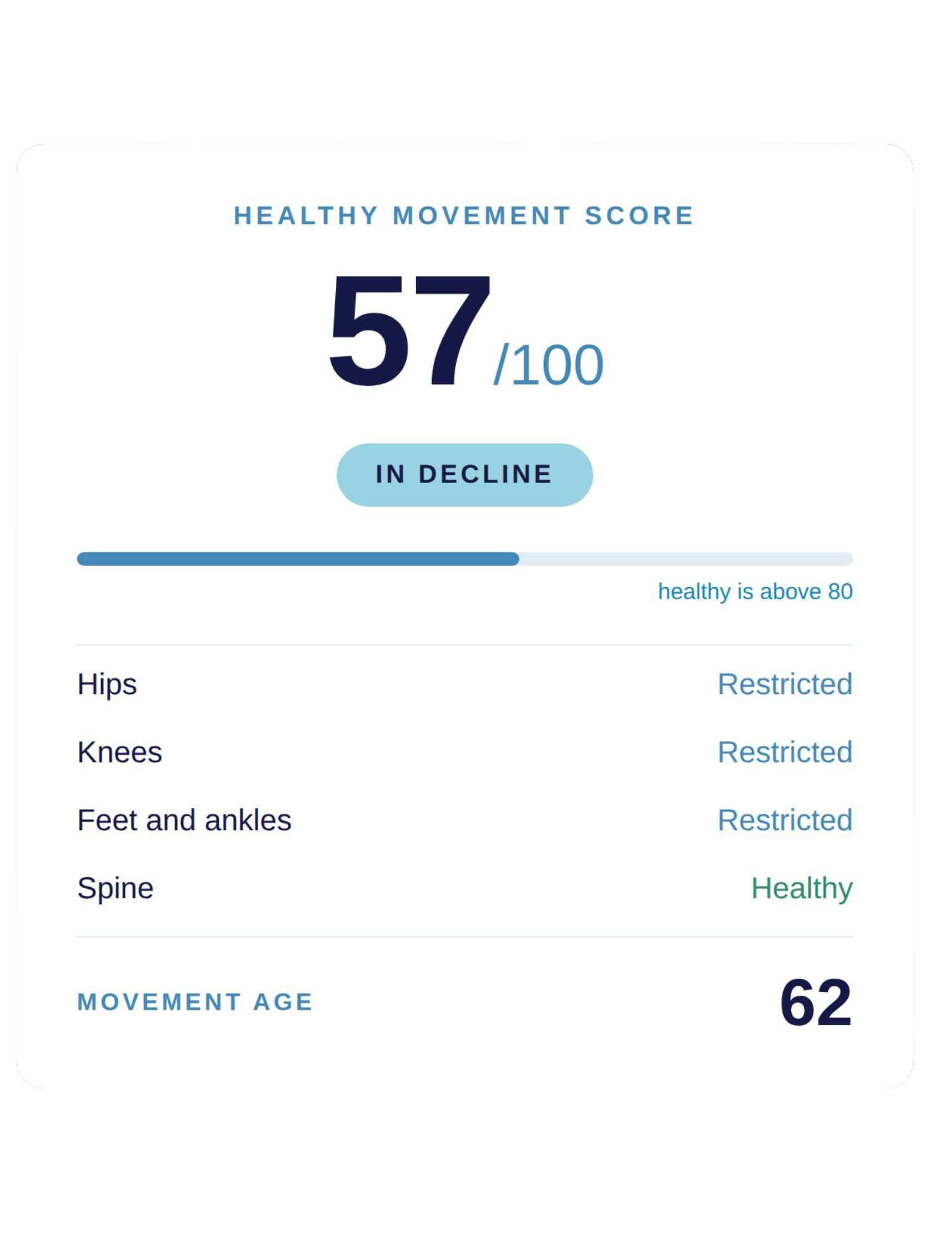
Your Movement Health Score is the number that predicts how well you live and move, and almost nobody has ever measured it. In this episode, Kim Nartker breaks down what healthy really means and reveals the testing gap that leaves millions of people losing movement for years with no warning and no number to track it by. You will hear the moment her own husband swore he felt fine, while he had lost half the rotation in his neck. That is the gap this whole episode is about. WHAT YOU WILL LEARN Why no pain does not mean healthy and what to track instead What every health test on the market measures and what they all miss The research linking how well you move to how long you live Why fitness testing and frailty testing both leave you stranded in the middle How the Movement Health Score catches silent decline while you can still reverse it. 

Transcript

Kim (00:00.876)

Hey guys, welcome back to the Stretch Mobility Coaching Show. And today I hope you find this information helpful. I’m going to be talking about movement health. And I’m going to start off with this term healthy because most of us don’t know what being healthy actually means. It’s such a general term. And if you ask 10 people, you’re going to get 10 different answers on what it actually means to be healthy.


Your doctor has an idea of what they test and they call health. Your trainer is going to have performance and strength testing that is going to tell you the health of that. Your wellness provider is going to look at inflammatory responses. There you’ve got longevity providers, we’ve got our handhelds, our watches, so many things that keep us on track, but


Health is still a general term and it’s used to mean a lot of different things. And it is one of the most misunderstood words in our culture. And we you we use it like it means one thing, but that term is very complex. And health is a stack of layers, and most of us are only looking at one or two of these layers. And frankly, that’s all that we have the capacity to even do.


But in today’s show, I do want to break down all of these so that you have a better understanding of health and what you need to measure for your health. And by the end of today’s show, I want to be able to help you better understand the health of your movement system and how measuring the health of this system can help you live well every day throughout your lifespan. And I’m going to start with something.


I just experienced in a conversation with my husband the other day. And I think this will help you see why I’m teaching what I’m teaching and what this gap is that you’re not currently measuring. So my husband and I were talking and he was in his recliner and he said, I think I slip on my neck wrong. And so I said, Okay, well turn your head to the right, and he immediately said,


Kim (02:20.792)

I I don’t have any pain in my neck. I just slept on it wrong and I need you to work on me. But he did proceed to turn his head. And when he turned it, he only used about 50% of his mobility. His body knew not to put him into that other 50% because if he did go into that, then he would have pain. So he was only using a small portion of the


mobility that his neck allowed him. But that is what I want to show you. Our our bodies are, you know, wonderful at only having us use a certain amount of mobility. And we don’t push into it because our body knows if we push into that, then there’s going to be pain. Our body also knows that it has shut and taken that away for one reason or another.


But we measure things by pain. So this is where our problem is. We don’t have an adequate indicator of movement and the health of movement. And that’s the scale that we have all been using. And it is not what we need to use when we’re looking at movement health. So I hope hope you understand that. So you can you can move right now, and most of us aren’t going to push into.


An area that feels stiff. And we’re not going to do it because we we know we’re going to go into pain and none of us want to experience any pain. So it is that area, that loss of movement that we are not pushing into that I am talking about that we’re silently losing every day. And by the time we have lost most of our movement.


Our body can’t do the things that we want it to be able to do, like put on our shoes, you know, actually get into certain yoga poses, you know, get down to the floor and stay on the floor comfortably. And to use pain as an indicator, as a scale, guys, that is not what we need to use or measure. So today I’m gonna dive into the different.


Kim (04:43.97)

Testing. I want to talk about the gap that we don’t even see because we don’t even move into those ranges anymore. We we don’t even look at being worried that we’ve lost this mobility. So let’s dive into the show today, okay? So let’s talk first about what this gap is costing us. The actual research that’s out there.


there was a research study that was published in 2024 and it found that Americans, guys, Americans, USA, live twelve point four years on average impacted by disease and disability or disability, not disease and, but disease or disability at the end of life. And that’s the gap between how long we live and how long we live well.


Now, USA holds the largest time gap in the world. The global average gap is only 9.6 years. The US gap has grown from 10.9 years in 2000 to 12.4 years in 2019. And guys, this is gonna go up. I believe it’s higher than this already because we’re what in 2026? But this is slated to increase. And I know I’ve talked about


Surgical procedures increases increasing. but I really want you to see this side of our that last 15 years of life. other authors say the last decade of life, okay. The researchers named the main drivers of this health span gap as musculoskeletal disease.


Then it also added in mental health and substance use disorders, cardiovascular disease, cancer, diabetes, and then neurological diseases. Now, guys, I don’t know if you know this or not, but women have a wider gap than men, 2.6 years wider in the United States, 2.4 years wider globally. And the researchers attribute that wider gap specifically to a higher


Kim (06:58.866)

musculoskeletal disease burden in women. And when we look at these musculoskeletal conditions, the World Health Organization defined that to include arthritis, tendonitis, and osteoporosis. My ladies out there, you know, these become debilitating to all of us and we need to know more about why


We develop arthritis, why we have atendinitis, and why we develop osteoporosis, and then what we can do to not get there, right? So this is the layer my work catches before it becomes a diagnosis, before it becomes the years that were taken from the back end of your life. My mission is to help you move well every day of your life. But for most of us, we are measuring health broadly.


And we dive into healthcare or fitness seeking help and ending up with these statistics and diagnoses. So, in order to change these statistics, we have to look upstream at the current testing we have available to us. So, I’m going to break down many of these testing standards, and I’m going to start with the fitness standard testing. Now, this is what fitness and strength and conditioning.


world uses. Okay. The standards are built around squatting, a deadlift, pressing, pulling, pushing, rows, plyometrics, and combination lifts, and of course, high intensity workouts. Some of you guys know that as HIT workouts. Fitness testing measures performance against those particular standards. Can you squat your body weight? How fast can you run a mile? How many push-ups can you do? And what is your VO2 max?


Now, these tests assume that your movement system underneath is already healthy. When it is healthy, you make the gains that you are looking for using our fitness standards. Now, the problem is that fitness standards are not the first tool for someone whose joints are in decline and whose muscles are deconditioned. These standards are built for the healthy individual, not for the person whose system needs to be restored before strength.


Kim (09:16.664)

Can actually do what it needs to do. But if all of us don’t really understand this term health, then of course we’re all going to flock to either the healthcare system or the fitness system, right? We have fitness testing that tells us whether we are meeting fitness standards. But here is the question nobody is asking for the people who fail fitness test. Is fitness the answer? Or


Do they need something else first? Now, there are other testing methods, and the ones that are widely out there that you’re gonna get from like your personal trainers and other non medical people are your functional movement screens and the selective functional movement assessments. And this is also known, I believe, in the community as FMS. And this is open to non medical.


And medical professionals, personal trainers, strength coaches, fitness professionals, athletic trainers, chiropractors, and physical therapists. There are over 60,000 of these people certified with FMS worldwide. This tests seven movement patterns. It tests a deep squat, a hurdle step, inline lunge, shoulder mobility, active straight leg raise, trunk stability, push-up, and rotary stability. And each movement,


is scored zero to three. Composite score zero to twenty one. Now if you have pain during any movement, that automatically scores that movement as zero and it triggers a referral for a clinical evaluation. So you that’s going to trigger a referral to an athletic trainer, a chiro, or a physical therapist. A composite score of 14 or lower is considered a failed test.


Now in 2017, systematic review and meta-analysis found that individuals with a composite score of 14 or lower had 2.74 times higher odds of sustaining a musculoskeletal injury compared to those with higher scores. Now, guys, this has been validated in NFL players, football players, firefighters, female collegiate athletes, rowers, soldiers, EMTs.


Kim (11:42.358)

Youth volleyball players, you name it. Now, a failed FMS tells you that you are at higher risk of getting hurt if you train. And guys, that’s useful information. And that is what FMS was built for. Now, what FMS does not tell you is whether your movement system is aging well, whether the silent shutdown cycle is running, whether your joint capsules have lost their mobility silently.


Whether your deep stabilizers are activating or not, and whether your movement age is older or younger than your chronological age. The FMS was validated on athletes and military and tactical populations to prevent training injuries, but it was never designed to track movement decline that runs for decode decades in all of us. And guys, that is the gap that my work fills. Now


The selective functional movement assessment is also known as the SFMA, and it’s reserved for licensed health care care professionals, physical therapists, athletic trainers, chiropractors, and physicians use this testing. And it is a diagnostic system, and it’s used when pain is present. And it’s gonna and it’s gonna identify the cause of the pain, but it’s not going to necessarily go to the source of the pain. And it is clinically used.


And designed for rehabilitation interventions for musculoskeletal disorder. So I want you to understand these terms. We’re talking about testing to see if you’re going if you go into fitness and are going to be prone to injury. If you test and have pain, it is a direct referral to someone who has a medical scope of practice or healthcare license.


And it is used to design rehabilitation interventions for musculoskeletal disorders. Okay. So you’ve got one test that identifies, hey, are you going to get injured if you go do fitness? And you’ve got one test that says, if you do work out with us and you already have pain now, then I’m going to refer you over to PT. So that is a great fitness standard for injury prevention. It’s also a great


Kim (14:03.916)

referral over to physical therapy or other licensed healthcare providers that can now you know prescribe treatment but that in itself doesn’t tell you if your movement is healthy it just says if you’re at risk if you do fitness. Okay. There’s a bunch of us that don’t do fitness. We don’t know how to do fitness. Don’t even know where to start with fitness. And if we did fitness, we would get hurt.


So the testing is going to tell us we’re going to get hurt, but it doesn’t dig deeper to, you know, why we’re getting hurt and what we can do about it outside of fitness. So, you know, that leads me to believe is this test, if you fail it, really, you know, it’s looking at a metric of injury, but


I’m going to dig deeper into this. I’m going to show you some more testing because I hope that you come to the same conclusion that I do. We’re still missing, there’s still a gap here, okay? So let’s go into biological age testing. And this is what the wellness industry has built. And these are direct consumer through companies that measure from saliva, blood, and urine samples that are sent to a lab.


It’s going to test the molecular and cellular level or layer of how you are aging. We’re talking about DNA, methylation patterns, inflammator, inflammatory markers, metabolic function, and cellular signals. They’re going to use all sorts of tools to be able to come up with this bio-age. There are very, very different ones and many different ones that you can get tested on.


And what this gives you is a biomarker that you can track, a number that can change through nutrition, lifestyle, sleep, stress management, and medical guidance. And these tests are helping us make adequate changes to improve our metabolic health and the health of the inside of our body. Okay. And then we have testing downstream for those people who have osteoporosis, who have


Kim (16:23.476)

severe arthritis with deconditioning for those that are falling all the time. You know, we have gate speed test, we have frailty and senior functional testing, and this is found in the geriatric medicine area. we have physical performance testing like our sit-to-stand test. We have other tests, but again, this is testing us after


We have become frail. And it’s built for an older adult already deconditioned, severely deconditioned, and and most likely sarcopenia. Okay. You have these people may have arthritis long term, may have had surgeries, may have had many surgeries. They are very deconditioned and they can barely move. And when they do move, they’re a high fall risk. Okay. and


Then there are rehabilitation tests, tests, tests, tests. And this is what physical therapy uses. You’ve got range of motion measurements, manual muscle testing, you’ve got special tests for specific joints, functional movement assessments. And these are all built for someone with a diagnosis, someone that is about to go into surgery or has just got out of surgery. And


they have a documented injury or they have a complaint of pain. And this is triggered by something already being wrong. So you go to physical therapy because something has happened. Now I spent 25 years using these tests and they work for the population they were built for. Post-surgical patient, the person with a documented pathology. This person can’t move. Okay. And when they do, they have pain.


it wasn’t designed. None of these tests were adequately designed for the upstream person, the person whose body is changing, but who has no diagnosis yet. other tests out there are on the direct-to-consumer market. So you’ve got wearables, you’ve got the aura, you’ve got your Apple Watch, your Garmin, your Fitbit, you’ve got things that measure HRV, sleep, heart rate, steps, recovery scores.


Kim (18:47.032)

You’ve got continuous glucose monitors that measures glucose response. You’ve got body comps, DEXA scans that measure muscle mass and fat and bone density. You’ve got your genetic testing, and then you’ve got your hormone and functional medicine panels that really dive deeper into more comprehensive blood work.


Okay, so all of these tests out there, they all measure different things. And you really need to understand, you know, instead of just going, hey, I’ve got to measure it all, which I’m not saying you don’t have to measure it all. That’s not what I’m saying here. What I am saying is based on where you are and what you are able to do, you need to pick one thing and do something that can fit into your lifestyle so that you can make that change. But one test may not impact the outcome.


Of another. And that’s the gap I’m talking about here. This is the movement health decline. This is the epidemic that we have out here when we’re talking about people falling, orthopedic surgeries on the rise, and that 12.4 years that we’ve lost our quality of life. A 25-year-old who feels tight doesn’t really have a place to go. They typically go to fitness.


Or they go to an assisted stretching place. And you know, assisted stretching is gonna do some simple testing to be able to show you you improved flexibility. But I want you to hang on here because I’m gonna go through a research study that talks about that too. and then I’m just gonna dig more into it for you. So


A 25 year old, a 40 year old, a 50 year old, where you have changes in your body and you want to do something about it. You don’t want to stay on the same path. You do not want to go to surgery and you’re ready to fix it. That person really doesn’t have a place to go. Now, fix if they go into fitness, then they’re going to tell her, Hey, squat your body weight. They’re going to use FMS to show her.


Kim (21:07.234)

That she is at training risk, but it doesn’t, it doesn’t look at health decline. When we look at frailty testing, when we’re using that in rehabilitation, this rehab testing, it it doesn’t apply to this population. And it’s not triggered because nothing is wrong or nothing is found on a scale. This person may or may not even have a diagnosis yet.


We do know their nervous system is working over time. We do know that they can’t move and that if they move they have pain. But that is the gap I’m talking about, okay? So 40-year-old who’s losing function really has nowhere to go. This person’s not frail, not had surgery, doesn’t want to have surgery, and her fitness might still be, you know, she might still be able to run or walk or do the things that she wants to be able to do.


FMS might not catch what is happening upstream of her movement patterns, but she or he knows something is changing and and there is no test for that. Well, there is a test, but you don’t know about it. A 55-year-old who feels that their body is changing really has nowhere to go. The physical, if you go to your annual physical, going to get your blood work done, if it’s shown as normal, then the doctor’s gonna send you home and say you’re in good health.


But there is a decline that’s happening that is leading you down a path that you don’t want to be on. And fitness testing sits on the end for the healthy person. Rehab and frailty testing sits on the other end for you when you’re broken. Biological age testing measures the inside of your body. And in between is the entire population of people whose movement is silently changing.


And who have no number to track it by. Every test on the market right now measures something very important, but none of them measure whether your body can do what you want it to do tomorrow, next year, or when you’re in your 80s. And guys, I don’t know about you, but when I’m in my 80s, I want to be out in my garden. I want to go to the beach. I want to walk on the beach. I want to get into the water. I want to be able to get down to the floor, play with my grandkids, and I don’t want to look silly.


Kim (23:33.004)

And have to go and tell my grandchild, sorry, Mimi can’t get up right now because her hip doesn’t move. But I’m not in pain. So we need another predictor, okay? So before I dive deeper into here, and I know I’m getting passionate about this because this is my area. So I hope it’s helpful for you. I want to go into the research we have on mobility. And I want you to know how it is tied to your lifespan.


And I’ve talked about this study. It was done in 2024 in the Scandinavian Journal of Medicine and Science and Sports. the A-R-A-U-J-O is the study that was published in 2024. I can never say that right. Now, researchers in Brazil in Brazil followed 3,139 adults aged, they were ages 46 to 65, and they followed them for about


13 years. They used what they called passive movement assessment, and they called that the flexatest. The examiner moved each joint passively and graded how much motion the body allowed across 20 movements and seven different joints. Each person got a single score from 0 to 80. Now the researchers labeled this flexibility, which that’s typical of.


What we talk about when we’re talking about assisted stretching is what they give in physical therapy. stretching is one of the most used techniques to treat tightness. Now, what this test actually measured was total passive movement at the joints, which combines two different things. It combines muscle flexibility on one hand and joint mobility on the other, but the test does not separate these two.


And when the examiner pushed one of the joints to end range and the motion stop, the stop that happened could have been from the tight muscle or from a restricted joint capsule. The flexa test cannot tell you which one it came from, and it combines them into a single number. Guys, flexibility and joint mobility are not the same thing. Flexibility is the ability of a muscle to lengthen, it’s a muscle property.


Kim (25:57.144)

Joint mobility is the ability of a joint to move through its available range. That is a joint property, but we’re not measuring that range that has already been taken from us, the unavailable range that we came to this earth for. I mean, we came to this earth with more than an available range of motion when we were younger.


We had more joint mobility. This silent decline that I talk about steals our joint mobility. And so now we’re just tracking the available that we have today. And we need to track differently. We need to be able to score it when we’ve lost it so that we can regain it. Because guys, the link between the loss of mobility and the testing that we’re not testing it and and the


Sessions that are not giving us that range back, that is where this gap is. The wellness industry uses the terms flexibility and mobility interchangeably, and they they should not be used that way. You have to have flexible muscles, and you cannot have flexible muscles and


I’m sorry, you can have flexible muscles and a restricted joint. You can have a mobile joint and tight muscles, but both of these are going to live in different tissues and they respond to different things. And what I am talking about here, okay, medical system talks about the available range, fitness system talks about your available range. I am talking about the range that you are losing silently, that you do have control over, that you can gain and


When you find that, when it’s identified, when you track it, when you actually preserve it and get it back, that’s when the game changes. Now, when we’re talking about this research and the FLEXA test, what they found is that people with low scores died sooner from natural causes at statistically significant rates. Women in the lowest scoring group had roughly 4.78 times the mortality risk of women.


Kim (28:17.9)

with the higher scoring. men in the lowest scoring group had roughly 1.87 times. So there is a strong association statistically significant over 13 years in one of the largest studies of its kind ever published. Now guys, this is association. It is not proof of causation. And a program of stretching


Or mobility work has not been shown to change your mortality. I am not going to be the one that tells you that if you stretch, it will save your life. Even a test that combines muscle flexibility and joint mobility into a single number. This this test predicts how long you live. Imagine what a test that separates those two tissues and adds active movement.


And then also looks to see if your deep stabilizers and your other muscles are actually doing things in a healthy way. The flexa test measured a partial picture and it’s tied to mortality. My movement health score measures a full picture. I’m going to measure musc muscle flexibility tested separately from joint mobility. Okay, so if I’m gonna look.


At the full picture, I look at active movement tested separately from passive movement. I’m going to look at muscles more comprehensively to see which ones are working, which ones are not working, and then we’ve got to dig deeper into that because we have stabilizing muscles and we have moving muscles. So it gets very complicated. Movement health predicts how long and how well you will live.


So let’s talk about this movement health score. I built this score because we needed a testing system that catches people upstream of a problem. Real information about the health of your movement. It’s trackable, it’s changeable, and it gives you control. You can take and get this score in your 20s, your 30s, your 40s, your 50s before you become frail so that you don’t become frail. And it’s going to tell you whether your movement system is healthy.


Kim (30:42.7)

Or whether it’s in decline. And most of you are gonna go, why do I even need to know that? Because if it’s in decline, it it tells you exactly what things you need to do, how you can regain that mobility back. Guys, if falls are because we’ve lost orsiflexion, and falls are things we are working on in fitness through fitness standards, then


If we could improve that mobility in the ankle upstream and preserve how your deep muscles activate and your primary moving muscles stay strong and function, that is where the magic is. And that is the part I live in. Okay, a movement health score is going to give you the power to choose the right type of workout that is best suited for your age and your


Function. And it’s going to dive deeper into regaining the mobility that you’re losing that you don’t even know you’re losing. So let’s talk about how the movement health score works alongside biological age testing. Biological age test again measures your body’s chemistry. You know, your inflammatory markers, your DNA patterns, your biomarkers, the cellular signals of how you are aging on the inside of your body.


You’re gonna give a sample of blood, urine, saliva, saliva, you’re gonna send it to a lab, and that number is gonna reflect what your tissues are doing at the cellular level. And this testing is gonna give you control over your metabolic health. The movement health science gives you control over your movement health through testing and then opens up that end-range motion so you have more available range of motion.


And then gives you the ability to know what you need to do to be good enough to do the fitness standard. So when you do go into fitness, when you are strength training, then you get the benefits of strength training.


Kim (33:00.108)

All of these tests work together. One measures the inside, the other measures how well you move. The medical system tests frailty. I test for what comes way before that.


So, guys, there is a lot of information out there, and it is all very, very confusing. But what you have to do is better understand what health really is. And health is related to diet and lifestyle for sure. But there is a decline that is silently happening in your body right now, and it is stealing your joint mobility. And when it does that, you are left with available range. And when it is lost.


It is not lost because you can regain that. However, if you go into the medical system, you’re only going to get back what they have time to give you back. Their focus is not getting back that mobility that you’re lost. Their focus becomes chasing your symptoms, which are reactive, which are your pain. But if you look upstream of that and you regain that mobility and don’t allow your body to


Take that mobility away. If you keep the muscles that are supposed to stabilize you healthy, and you keep the muscles that are supposed to move your joints healthy, and you know specifically the exercises that you need to do to preserve your movement health, that is my area. That’s what I talk about, and that is the tool.


that I give when I work with clients and I work with clients both virtually and in person. And if you don’t want to sit back and continue losing the range of motion, the joint mobility that you have right now, and you don’t want to be a part of the statistics. You don’t want that 12.5 years, the last 12.5 or 12.4 years of your life to be you


Kim (35:11.094)

In an unhealthy state, that you’re not able to move because of musculoskeletal problems, then please pick up the phone and call me. Please book on my website. I will go through and I will do advanced testing. We’re going to look at active testing. These are actually things that I have developed and I have scored that look specifically at how much joint mobility you have lost, what you have remaining.


And then I’m going to go deeper into that and look at the muscles, look at the health of your muscles. I follow the five drivers of healthy movement. And driver one is joint health, driver two is muscle health, driver three is cellular health, because once you cascade on one, two, and three, then that cellular health goes down. Then I look at nutrition as it relates to building muscle mass.


I don’t look at I, you know, you have to go outside to look at nutrition for weight loss and all other things. I am looking specifically at how you can build the health of your muscles and protect the health of your joints. And then I’m gonna look at the nervous system because the nervous system is what protects all of us when we are in this silent decline. And the nervous system is not meant to do that. The nervous system is taking away and stealing.


Your joint mobility right now and you don’t even know it. And when you get into the medical system, they’re only going to look at your available range of motion. And when you go into fitness, they’re only going to be testing your available range of motion. And you’re only going to be staying within that available range in both of those systems. But when you jump outside that system and you’re looking at health span, you have to be able to improve.


And regain joint mobility to be healthy, to have healthy movement. So, guys, I hope this episode was helpful for you. I hope that if you better understand it, that you’re gonna go and take your movement health score. I do have a free test on the website that you can do. If you do that test and you pass and you think, Woo, I’m healthy, guys. I’m here to tell you that test is made very easily, and everyone can do it, and you’re not gonna have pain. So


Kim (37:34.828)

If you do that test, and some of those tests were a little bit difficult, meaning you were stiff going into the insides of it, even though you did it. I want you to jump on a call with me. I want you to come into the studio and let me do some further testing and let me look at the health of your movement system. So this episode hopefully gave you a better understanding of what health is, especially movement health, why movement health is important, how you can preserve it.


So that you’re not silently losing that in-range mobility. Thanks for joining me today, guys. If you could subscribe to my YouTube channel, follow my podcast, follow me on social media, come in and see me in the studio. Please share this information with your friends and family. And let’s keep our movement system healthy. I’ll see you next week. Thanks again.

Book Your Unlock Healthy Joint Mobility Session

Women’s Movement Health: How Menopause Affects Movement Health

Women’s Movement Health: How Menopause Affects Movement Health

You lost the weight. Your hormones are dialed in. You are doing strength training. So why are your joints tighter than ever in menopause? In this episode, I am answering the question Peter Attia and Dr Abbie Smith Ryan left open in their conversation on Women’s Health and Performance. The tendon fear. The fall risk. The Type II muscle fiber loss. The metabolic flexibility piece. All of it leads back to one upstream cause nobody is testing for. Your joint capsule and the Silent Shutdown Cycle are running in the background of your body. Here is what you will learn. What metabolic flexibility actually means and why it lives inside your skeletal muscle. Why your Type II fast-twitch muscle fibers are the ones that catch you when you trip, and why menopause accelerates their loss. What is happening to your tendons after estrogen drops, and why Dr Abbie was right to fear the Achilles tear. The upstream piece neither Peter nor Abbie discussed. The joint capsule restriction and Arthrogenic Muscle Inhibition determine whether your training builds you up or breaks you down. The five-step order that protects your movement system through perimenopause, menopause, and the years after. I am a Stretch Mobility Coach. I test joint mobility. I unlock what has been lost. I help women in midlife move with confidence again. This episode brings the science of the joint capsule to a conversation that has been missing it. Ready to find out where your body actually is. Book your Unlock Healthy Joint Mobility Session at our Beckett Ridge studio. In person or virtual. One session. Every joint is tested. Your Mobility Health Score and your Movement Age in your hand.

CHAPTERS

  • 0:00 Why am I answering Peter and Abbie’s open questions
  • 2:30 What metabolic flexibility actually means
  • 8:00 The fall risk Peter Attia warned about
  • 15:00 The tendon tear fear, Dr Abbie raised
  • 22:00 The upstream piece they both missed
  • 30:00 The five-step order that protects your movement

The science I reference in this episode is from peer-reviewed research. Full citation list available on request.

Hello, everyone. Welcome to the Stretch Mobility Coaching Podcast. I am Kim Nartker, and I am the founder of the Stretch Mobility Coach and the creator of the Stretch Method.

This podcast is about one thing, the science of healthy movement and why your body is not moving the way that it should. Every episode, I’m going to dig into the research on joint mobility and muscle health. I’m going to talk about what is really happening inside your body when you feel tight, stiff and sore.

And I’m going to give you the truth about what it takes to move well for the rest of your life, every day of your life and to feel amazing when you do. Let’s dive in, shall we? Hey guys, welcome back to the show today.

And today I’m going to be continuing our conversation on menopause. When I say menopause, I’m also sort of talking a little bit about paramenopause and postmenopause as well. But this series, I started last week in the show.

And this week, I’m going to pick up with women’s health, which I’m going to call this women’s movement health and how menopause affects your joints, muscle health and your movement quality. Now, this past weekend, while I was working out in my flower beds, I listened to Peter Attia’s podcast. He was talking with Dr. Abbie Smith Ryan, who is an exercise physiologist at the University of North Carolina.

And the title of the episode was Women’s Health and Performance and How Training Nutrition and Hormones Interact Across Life Stages. And if you haven’t heard the podcast yet, it’s a great one. It’s a great conversation between two people who are deeply serious about what is actually happening to women’s bodies through perimenopause, menopause, and the years after.

Now, I listened to that episode and caught two moments where both of them asked a question, but both of them had no clear answer. One was on tendons, specifically about loading and jumping in a perimenopausal body, and the fear of tearing something, and the other was about balance and falls, and what happens when an older post-menopausal female is bumped or she trips and cannot catch herself, so she falls. And I want to bring my science to those questions today, the science around movement health, because there is a piece of this picture that lives upstream of the muscle, the hormone, and of the tendon that did not come up in their discussion.

And in this conversation I have with women in menopause, I talk about these things in my studio every day. And today I want to talk about this same subject with you. I also want to bring to the table a new word.

They mentioned a new word in the podcast, and I want to teach you what that word is and what it means for your movement health. And the word is metabolic flexibility. Now I have not heard that term before.

I’ve heard of metabolic dysfunction, but they really in this podcast talk about metabolic flexibility and inflexibility. And I had to go back to the research after listening, and I want to share what I learned with you. Now a quick word about what I am bringing before I start.

I am a movement specialist, and I focus on the healthy movement and how you can control the decline that happens in your joints and muscles before it becomes a diagnosis and causes you to experience pain. Now some of you have experienced pain already. I do work with those people because they’ve been through the health care system and have been discharged or didn’t work.

So my focus of care is testing movement and tracking movement that is not healthy. And I offer programs that help you get back lost joint mobility that you thought was gone for good. And the hormone therapy and medical pieces I mentioned are from their show.

They’re just to help you connect the dots for your movement health. I am not a doctor or a scientist. What I am bringing today is the Joint Capsule and the Movement System Science that I have not heard connected in this conversation yet.

And that’s my lane. And I think it completes the picture they were drawing in the show. Now I guess I need to ask you first, have you heard of the word metabolic flexibility?

I had not heard of it. I had to look it up. And this is what I found out.

This is how it affects the things that are going on in your body right now in perimenopause, menopause, and postmenopause, okay? And this word is key for that. And here’s what I found when I dove into the research.

The term was coined by Kelly and colleagues in 1999. And the modern definitive review was by Good, Pastor, and Sparks in Cell Metabolism in 2017. And the definition of metabolic flexibility is the ability of your body to switch between burning fat and burning carbohydrate based on what is available and what your body is demanding at that time.

After a meal, a healthy body switches into glucose burning and stores away the excess. Between meals and overnight, it’s going to switch back on to fat burning. And that switch is automatic and seamless in a person who has metabolic flexibility.

Now when the switch breaks down and you stay stuck, then glucose stays elevated after meals because your body cannot get it out of your blood and into the cells that should be burning it. Fat does not get access between meals because your body cannot toggle back to burning fat the way it used to when you’re in perimenopause and postmenopause. Now the broken switch has a name in the literature.

And that broken switch is called metabolic inflexibility. It is the engine underneath insulin resistance, type 2 diabetes, and most of the metabolic decline that shows up in all of us in midlife. And the site of metabolic flexibility, I bet you’re not going to be able to guess this.

Skeletal muscle. Yes, specifically type 2 fast twitch fibers. And I want to dive more into these type 2 fibers and their role, but right now I want to break down muscle because muscle is the largest insulin sensitive organ in your body.

And if your muscle is smaller and weaker, your switching capacity is smaller and weaker. And if you’ve been listening to my show, you should recall me breaking muscle into muscle health category. This is to help you see the complexity of skeletal muscle and what the muscle requires to be healthy.

A healthy muscle can build strength, an unhealthy muscle feels weak, but the engine underneath the muscle is causing a muscle decline and a loss of muscle function that is larger than what we perceive as weakness. It is that I want you to better understand as I break this down today. Now, body composition changes in midlife due to many things.

Aging is only one of those things, but a large change in body composition, changes come from the loss of skeletal muscle. As women in midlife, this loss seems to cascade for us. Body composition is the visible result of a muscle system that lost some of its switching capacity.

Many of us are not as hungry as we used to be, and because we are gaining weight, most of us are okay with eating less during this time of life, because we want to lose that weight. But I want you to know it is important to look at the research here and choose things that help improve your metabolic flexibility. The fix is not eating less.

Try to resist this urge because to be able to build muscle, which is your end goal, you are going to have to eat enough protein. And even if you are hungry or not, you are going to have to get protein in. And that is a very hard thing for females at many ages.

And certainly, you know, midlife and beyond. The fix is preserving and rebuilding muscle so that your switch can be turned on like it should be. And then, you know, it can switch back and forth.

Now, after a meal, a healthy body switches into glucose burning and stores the excess. Between meals and overnight, it switches back to fat burning. That switch is automatic in a metabolically healthy person.

And when it breaks down, you are going to stay stuck in sort of one fuel pattern. Your glucose is going to stay elevated after meals because your body can’t get it out of your blood and into your cells. Fat does not get accessed between meals because the body can’t toggle back and forth.

Okay, the switch is broken. And this is called metabolic inflexibility. And it’s the engine underneath insulin resistance, type 2 diabetes, and most of the metabolic decline that shows up at med life.

And here’s the part that connects this to everything to your joint and your muscle health. The site of metabolic flexibility is your skeletal muscles, specifically the type 2 fast twitch fibers. Muscle is the largest insulin sensitive organ in your body.

And type 2 fibers have most of the glucose transporters that pull glucose out of your blood after a meal. So if you have less muscle and especially less type 2 muscle, your switching capacity drops. Now that’s the simplest version of what I learned.

Metabolic flexibility conversation is a muscle conversation and specifically a type 2 muscle fiber conversation. Now here’s why metabolic flexibility matters for you. When you hear people talk about metabolic flexibility, they’re talking about whether your muscle can still do its job as the switching engine for your fuel.

Body composition changes in midlife and it’s during this time we see decreased wellness health scores, increase in visceral fat and fat around your abdomen. We also see muscle health, joint health decline. They are the visible result of a muscle system that has lost some of its switching capacity.

Again, the fix is not for you to eat less. The fix is preserving and rebuilding the muscle that runs the switch. Specifically, the type 2 fibers are what we’re going to be talking about, and I’m going to get into those type 1 fibers as well because there’s two types of muscle fibers.

Now let’s talk about these falls. Falls are actually an epidemic in the senior population. Now I want to talk about how does a fall relate to metabolic inflexibility, joint and muscle loss.

Now in the episode, Peter raised something that I could have answered, but of course I was not the one being interviewed. He talked about how an older adult who gets bumped or trips often cannot catch herself. So she or he will fall and this fall is the beginning.

It seems minor and most of our parents will have this type of fall and or maybe you’ve fallen and they’re going to laugh it off as not knowing what happened. Now guys, our body cannot recover the balance fast enough. So during this time period in our lives, Peter framed this as a concern.

Most Americans having lost the type 2 muscle fibers that is needed to react in these moments. He wanted to know what the research said about it in the show and Dr. Abbie told him that people should go to see a PT or a personal trainer. And then Peter said, there’s a large gap of experience with the midlife population when we’re talking about personal trainers and I felt the listener was left with what do I do to gain these type 2 muscle fibers.

So that I can help my parents decrease their fall risk and help me and my family prevent falls as we are all going through this midlife change. Guys, we start losing muscle in our early 30s and for someone who is also hypermobile, it can be sooner due to the laxity in their joints. The muscle loss is triggered by the joint and this is the area that is not addressed at the source and it’s not addressed consistently and under what it needs to be dressed as far as frequency is to make changes.

So let’s dig into the muscle fibers for a bit here so you can better understand them. The fiber you lose first is the type two fibers. Now your skeletal muscle is made of two main fibers.

Type one, which are your slow twitch and type two, which are your faster muscle fibers. Type one, slow twitch handles your endurance and your posture. Type two, the fast twitch ones handle power, speed, propulsion and reaction time.

And type two fibers are the ones that fire when you start to fall and your body has to throw a hand out to catch a counter. They are the ones that fire when your foot catches on a sidewalk crack and you have to have like that second to put your other foot down before you hit the ground. They are also the ones that fire when you reach to grab something falling.

Type two is the catch yourself fiber, okay? It’s also the propulsion. That’s where our power goes.

And this fiber also handles our speed, our power. Now, I don’t know about you, but I don’t want to lose any of my power, but I have felt that loss over the last few years. And you’re already feeling it too.

And you’re already losing it. If you’re in that perimenopause, menopause and postmenopausal midlife time period. I guess I want to raise a hand of those of you who are already feeling that loss of power.

Comment, let’s get a discussion going on this so that you can learn more. Now, the research is clear that type 2 fibers atrophy. That means they get smaller, they lose muscle mass and they lose muscle function and muscle health.

And this happens preferentially with aging. Now, some of the reviews, there were some research that described type 2 fibers as 10 to 40% smaller in the elderly compared to a younger population. Now, type 1 fibers stay relatively similar in size.

So, you lose the fast catching fibers first and you keep the slow endurance fibers longer. But by the time most of us are in our 60s, we have already lost a significant portion of the type 2 muscle fibers that we had when we were 30. And guys, this is compounded for us because estrogen also drops at menopause.

And the hormone estrogen, that decrease is global throughout our skeletal muscle along with the joints and the tendons. And the muscle research suggests that estrogen helps preserve muscle contractile speed and quality. So, when our estrogen drops, the type 2 muscle fibers atrophy, this will actually accelerate beyond what age alone would do.

Now, Peter’s concern about people being bumped and falling is exactly the right concern and most of us are unaware of the role of the loss of estrogen at menopause and how it affects our movement throughout our lifespan, especially that five to seven years after menopause. Let’s dig into this metabolic flexibility and these muscle fibers and how and what it means for you specifically

“. Metabolic flexibility as it relates to the health of your skeletal muscle is key during med life at all stages, okay?

And strength training alone will not rebuild your muscle and stop the muscle loss that is already happening. You can maintain, but you’re not going to build that extra and it’s because the health of the muscle is not there. It’s not functioning the way that it’s supposed to function anymore.

And if you’ve had weight gain and you can’t seem to get rid of it, that is already your first sign that your muscle switching is delayed or it’s not working properly at all. And as discussed above, this is metabolic inflexibility based on the literature. Now muscle loss is occurring 3 to 8% during med life and it increases when we reach the age of 60 and beyond.

It’s like we’re on a cliff and we’re about to fall over guys. And what you don’t know is that you’re thinking when you fall over, there’s something there to catch you. But I’m here to tell you guys.

I see these ladies postmenopausal go into rotator cuff tears, go into hip dysfunction within just a few days because of a cycle that happens in your body. Now this muscle loss relates to your deep muscles that support your joints and your larger muscles that move your joint. Both of these muscles are in decline.

And when your joint and muscle are in decline, I call this the silent shutdown cycle. When you add menopause to the top of that, then we have aches and pains and stiffness in our joints. And you can feel it more when you’re sleeping, it disturbs your sleep.

It’s so many things. Menopause really just sucks. Now your type 2 muscle fibers are lost with the loss of end range joint mobility.

So what that means is the joint mobility that you’re losing in your thoracic spine, in your hips, in your ankles, in your wrist, and all of those joints, all of them comparatively, you’re losing end range joint mobility. And the ones we’re seeing it in right now are thoracic spine, shoulders, hips and ankles. So if you have lost joint mobility, and you’re not going to know that you lost it, and I’ll go through that again, but when you’ve lost that end range joint mobility, your body sort of takes away.

It’s sort of like this glass, you know, let’s say this is your joint mobility. And by the time you hit menopause, you know, you’ve already lost this much of that end range. And now your joint mobility and those, you know, shoulders, thoracic spine, your hips and your ankles, you only have this much available range to move in.

And this is a limitation, okay? Until you get all of this back, you’re not going to get those type two fast twitch muscles because you can’t gain that on a system that’s being inhibited. You can practice it and you can learn things, but you’re not going to gain it until you gain that end range joint mobility.

That is driver one of the five drivers of movement health. And when someone bumps you in a crowd, your type two fibers are what stabilize you. They’re what are required to prevent a fall, along with making sure that you have good joint mobility.

Now, it’s during midlife we lose bone due to the cascade of the silent shutdown cycle and the loss of muscle health and strength. We need to preserve muscle during this time to prevent the loss in skeletal muscle and prevent the loss of joint mobility decline, as well as that global aspect of the cascade that happens with menopause. Now, this is the cascade Peter was pointing at and it’s the most underestimated cycle that is not being addressed in midlife.

Most of us have no idea except for we know we’re achy, we know we’re not sleeping well, we know we’re having hot flashes, we’ve got the changes of life going on. And while we’re going through that, there’s a lot more that is being taken away from us. And I want you to understand that because this has huge ramifications on your movement health.

And the type 2 loss is completely silent. You will not feel pain, it does not hurt, and there is no symptom that tells you that it is happening. The first symptom is the fall.

Now, the falls don’t stop with just balance training, and balance training is the most utilized treatment for fall prevention. We need to look more at the joint and muscle health. Another unaddressed important factor is the general loss of muscle mass.

Now, this is the function of the muscle we’re losing. But we explain this loss of function more as weakness, and this is what we need to pay more attention to. Metabolic flexibility is a new term for me, but it comes down to muscle quality and muscle health.

You don’t just turn metabolic inflexible overnight. This is part of the silent decline I discussed that happens starting at the joint level, then turns off the muscle cascade that leads to falls and joint and muscle conditions. Now, I want to talk about Abbie’s concern.

The second thing that she talked about was the fear of a tendon tear with loading. We know the research supports loading our joints to preserve tendon health, and she was concerned about this because she is already feeling tightness in her joints and relating it to muscle health. Now, she was speaking about her own concern around this loading aspect, and she presented the research on jumping and loading and how important it is for hypertrophy and tendon health.

She is a researcher who actively trains, and she talked about the fear of tearing her Achilles tendon if she pushed too hard into jumps or loading during this stage of life. That is an

“informed researcher saying she has seen something in the literature that worries her about her own body. And I want to validate what she is concerned about because she is not the only person who has this fear.

In fact, fitness shows us to push harder and also gives us ways to tape our joints for protection. And this is the gap that Stretch Mobility Coaches address, and we address this through proven methods that improve end-range joint mobility in the hip and the foot system. And this is an important misstep, and I want you to see that you do have the things that you can do during this time.

You just need to have the right things and do them in the right order. Let’s talk about what happens to your tendons during menopause. Tendons are made largely of collagen.

Estrogen supports collagen synthesis and tendon health. Before menopause, women actually have lower tendinopathy rates than age-matched men, and that advantage disappears after menopause. Now, the Ganderton and Collies systematic review in the Journal of Musculoskeletal and Neuronal Interactions, it was in 2016, they documented that as estrogen declines after menopause, collagen production can decline, tendons become thinner, and rates of tendon pathology and rupture increase.

Estrogen receptors are present in tendon tissue, and when estrogen drops, the receptors that were supporting tendon maintenance, they lose their signal. Now, post-menopausal women, and again, guys, this is after age 52, it’s going to vary for many of us. It’s five to seven years after our last cycle, but that does change, different surgeries and such.

But post-menopausal women have lower collagen density in their tendons, and it’s slower and harder to heal after microtrauma, and it takes us longer to heal than it did when we were in our 30s. Now, Cook and colleagues in the Scandinavian Journal of Medicine and Science and Sports in 2007 found that physically active post-menopausal women on hormone therapy had different Achilles tendon characteristics than non-users, and this just suggested that hormone therapy may support tendon health in this population. This is not me supporting or not supporting something, I’m just giving you the data.

Now, the research shows that red light therapy can aid in tendon health and muscle recovery, as well as having bone benefits. Research also shows that limited ankle dorsiflexion is a proven risk factor for Achilles tendinopathy. Restoring in-range ankle joint mobility, and guys, it’s not just the ankle here, okay?

Because without in-range, your tendon cannot be loaded through its full length, which is what the research shows is required for tendon adaptation. So when Abbie said she was scared of tearing her Achilles with loading and jumps, she was reading the research correctly. The tendon environment in a post-menopausal body is more vulnerable.

Pushing high-impact loading into that environment without preparation is a real risk for this population. I want to break down what Dr. Abbie and Dr. Attia did not fully understand or conclude in the episode that I listened to. Peter wanted to know how to train the fall risk away.

Abbie wanted to know how to load without tearing her achilles. Both of them were in the same problem from different angles. How do you build type 2 fibers and load tendons in a post-menopausal body that it needs desperately and also the body is more fragile than a body that trained at age 30 or 35?

They both correctly pointed at strength training and progressive loading as the answer. They are both right. But there is a piece they did not discuss and it’s the piece that determines whether the loading gives your tendons fully what they need or it ends in the exact tendon tear that Abbie was afraid of.

And that piece is upstream to the muscle, upstream to the tendon, and it is the joint. And it is this conversation that is so important and there’s a huge gap currently when we discuss treatments and programming for this population. Now, here’s what completes the picture.

This is the part of the conversation that is mine, okay? I’ve not heard either of them or anyone else in the high-performance menopause space talk about it yet. I think when you hear it, the tendon fear and the fall concern stop being two different problems and become more of one problem with a known upstream cause.

Now, when we look at the five drivers of movement health and the silent shutdown cycle, all of the falls, the tendon tears, they decrease with addressing these five drivers. The first driver is joint health. Making sure to maintain joint in-range mobility is key to loading a tendon through its entire range in a healthy way.

And for falls, we can keep joints strong and mobile, and we can keep them from losing more joint mobility. Now, let’s dig into the silent shutdown cycle. Long before menopause, your daily life of sitting, driving, repetitive desk work, sleeping on one side and that same side, all of these things place pressure on your joints and your body.

And this leads to a joint restriction of the moving joints, which are your thoracic spine, your hips, your shoulders, and your ankles. Now, the joint capsule is a sleeve of tissue that wraps around joints, and what wraps around the bone, shall we say. And I don’t have one here in front of me right now.

But this is a sleeve of tissue that wraps around the bone, and it loses its normal in-range mobility year over year. And you will not feel pain or symptoms during this time, because pain is what shows up last. And by the time pain signals, you already have many joint and muscles that are in decline throughout your body.

And when a joint capsule restricts, there are mechanoreceptors inside of it that send altered signals to your nervous system. And then your nervous system responds by quietly turning down the deep, stabilizing muscles around the joint. And this causes your joints to be unsupported.

And it primes them for restriction. This is documented in the neuromuscular phenomenon. And the medical term is Arthrogenic Muscle Inhibition.

The foundational reference is Hopkins and Ingersoll in the Journal of Sports Rehabilitation in 2000. The deep stabilizers are delayed or absent because the nervous system is called to protect the joint that has lost normal capsule mobility. Now in my work, I call this whole process the silence shutdown cycle because it runs silently for years without any pain.

Now here’s how it connects to the tendon fear. Now neither Peter or Abbie raised this that I’m about to talk about in the episode. A jump and a heavy load do not go through your muscle in isolation.

It goes through your joint. And if the joint capsule has lost mobility and the deep stabilizers that are supposed to protect that joint have been shut down by Arthrogenic Muscle Inhibition, which is also AMI, the joint can’t center itself under that loaded pressure. And it absorbs the force in a compensation pattern.

Your larger muscles, those are like your biceps, your quadriceps, your hamstrings, your glute max, those muscles take over jobs they weren’t built for. The tendon attachments to those muscles end up loaded in positions and at angles they were not designed to absorb. And they’re not going through that full range they need to impact that the research shows us that is required.

Now when you layer that on top of a tendon that is already more fragile because estrogen is dropped, you have a tendon with weakened collagen being loaded by a body that cannot center the joint above it and that is the recipe for an Achilles tear that Abbie was afraid of. And it is not that loading is wrong because the research supports loading, but loading is what post-monopausal women need most. It is also loading into a shut down movement system that is what I’m saying is wrong.

Okay, the order matters more after menopause than it did in our younger years. And this is what I want you to walk away with today from this episode. Now let’s connect this to the falls where Peter had his concern.

Peter talked about the type 2 fast twitch fibers and what we lose first with aging and how they are critical for catching a fall and the research backs this. Power declines before strength and strength declines before size. Now type 2 fibers of these muscles atrophy, they get smaller, they lose function and they atrophy faster than type 1 with age which is why an older adult can lose the ability to react fast enough to recover from a stumble.

And the muscles that actually generate the force to catch a fall are the larger type 2 dominant muscles. These are your quadriceps, your glute max, your gastrocnemius. These are the explosive power muscles Peter is talking about when he says train these type 2 fibers to prevent falls.

These are the layers of the specific muscles. Okay, but guys, you can’t prevent a fall in a joint that doesn’t have full mobility because then you’ve got that silent shutdown cycle happening. So you can’t get rebuilding and strength in a muscle that can’t get the full load through the tendon that also can’t get that full mobility through the joint.

Now here’s layers of the specific muscles, okay. Layer one is type one deep stabilizers. Those are like your multifidus and your transverse abdominus.

Those are the first ones that are inhibited by this silent shutdown cycle. The multifidus is one of the deep muscles that protects your spinal joints posteriorly, and the transverse abdominus protects these joints anteriorly. And these are the feed forward muscles that pre-activate before you move.

Now, when they shut down, your body loses its early warning and stabilization system. You stop sensing the stumble with this shutdown of the deep muscles. Now, layer two are the type two larger muscles like your quadriceps, your glute medius, your gastrocnemius.

They actually get inhibited by AMI as well. And these are the muscles that Dr. Attia is talking about when he says you need fast power to catch a fall. And when they shut down, you do not have that explosive recovery force even if you sense the stumble.

And many of you have been here before. You sense that stumble and you just keep going down. It’s like this slow decline to the ground.

Now, when both layers are shut down, you cannot detect the fall coming and you cannot generate the force to catchb it. And that’s the silent shutdown cycle in full effect. And that is why it’s not a fitness problem.

It is an operation systems problem. Now the silent shutdown cycle inhibits both deep stabilizers that fire before you move and the larger type 2 muscles that catch you when you stumble. And Peter Attia is right that we need to train type 2 fibers as we age.

But guys, the missing piece is that no amount of fast twitch training will overcome a nervous system that has been shut down. And when those muscles are shut down through AMI, you have to restore the system first. Now a type 2 fiber that is being told by the nervous system to stay turned off, to stay inhibited, it does not fire.

And because you have been strength training the muscle around it, it doesn’t turn it back on. The strength you build in a body in shutdown reinforces compensation patterns and it leaves your deep stabilizer shut off. The corrective step that should catch the fall is still missing because the muscle that produces it is still inhibited.

You can lift heavy three days a week and still go down when

“you trip if your deep stabilizers are not reactivated. Then you have to address the larger muscle groups. In this silent shutdown, they are holding the joint, those larger muscles, and they are losing mass and losing health and they are getting tight.

And these require addressing Driver 1, which is the joint, along with Driver 2, deep muscles and larger muscles. Both are going to make it a more complete process, but you also need to address the other drivers for movement health. Every single one of them are important.

Now that’s the piece that completes this conversation. Train Type 2 with loading, yes. Load tendons progressively, yes.

And restore the capsule mobility and the stabilizer activation first, so that the loading lands on a body that can absorb it. Make sure your body is not strengthening in compensation. Now the order is testable and the missing piece is measurable.

And this is what I do. Now here’s the order that would complete their protocol that they’re talking about. If I could put my work in the middle of their conversation, here is the order I would offer for a postmenopausal woman.

Who wants to do exactly what Peter and Abbie are prescribing. Train hard, load tendons safely, build type 2 fibers, catch yourself when she falls or when she trips. Stay metabolic, flexible and avoid the surgery list.

Now here’s how you go about doing that. Number one, you need a mobility health assessment. And this is going to test every joint in your body and not just painful joints.

This is going to measure whether the small joints in your spine, your hips, your shoulders and your ankles have lost in-range mobility and rather the deep stabilizers around them are firing or not firing. And it’s going to produce a mobility health score and it’s going to produce a movement age. Now this is the baseline that tells you what kind of body you can load and if it’s safe to do that.

Overloading a weak muscle and a tendon in decline can cause a tear. We’ve seen that in the literature. Step two is to unlock these joints, okay?

This is where the assessment shows capsular restriction and then we restore mobility with hands on work matched to where the restriction is. And the guys, the capsule has to be addressed first because it is the input that’s keeping the deep stabilizers inhibited. And once the capsule moves, the nervous system stops sending that shut down cycle.

Step three is you have to reactivate these deep stabilizers that have gone quiet and have to be brought back before any explosive or heavy loading goes through the joints. Now, your daily homework once you have addressed driver one and driver two is to do five to ten minutes of targeted activation. Now this is the unglamorous step of every loading program and this is what every loading program skips.

Most programs show us activation drills of larger muscles but do not follow the complexity that is required to activate and keep those muscles activated. Unfortunately, guys, the inhibition is not a one-time occurrence and you cannot gain all-in range mobility in one session and keep it. It is way more complex programming and testing that is required to successfully do this and it is also the step that decides whether your tendons absorb the load safely or whether they tear under stress.

Step 4 is to load including your type 2 specific ones. This is what Peter and Abbie were prescribing you can actually load. Resistance training for muscle, impact loading for bone in the doses the research supports and it is critical for type 2 fiber preservation and reaction time, fast and powerful loading.

You want to do plyometric work where it is appropriate, Olympic style movement at appropriate doses. The Lift More Randomized Controlled Trial by Watson and Colleagues in the Journal of Bone and Mineral Research in 2018 showed that postmenopausal women with low bone mass who did supervise twice weekly high intensity resistance and impact training for 8 months gained about 4% lumbar bone density. Now the work is going to work but the key is that the body is prepared for your in your movement system so that it works efficiently.

Now step 5 is to maintain and guys estrogen doesn’t come back and that’s why you need to consult with your doctor to see if estrogen is something you need to add back in or not. That’s the conversation you have to have with your doctor. The silent decline cascade does not stop no matter whether you take estrogen or not.

In fact, we see it return after small activities, stress, anything. The biggest thing here is understanding this cycle and this becomes key because maintenance is not optional and the frequency is set by testing and not by how you feel. You test, you check your in range mobility, you adjust and you progress your programming and the mobility health score and the movement age are just instruments and that is how you know that your work is holding.

Now, I want to close this up today and I want you to walk away with the word metabolic flexibility, how it lives in your muscle and especially in your type 2 muscle fibers. Type 2 muscle fibers is what catches you when you trip, type 2 is what disposes glucose after a meal. You are losing it faster after menopause and Peter and Abbie are right that you need to rebuild it.

Tendons are more vulnerable after menopause and Abbie was right to fear that Achilles tear. The research supports her concern. Post-menopausal tendons are thinner and slower to heal and more prone to injury.

Both of those are real and both of those are addressed by training, but the piece that determines whether the training builds type 2 fibers safely or whether it tears the the tendon is what Abbie was afraid of, is the joint capsule and the deep stabilizer inhibition and the compensation that lives upstream of the muscle and upstream of the tendon. Now that’s the upstream conversation that did not come up in their episode, and it is the one that completes this picture. And if you are training your body and it feels off, you’re afraid to load it like Abbie said she was, and if you have been bumped lately and you notice you almost didn’t catch yourself, like Peter described, your joint capsule and your deep stabilizers are sending you a signal, guys.

You need to book an Unlock Your Healthy Joint Mobility Session. You can do that at Beckett Ridge here in the studio, or I also offer in-person and virtual sessions. One session you’re going to get your mobility health score and your movement age, and that’s going to tell you a lot, okay?

Then you have the upstream picture that the highest level menopause performance conversations are still missing. And then you can load with confidence without fear. Peter and Abbie gave you a great conversation, and I’m bringing the piece they couldn’t answer.

Now you have everything that you need so that you are set up for success. I look forward to seeing you in the studio, and I’ll see you next week here on the show. Until then, keep moving well.

Thanks for joining me today on the show. If this episode resonated for you, please consider sharing it with someone who is tight, stiff or sore. Want to share your own healthy movement story with me?

Email my team at support at thestretchmobilitycoach.com. Now here are a few quick things before you go. I now offer virtual sessions nationwide.

I also have a new app that delivers a daily workout of the day. This new app gives you the tools you need to stop the silent decline that is happening in your body right now. Connect with me to gain access to this new app and to schedule a virtual session with me.

If you feel called to work in the field of healthy movement, head on over to the website at www.thestretchmobilitycoach.com/careers, and apply for our studio coach position. Want more info? Head on over to our resource page on our website for free articles and other topics to support your healthy movement journey.

Now guys, I’m happy to say my book is almost ready. Keep your eyes out for it. It’s called Healthy Movement, The Breakthrough Science of Moving Well for Life.

I am excited to share the book with you. Until next week, keep on moving, and please feel amazing when you do. See you next week.

Book Your Unlock Healthy Joint Mobility Session

Why You Might Need a Physical Therapist, a Chiropractor, or a Stretch Mobility Coach: Understanding the Differences

Why You Might Need a Physical Therapist, a Chiropractor, or a Stretch Mobility Coach: Understanding the Differences

?

Why do I need a physical therapist, a chiropractor, or a mobility coach?

?

Stop guessing. Stop tracking. Get tested with our Healthy Joint Mobility Session.

When it comes to keeping your body moving well, different professionals play different roles. Here’s how each one helps and why you might need them.

Why It Happens—The Real Reason You’re Feeling “Old”

Physical Therapist

You’d seek a physical therapist if you’re recovering from an injury, surgery, or dealing with a diagnosed condition. They specialize in treating dysfunction, easing pain, restoring your motion, and rebuilding strength where it’s needed most. Their work is targeted and clinical, aimed at getting you back to function after you’ve been hurt or limited.

Chiropractor

A chiropractor is your go-to if you’re dealing with joint restrictions or misalignment, particularly in the spine. Their adjustments are quick and can relieve pressure, improve mobility, and reduce pain. They’re especially helpful when the problem is mechanical and you need that joint to move freely again.

Stretch Mobility Coach

We’re here when you want to optimize your joint and muscle health for the long run. We focus on the joint capsule, activate and strengthen the muscles around it, and progressively build your skeletal muscle health. We’re not waiting for dysfunction; we’re preventing it. We help keep you moving optimally and can even step in after rehab to keep you strong and flexible.

Stretching or Massage

Stretching and massage can feel really good and give temporary relief by relaxing muscles or improving circulation, but they don’t address the root cause of that pain or stiffness. A Stretch Mobility Coach is focused on identifying unhealthy joint and muscle patterns that cause that recurring pain. We’re not just relaxing the muscles; we’re optimizing your joint health, activating the right muscles, and strengthening them in a way that lasts. So if someone wants to get rid of pain long-term and move better, seeing a Stretch Mobility Coach is key, because we’re addressing the deeper causes, not just the symptoms.

Personal Trainer

MAT, or Muscle Activation Techniques, done by a personal trainer, can help reactivate muscles that aren’t firing well. That’s great for improving muscle function, but it doesn’t necessarily address the health of the joint capsule or the long-term flexibility of the joint.

A personal trainer can then strengthen muscles, but they’re usually working with the muscles that are already active and within a range of motion that’s available. What’s different about seeing a Stretch Mobility Coach is that we focus on the joint capsule first—so we optimize that joint health. Then we activate and strengthen muscles around that healthier joint, so you’re not just working with what you have—you’re expanding what your body can do. So someone working with MAT and personal training could benefit from a Stretch Mobility Coach to make sure their joints are healthy, flexible, and ready to support all that muscle work.

How to Know if Your Joint Capsule is Too Fibrotic to Change

Maybe you have done PT, Chiro, massage and everything else, you’ve even been to the surgeon and they are ready to cut on you but you don’t have pain so you are waiting. During that time your capsule may or may not be in the plastic no turning back period, but it also may not. MRI’s can show thickening in the joint capsule and PT can test to see and tell you clinically that your capsule is firm, but that may not mean it is in the plastic phase that can not be restored.

A Stretch Mobility Coach will  assess how your joint responds over time. A Stretch Mobility Coach sessions are not cut off my insurance with slow progress like other disciplines of care.  If there’s no improvement in flexibility after consistent work, it may be in that plastic, diseased state.

How Long Does It Take to Build Back Muscle Before That Plastic State?

If you’re working with a Stretch Mobility coach right before that phase, it could take 6-12 months of consistent effort. The joint needs flexibility, muscles need activation, and the body needs time. Reassess at 6 months, and if there’s progress, keep going. If not, reconsider.

With consistent isolation exercises, resets like red light, and weekly Stretch Mobility Coaching optimization sessions, even small progress is a good sign. If there’s improvement in 6 months, continue. If not, you may stop then. As long as there’s some progress, even slow, you’re on the right track! When you are in an in-between phase, there is still a chance you can see improvements that will last when you put in the work and do all things needed to restore better joint capsule health.

All Pieces of the Puzzle

Each of us plays a vital role in your movement. Physical therapists help you recover, chiropractors help you align and move freely, and Stretch Mobility Coaches keep your body ready for life. We keep you game day ready, yoga ready, sport ready, dance ready, and even walking ready. Together, we ensure your body stays ready to move and thrive.

Book Your Unlock Healthy Joint Mobility Session

Menopause Shoulder Pain: The Hidden Cause of Rotator Cuff Tears

Menopause Shoulder Pain: The Hidden Cause of Rotator Cuff Tears

Peter Attia and Dr. Abbie Smith Ryan had a powerful conversation on Women’s Health and Performance. They covered training nutrition and hormones across life stages. But two questions hung in the air without answers. Why are older adults falling when they get bumped? And why is Dr. Abbie afraid of tearing her Achilles tendon when she trains?
I am bringing the missing piece. The joint capsule and the deep stabilizer shut down that lives upstream of every muscle and tendon conversation happening in menopause health right now.
In this episode, you will learn what metabolic flexibility means for your muscles and your joints. Why are your Type II fast-twitch fibers the ones that catch you when you trip? Why do tendons get more fragile after estrogen drops? And the five-step order that protects your movement system so you can train hard and load safely without ending up in the surgery line.

WHAT YOU WILL LEARN

  • 00:00 Why this case matters for every woman over 45
  • 03:00 The Musculoskeletal Syndrome of Menopause
  • 07:00 Why estrogen withdrawal hits every joint at once
  • 12:00 The Silent Shutdown Cycle in a menopausal body
  • 17:00 Why the suitcase did not cause the tear
  • 22:00 The 5 Drivers of Healthy Movement
  • 27:00 Why 3x per week is the new minimum after menopause 32:00 What to do before your shoulder tells you anything

Hello, everyone. Welcome to the Stretch Mobility Coaching Podcast. I am Kim Nartker, and I am the founder of the Stretch Mobility Coach and the creator of the Stretch Method.

This podcast is about one thing, the science of healthy movement and why your body is not moving the way that it should. Every episode, I’m going to dig into the research on joint mobility and muscle health. I’m going to talk about what is really happening inside your body when you feel tight, stiff and sore.

And I’m going to give you the truth about what it takes to move well for the rest of your life, every day of your life and to feel amazing when you do. Let’s dive in, shall we? Hey guys, welcome back to the show today.

And today I’m going to be continuing our conversation on menopause. When I say menopause, I’m also sort of talking a little bit about paramenopause and postmenopause as well. But this series, I started last week in the show.

And this week, I’m going to pick up with women’s health, which I’m going to call this women’s movement health and how menopause affects your joints, muscle health and your movement quality. Now, this past weekend, while I was working out in my flower beds, I listened to Peter Attia’s podcast. He was talking with Dr. Abbie Smith Ryan, who is an exercise physiologist at the University of North Carolina.

And the title of the episode was Women’s Health and Performance and How Training Nutrition and Hormones Interact Across Life Stages. And if you haven’t heard the podcast yet, it’s a great one. It’s a great conversation between two people who are deeply serious about what is actually happening to women’s bodies through perimenopause, menopause, and the years after.

Now, I listened to that episode and caught two moments where both of them asked a question, but both of them had no clear answer. One was on tendons, specifically about loading and jumping in a perimenopausal body, and the fear of tearing something, and the other was about balance and falls, and what happens when an older post-menopausal female is bumped or she trips and cannot catch herself, so she falls. And I want to bring my science to those questions today, the science around movement health, because there is a piece of this picture that livesupstream of the muscle, the hormone, and of the tendon that did not come up in their discussion.

And in this conversation I have with women in menopause, I talk about these things in my studio every day. And today I want to talk about this same subject with you. I also want to bring to the table a new word.

They mentioned a new word in the podcast, and I want to teach you what that word is and what it means for your movement health. And the word is metabolic flexibility. Now I have not heard that term before.

I’ve heard of metabolic dysfunction, but they really in this podcast talk about metabolic flexibility and inflexibility. And I had to go back to the research after listening, and I want to share what I learned with you. Now a quick word about what I am bringing before I start.

I am a movement specialist, and I focus on the healthy movement and how you can control the decline that happens in your joints and muscles before it becomes a diagnosis and causes you to experience pain. Now some of you have experienced pain already. I do work with those people because they’ve been through the health care system and have been discharged or didn’t work.

So my focus of care is testing movement and tracking movement that is not healthy. And I offer programs that help you get back lost joint mobility that you thought was gone for good. And the hormone therapy and medical pieces I mentioned are from their show.

They’re just to help you connect the dots for your movement health. I am not a doctor or a scientist. What I am bringing today is the Joint Capsule and the Movement System Science that I have not heard connected in this conversation yet.

And that’s my lane. And I think it completes the picture they were drawing in the show. Now I guess I need to ask you first, have you heard of the word metabolic flexibility?

I had not heard of it. I had to look it up. And this is what I found out.

This is how it affects the things that are going on in your body right now in perimenopause, menopause, and postmenopause, okay? And this word is key for that. And here’s what I found when I dove into the research.

The term was coined by Kelly and colleagues in 1999. And the modern definitive review was by Good, Pastor, and Sparks in Cell Metabolism in 2017. And the definition of metabolic flexibility is the ability of your body to switch between burning fat and burning carbohydrate based on what is available and what your body is demanding at that time.

After a meal, a healthy body switches into glucose burning and stores away the excess. Between meals and overnight, it’s going to switch back on to fat burning. And that switch is automatic and seamless in a person who has metabolic flexibility.

Now when the switch breaks down and you stay stuck, then glucose stays elevated after meals because your body cannot get it out of your blood and into the cells that should be burning it. Fat does not get access between meals because your body cannot toggle back to burning fat the way it used to when you’re in perimenopause and postmenopause. Now the broken switch has a name in the literature.

And that broken switch is called metabolic inflexibility. It is the engine underneath insulin resistance, type 2 diabetes, and most of the metabolic decline that that shows up in all of us in midlife. And the site of metabolic flexibility, I bet you’re not going to be able to guess this.

Skeletal muscle. Yes, specifically type 2 fast twitch fibers. And I want to dive more into these type 2 fibers and their role, but right now I want to break down muscle because muscle is the largest insulin sensitive organ in your body.

And if your muscle is smaller and weaker, your switching capacity is smaller and weaker. And if you’ve been listening to my show, you should recall me breaking muscle into muscle health category. This is to help you see the complexity of skeletal muscle and what the muscle requires to be healthy.

A healthy muscle can build strength, an unhealthy muscle feels weak, but the engine underneath the muscle is causing a muscle decline and a loss of muscle function that is larger than what we perceive as weakness. It is that I want you to better understand as I break this down today. Now, body composition changes in midlife due to many things.

Aging is only one of those things, but a large change in body composition, changes come from the loss of skeletal muscle. As women in midlife, this loss seems to cascade for us. Body composition is the visible result of a muscle system that lost some of its switching capacity.

Many of us are not as hungry as we used to be, and because we are gaining weight, most of us are okay with eating less during this time of life, because we want to lose that weight. But I want you to know it is important to look at the research here and choose things that help improve your metabolic flexibility. The fix is not eating less.

Try to resist this urge because to be able to build muscle, which is your end goal, you are going to have to eat enough protein. And even if you are hungry or not, you are going to have to get protein in. And that is a very hard thing for females at many ages.

And certainly, you know, midlife and beyond. The fix is preserving and rebuilding muscle so that your switch can be turned on like it should be. And then, you know, it can switch back and forth.

Now, after a meal, a healthy body switches into glucose burning and stores the excess. Between meals and overnight, it switches back to fat burning. That switch is automatic in a metabolically healthy person.

And when it breaks down, you are going to stay stuck in sort of one fuel pattern. Your glucose is going to stay elevated after meals because your body can’t get it out of your blood and into your cells. Fat does not get accessed between meals because the body can’t toggle back and forth.

Okay, the switch is broken. And this is called metabolic inflexibility. And it’s the engine underneath insulin resistance, type 2 diabetes, and most of the metabolic decline that shows up at med life.

And here’s the part that connects this to everything to your joint and your muscle health. The site of metabolic flexibility is your skeletal muscles, specifically the type 2 fast twitch fibers. Muscle is the largest insulin sensitive organ in your body.

And type 2 fibers have most of the glucose transporters that pull glucose out of your blood after a meal. So if you have less muscle and especially less type 2 muscle, your switching capacity drops. Now that’s the simplest version of what I learned.

Metabolic flexibility conversation is a muscle conversation and specifically a type 2 muscle fiber conversation. Now here’s why metabolic flexibility matters for you. When you hear people talk about metabolic flexibility, they’re talking about whether your muscle can still do its job as the switching engine for your fuel.

Body composition changes in midlife and it’s during this time we see decreased wellness health scores, increase in visceral fat and fat around your abdomen. We also see muscle health, joint health decline. They are the visible result of a muscle system that has lost some of its switching capacity.

Again, the fix is not for you to eat less. The fix is preserving and rebuilding the muscle that runs the switch. Specifically, the type 2 fibers are what we’re going to be talking about, and I’m going to get into those type 1 fibers as well because there’s two types of muscle fibers.

Now let’s talk about these falls. Falls are actually an epidemic in the senior population. Now I want to talk about how does a fall relate to metabolic inflexibility, joint and muscle loss.

Now in the episode, Peter raised something that I could have answered, but of course I was not the one being interviewed. He talked about how an older adult who gets bumped or trips often cannot catch herself. So she or he will fall and this fall is the beginning.

It seems minor and most of our parents will have this type of fall and or maybe you’ve fallen and they’re going to laugh it off as not knowing what happened. Now guys, our body cannot recover the balance fast enough. So during this time period in our lives, Peter framed this as a concern.

Most Americans having lost the type 2 muscle fibers that is needed to react in these moments. He wanted to know what the research said about it in the show and Dr. Abbie told him that people should go to see a PT or a personal trainer. And then Peter said, there’s a large gap of experience with the midlife population when we’re talking about personal trainers and I felt the listener was left with what do I do to gain these type 2 muscle fibers.

So that I can help my parents decrease their fall risk and help me and my family prevent falls as we are all going through this midlife change. Guys, we start losing muscle in our early 30s and for someone who is also hypermobile, it can be sooner due to the laxity in their joints. The muscle loss is triggered by the joint and this is the area that is not addressed at the source and it’s not addressed consistently and under what it needs to be dressed as far as frequency is to make changes.

So let’s dig into the muscle fibers for a bit here so you can better understand them. The fiber you lose first is the type two fibers. Now your skeletal muscle is made of two main fibers.

Type one, which are your slow twitch and type two, which are your faster muscle fibers. Type one, slow twitch handles your endurance and your posture. Type two, the fast twitch ones handle power, speed, propulsion and reaction time.

And type two fibers are the ones that fire when you start to fall and your body has to throw a hand out to catch a counter. They are the ones that fire when your foot catches on a sidewalk crack and you have to have like that second to put your other foot down before you hit the ground. They are also the ones that fire when you reach to grab something falling.

Type two is the catch yourself fiber, okay? It’s also the propulsion. That’s where our power goes.

And this fiber also handles our speed, our power. Now, I don’t know about you, but I don’t want to lose any of my power, but I have felt that loss over the last few years. And you’re already feeling it too.

And you’re already losing it. If you’re in that perimenopause, menopause and postmenopausal midlife time period.

I guess I want to raise a hand of those of you who are already feeling that loss of power.

Comment, let’s get a discussion going on this so that you can learn more. Now, the research is clear that type 2 fibers atrophy. That means they get smaller, they lose muscle mass and they lose muscle function and muscle health.

And this happens preferentially with aging. Now, some of the reviews, there were some research that described type 2 fibers as 10 to 40% smaller in the elderly compared to a younger population. Now, type 1 fibers stay relatively similar in size.

So, you lose the fast catching fibers first and you keep the slow endurance fibers longer. But by the time most of us are in our 60s, we have already lost a significant portion of the type 2 muscle fibers that we had when we were 30. And guys, this is compounded for us because estrogen also drops at menopause.

And the hormone estrogen, that decrease is global throughout our skeletal muscle along with the joints and the tendons. And the muscle research suggests that estrogen helps preserve muscle contractile speed and quality. So, when our estroge drops, the type 2 muscle fibers atrophy, this will actually accelerate beyond what age alone would do.

Now, Peter’s concern about people being bumped and falling is exactly the right concern and most of us are unaware of the role of the loss of estrogen at menopause and how it affects our movement throughout our lifespan, especially that five to seven years after menopause. Let’s dig into this metabolic flexibility and these muscle fibers and how and what it means for you specifically. Metabolic flexibility as it relates to the health of your skeletal muscle is key during med life at all stages, okay?

And strength training alone will not rebuild your muscle and stop the muscle loss that is already happening. You can maintain, but you’re not going to build that extra and it’s because the health of the muscle is not there. It’s not functioning the way that it’s supposed to function anymore.

And if you’ve had weight gain and you can’t seem to get rid of it, that is already your first sign that your muscle switching is delayed or it’s not working properly at all. And as discussed above, this is metabolic inflexibility based on the literature. Now muscle loss is occurring 3 to 8% during med life and it increases when we reach the age of 60 and beyond.

It’s like we’re on a cliff and we’re about to fall over guys. And what you don’t know is that you’re thinking when you fall over, there’s something there to catch you. But I’m here to tell you guys.

I see these ladies postmenopausal go into rotator cuff tears, go into hip dysfunction within just a few days because of a cycle that happens in your body. Now this muscle loss relates to your deep muscles that support your joints and your larger muscles that move your joint. Both of these muscles are in decline.

And when your joint and muscle are in decline, I call this the silent shutdown cycle. When you add menopause to the top of that, then we have aches and pains and stiffness in our joints. And you can feel it more when you’re sleeping, it disturbs your sleep.

It’s so many things. Menopause really just sucks. Now your type 2 muscle fibers are lost with the loss of end range joint mobility.

So what that means is the joint mobility that you’re losing in your thoracic spine, in your hips, in your ankles, in your wrist, and all of those joints, all of them comparatively, you’re losing end range joint mobility. And the ones we’re seeing it in right now are thoracic spine, shoulders, hips and ankles. So if you have lost joint mobility, and you’re not going to know that you lost it, and I’ll go through that again, but when you’ve lost that end range joint mobility, your body sort of takes away.

It’s sort of like this glass, you know, let’s say this is your joint mobility. And by the time you hit menopause, you know, you’ve already lost this much of that end range. And now your joint mobility and those, you know, shoulders, thoracic spine, your hips and your ankles, you only have this much available range to move in.

And this is a limitation, okay? Until you get all of this back, you’re not going to get those type two fast twitch muscles because you can’t gain that on a system that’s being inhibited. You can practice it and you can learn things, but you’re not going to gain it until you gain that end range joint mobility.

That is driver one of the five drivers of movement health. And when someone bumps you in a crowd, your type two fibers are what stabilize you. They’re what are required to prevent a fall, along with making sure that you have good joint mobility.

Now, it’s during midlife we lose bone due to the cascade of the silent shutdown cycle and the loss of muscle health and strength. We need to preserve muscle during this time to prevent the loss in skeletal muscle and prevent the loss of joint mobility decline, as well as that global aspect of the cascade that happens with menopause. Now, this is the cascade Peter was pointing at and it’s the most underestimated cycle that is not being addressed in midlife.

Most of us have no idea except for we know we’re achy, we know we’re not sleeping well, we know we’re having hot flashes, we’ve got the changes of life going on. And while we’re going through that, there’s a lot more that is being taken away from us. And I want you to understand that because this has huge ramifications on your movement health.

And the type 2 loss is completely silent. You will not feel pain, it does not hurt, and there is no symptom that tells you that it is happening. The first symptom is the fall.

Now, the falls don’t stop with just balance training, and balance training is the most utilized treatment for fall prevention. We need to look more at the joint and muscle health. Another unaddressed important factor is the general loss of muscle mass.

Now, this is the function of the muscle we’re losing. But we explain this loss of function more as weakness, and this is what we need to pay more attention to. Metabolic flexibility is a new term for me, but it comes down to muscle quality and muscle health.

You don’t just turn metabolic inflexible overnight. This is part of the silent decline I discussed that happens starting at the joint level, then turns off the muscle cascade that leads to falls and joint and muscle conditions. Now, I want to talk about Abbie’s concern.

The second thing that she talked about was the fear of a tendon tear with loading. We know the research supports loading our joints to preserve tendon health, and she was concerned about this because she is already feeling tightness in her joints and relating it to muscle health. Now, she was speaking about her own concern around this loading aspect, and she presented the research on jumping and loading and how important it is for hypertrophy and tendon health.

She is a researcher who actively trains, and she talked about the fear of tearing her Achilles tendon if she pushed too hard into jumps or loading during this stage of life. That is an informed researcher saying she has seen something in the literature that worries her about her own body. And I want to validate what she is concerned about because she is not the only person who has this fear.

In fact, fitness shows us to push harder and also gives us ways to tape our joints for protection. And this is the gap that Stretch Mobility Coaches address, and we address this through proven methods that improve end-range joint mobility in the hip and the foot system. And this is an important misstep, and I want you to see that you do have the things that you can do during this time.

You just need to have the right things and do them in the right order. Let’s talk about what happens to your tendons during menopause. Tendons are made largely of collagen.

Estrogen supports collagen synthesis and tendon health. Before menopause, women actually have lower tendinopathy rates than age-matched men, and that advantage disappears after menopause. Now, the Ganderton and Collies systematic review in the Journal of Musculoskeletal and Neuronal Interactions, it was in 2016, they documented that as estrogen declines after menopause, collagen production can decline, tendons become thinner, and rates of tendon pathology and rupture increase.

Estrogen receptors are present in tendon tissue, and when estrogen drops, the receptors that were supporting tendon maintenance, they lose their signal. Now, post-menopausal women, and again, guys, this is after age 52, it’s going to vary for many of us. It’s five to seven years after our last cycle, but that does change, different surgeries and such.

But post-menopausal women have lower collagen density in their tendons, and it’s slower and harder to heal after microtrauma, and it takes us longer to heal than it did when we were in our 30s. Now, Cook and colleagues in the Scandinavian Journal of Medicine and Science and Sports in 2007 found that physically active post-menopausal women on hormone therapy had different Achilles tendon characteristics than non-users, and this just suggested that hormone therapy may support tendon health in this population. This is not me supporting or not supporting something, I’m just giving you the data.

Now, the research shows that red light therapy can aid in tendon health and muscle recovery, as well as having bone benefits. Research also shows that limited ankle dorsiflexion is a proven risk factor for Achilles tendinopathy. Restoring in-range ankle joint mobility, and guys, it’s not just the ankle here, okay?

Because without in-range, your tendon cannot be loaded through its full length, which is what the research shows is required for tendon adaptation. So when Abbie said she was scared of tearing her Achilles with loading and jumps, she was reading the research correctly. The tendon environment in a post-menopausal body is more vulnerable.

Pushing high-impact loading into that environment without preparation is a real risk for this population. I want to break down what Dr. Abbie and Dr. Attia did not fully understand or conclude in the episode that I listened to. Peter wanted to know how to train the fall risk away.

Abbie wanted to know how to load without tearing her achilles. Both of them were in the same problem from different angles. How do you build type 2 fibers and load tendons in a post-menopausal body that it needs desperately and also the body is more fragile than a body that trained at age 30 or 35?

They both correctly pointed at strength training and progressive loading as the answer. They are both right. But there is a piece they did not discuss and it’s the piece that determines whether the loading gives your tendons fully what they need or it ends in the exact tendon tear that Abbie was afraid of.

And that piece is upstream to the muscle, upstream to the tendon, and it is the joint. And it is this conversation that is so important and there’s a huge gap currently when we discuss treatments and programming for this population. Now, here’s what completes the picture.

This is the part of the conversation that is mine, okay? I’ve not heard either of them or anyone else in the high-performance menopause space talk about it yet. I think when you hear it, the tendon fear and the fall concern stop being two different problems and become more of one problem with a known upstream cause.

Now, when we look at the five drivers of movement health and the silent shutdown cycle, all of the falls, the tendon tears, they decrease with addressing these five drivers. The first driver is joint health. Making sure to maintain joint in-range mobility is key to loading a tendon through its entire range in a healthy way.

And for falls, we can keep joints strong and mobile, and we can keep them from losing more joint mobility. Now, let’s dig into the silent shutdown cycle. Long before menopause, your daily life of sitting, driving, repetitive desk work, sleeping on one side and that same side, all of these things place pressure on your joints and your body.

And this leads to a joint restriction of the moving joints, which are your thoracic spine, your hips, your shoulders, and your ankles. Now, the joint capsule is a sleeve of tissue that wraps around joints, and what wraps around the bone, shall we say. And I don’t have one here in front of me right now.

But this is a sleeve of tissue that wraps around the bone, and it loses its normal in-range mobility year over year. And you will not feel pain or symptoms during this time, because pain is what shows up last. And by the time pain signals, you already have many joint and muscles that are in decline throughout your body.

And when a joint capsule restricts, there are mechanoreceptors inside of it that send altered signals to your nervous system. And then your nervous system responds by quietly turning down the deep, stabilizing muscles around the joint. And this causes your joints to be unsupported.

And it primes them for restriction. This is documented in the neuromuscular phenomenon. And the medical term is Arthrogenic Muscle Inhibition.

The foundational reference is Hopkins and Ingersoll in the Journal of Sports Rehabilitation in 2000. The deep stabilizers are delayed or absent because the nervous system is called to protect the joint that has lost normal capsule mobility. Now in my work, I call this whole process the silence shutdown cycle because it runs silently for years without any pain.

Now here’s how it connects to the tendon fear. Now neither Peter or Abbie raised this that I’m about to talk about in the episode. A jump and a heavy load do not go through your muscle in isolation.

It goes through your joint. And if the joint capsule has lost mobility and the deep stabilizers that are supposed to protect that joint have been shut down by Arthrogenic Muscle Inhibition, which is also AMI, the joint can’t center itself under that loaded pressure. And it absorbs the force in a compensation pattern.

Your larger muscles, those are like your biceps, your quadriceps, your hamstrings, your glute max, those muscles take over jobs they weren’t built for. The tendon attachments to those muscles end up loaded in positions and at angles they were not designed to absorb. And they’re not going through that full range they need to impact that the research shows us that is required.

Now when you layer that on top of a tendon that is already more fragile because estrogen is dropped, you have a tendon with weakened collagen being loaded by a body that cannot center the joint above it and that is the recipe for an Achilles tear that Abbie was afraid of

And it is not that loading is wrong because the research supports loading, but loading is what post-monopausal women need most. It is also loading into a shut down movement system that is what I’m saying is wrong.

Okay, the order matters more after menopause than it did in our younger years. And this is what I want you to walk away with today from this episode. Now let’s connect this to the falls where Peter had his concern.

Peter talked about the type 2 fast twitch fibers and what we lose first with aging and how they are critical for catching a fall and the research backs this. Power declines before strength and strength declines before size. Now type 2 fibers of these muscles atrophy, they get smaller, they lose function and they atrophy faster than type 1 with age which is why an older adult can lose the ability to react fast enough to recover from a stumble.

And the muscles that actually generate the force to catch a fall are the larger type 2 dominant muscles. These are your quadriceps, your glute max, your gastrocnemius. These are the explosive power muscles Peter is talking about when he says train these type 2 fibers to prevent falls.

These are the layers of the specific muscles. Okay, but guys, you can’t prevent a fall in a joint that doesn’t have full mobility because then you’ve got that silent shutdown cycle happening. So you can’t get rebuilding and strength in a muscle that can’t get the full load through the tendon that also can’t get that full mobility through the joint.

Now here’s layers of the specific muscles, okay. Layer one is type one deep stabilizers. Those are like your multifidus and your transverse abdominus.

Those are the first ones that are inhibited by this silent shutdown cycle. The multifidus is one of the deep muscles that protects your spinal joints posteriorly, and the transverse abdominus protects these joints anteriorly. And these are the feed forward muscles that pre-activate before you move.

Now, when they shut down, your body loses its early warning and stabilization system. You stop sensing the stumble with this shutdown of the deep muscles. Now, layer two are the type two larger muscles like your quadriceps, your glute medius, your gastrocnemius.

They actually get inhibited by AMI as well.

And these are the muscles that Dr. Attia is talking about when he says you need fast power to catch a fall. And when they shut down, you do not have that explosive recovery force even if you sense the stumble.

And many of you have been here before. You sense that stumble and you just keep going down. It’s like this slow decline to the ground.

Now, when both layers are shut down, you cannot detect the fall coming and you cannot generate the force to catch it. And that’s the silent shutdown cycle in full effect. And that is why it’s not a fitness problem.

It is an operation systems problem. Now the silent shutdown cycle inhibits both deep stabilizers that fire before you move and the larger type 2 muscles that catch you when you stumble. And Peter Attia is right that we need to train type 2 fibers as we age.

But guys, the missing piece is that no amount of fast twitch training will overcome a nervous system that has been shut down. And when those muscles are shut down through AMI, you have to restore the system first. Now a type 2 fiber that is being told by the nervous system to stay turned off, to stay inhibited, it does not fire.

And because you have been strength training the muscle around it, it doesn’t turn it back on. The strength you build in a body in shutdown reinforces compensation patterns and it leaves your deep stabilizer shut off. The corrective step that should catch the fall is still missing because the muscle that produces it is still inhibited.

You can lift heavy three days a week and still go down when you trip if your deep stabilizers are not reactivated. Then you have to address the larger muscle groups. In this silent shutdown, they are holding the joint, those larger muscles, and they are losing mass and losing health and they are getting tight.

And these require addressing Driver 1, which is the joint, along with Driver 2, deep muscles and larger muscles. Both are going to make it a more complete process, but you also need to address the other drivers for movement health. Every single one of them are important.

Now that’s the piece that completes this conversation. Train Type 2 with loading, yes. Load tendons progressively, yes.

And restore the capsule mobility and the stabilizer activation first, so that the loading lands on a body that can absorb it. Make sure your body is not strengthening in compensation. Now the order is testable and the missing piece is measurable.

And this is what I do. Now here’s the order that would complete their protocol that they’re talking about. If I could put my work in the middle of their conversation, here is the order I would offer for a postmenopausal woman.

Who wants to do exactly what Peter and Abbie are prescribing. Train hard, load tendons safely, build type 2 fibers, catch yourself when she falls or when she trips. Stay metabolic, flexible and avoid the surgery list.

Now here’s how you go about doing that. Number one, you need a mobility health assessment. And this is going to test every joint in your body and not just painful joints.

This is going to measure whether the small joints in your spine, your hips, your shoulders and your ankles have lost in-range mobility and rather the deep stabilizers around them are firing or not firing. And it’s going to produce a mobility health score and it’s going to produce a movement age. Now this is the baseline that tells you what kind of body you can load and if it’s safe to do that.

Overloading a weak muscle and a tendon in decline can cause a tear. We’ve seen that in the literature. Step two is to unlock these joints, okay?

This is where the assessment shows capsular restriction and then we restore mobility with hands on work matched to where the restriction is. And the guys, the capsule has to be addressed first because it is the input that’s keeping the deep stabilizers inhibited. And once the capsule moves, the nervous system stops sending that shut down cycle.

Step three is you have to reactivate these deep stabilizers that have gone quiet and have to be brought back before any explosive or heavy loading goes through the joints. Now, your daily homework once you have addressed driver one and driver two is to do five to ten minutes of targeted activation. Now this is the unglamorous step of every loading program and this is what every loading program skips.

Most programs show us activation drills of larger muscles but do not follow the complexity that is required to activate and keep those muscles activated. Unfortunately, guys, the inhibition is not a one-time occurrence and you cannot gain all-in range mobility in one session and keep it. It is way more complex programming and testing that is required to successfully do this and it is also the step that decides whether your tendons absorb the load safely or whether they tear under stress.

Step 4 is to load including your type 2 specific ones. This is what Peter and Abbie were prescribing you can actually load. Resistance training for muscle, impact loading for bone in the doses the research supports and it is critical for type 2 fiber preservation and reaction time, fast and powerful loading.

You want to do plyometric work where it is appropriate, Olympic style movement at appropriate doses. The Lift More Randomized Controlled Trial by Watson and Colleagues in the Journal of Bone and Mineral Research in 2018 showed that postmenopausal women with low bone mass who did supervise twice weekly high intensity resistance and impact training for 8 months gained about 4% lumbar bone density. Now the work is going to work but the key is that the body is prepared for your in your movement system so that it works efficiently.

Now step 5 is to maintain and guys estrogen doesn’t come back and that’s why you need to consult with your doctor to see if estrogen is something you need to add back in or not. That’s the conversation you have to have with your doctor. The silent decline cascade does not stop no matter whether you take estrogen or not.

In fact, we see it return after small activities, stress, anything. The biggest thing here is understanding this cycle and this becomes key because maintenance is not optional and the frequency is set by testing and not by how you feel. You test, you check your in range mobility, you adjust and you progress your programming and the mobility health score and the movement age are just instruments and that is how you know that your work is holding.

Now, I want to close this up today and I want you to walk away with the word metabolic flexibility, how it lives in your muscle and especially in your type 2 muscle fibers. Type 2 muscle fibers is what catches you when you trip, type 2 is what disposes glucose after a meal. You are losing it faster after menopause and Peter and Abbie are right that you need to rebuild it.

Tendons are more vulnerable after menopause and Abbie was right to fear that Achilles tear. The research supports her concern. Post-menopausal tendons are thinner and slower to heal and more prone to injury.

Both of those are real and both of those are addressed by training, but the piece that determines whether the training builds type 2 fibers safely or whether it tears the tendon is what Abbie was afraid of, is the joint capsule and the deep stabilizer inhibition and the compensation that lives upstream of the muscle and upstream of the tendon. Now that’s the upstream conversation that did not come up in their episode, and it is the one that completes this picture. And if you are training your body and it feels off, you’re afraid to load it like Abbie said she was, and if you have been bumped lately and you notice you almost didn’t catch yourself, like Peter described, your joint capsule and your deep stabilizers are sending you a signal, guys.

You need to book an Unlock Your Healthy Joint Mobility Session. You can do that at Beckett Ridge here in the studio, or I also offer in-person and virtual sessions. One session you’re going to get your mobility health score and your movement age, and that’s going to tell you a lot, okay?

Then you have the upstream picture that the highest level menopause performance conversations are still missing. And then you can load with confidence without fear. Peter and Abbie gave you a great conversation, and I’m bringing the piece they couldn’t answer.

Now you have everything that you need so that you are set up for success. I look forward to seeing you in the studio, and I’ll see you next week here on the show. Until then, keep moving well.

Thanks for joining me today on the show. If this episode resonated for you, please consider sharing it with someone who is tight, stiff or sore. Want to share your own healthy movement story with me?

Email my team at support at thestretchmobilitycoach.com. Now here are a few quick things before you go. I now offer virtual sessions nationwide.

I also have a new app that delivers a daily workout of the day. This new app gives you the tools you need to stop the silent decline that is happening in your body right now. Connect with me to gain access to this new app and to schedule a virtual session with me.

If you feel called to work in the field of healthy movement, head on over to the website at www.thestretchmobilitycoach.com/careers, and apply for our studio coach position. Want more info? Head on over to our resource page on our website for free articles and other topics to support your healthy movement journey.

Now guys, I’m happy to say my book is almost ready. Keep your eyes out for it. It’s called Healthy Movement, The Breakthrough Science of Moving Well for Life.

I am excited to share the book with you. Until next week, keep on moving, and please feel amazing when you do. See you next week.

Book Your Unlock Healthy Joint Mobility Session

The Knee Joint Capsule: The Hidden Key to Long-Term Knee Health

The Knee Joint Capsule: The Hidden Key to Long-Term Knee Health

Why do my knees lose flexibility?

Stop guessing. Stop tracking. Get tested with our Healthy Joint Mobility Session.

Why Your Knees Lose Flexibility — and What No One Talks About

When most people think about knee health, they focus on strength training, stretching, or alignment.
But what actually controls how the knee moves, stabilizes, and feels is the joint capsule — the fibrous sleeve that surrounds the joint.

When this capsule becomes thick, dehydrated, or restricted, your knee can’t glide properly.
That’s when stiffness, pressure, and reduced range of motion begin — even if your muscles are strong and you stay active.

At Stretch Mobility Coaching™, we help restore knee capsule health through Joint Optimization and Muscle Optimization using The Stretch Method® — a science-based process that keeps your joints healthy and moving for life.

Why the Joint Capsule Is the Missing Link in Longevity

Healthcare tends to treat pain after it starts.
Fitness tends to build strength on top of dysfunction.
But neither approach has been trained to monitor and restore the health of the joint capsule itself — until now.

As the founder of The Stretch Method® and Stretch Mobility Coach™, I’ve spent years studying how the capsule responds to specific types of mechanical load, muscle activation, and cellular recovery.
Here’s what science tells us happens inside the body when we apply our proprietary process of joint optimization, muscle optimization, and red-light support.

1. The Anatomy of the Knee Joint Capsule

The knee joint is a synovial hinge joint that connects three bones:

1. Femur (thigh bone)

2. Tibia (shin bone)

3. Patella (kneecap)

It allows flexion (bending) and extension (straightening) with a small amount of rotation when the knee is bent.

Surrounding these bones is the joint capsule, made of two main layers:

1. Fibrous Outer Layer – dense connective tissue that provides passive stability and blends with ligaments.

2. Inner Synovial Membrane – a thin, vascular lining that produces synovial fluid, which lubricates the joint and nourishes cartilage.

Together, these layers maintain a sealed, pressurized environment that allows the femur and tibia to slide and glide smoothly during motion.

2. The Capsule’s Three Key Roles

  1. Passive Stabilizer
    The fibrous layer resists excessive joint motion, protecting ligaments and cartilage when muscles are relaxed.

2. Sensory Organ
The capsule contains mechanoreceptors and proprioceptors that communicate with the nervous system, helping your body control movement and balance.

3. Fluid Regulator
The synovial membrane maintains and circulates synovial fluid, which reduces friction and delivers nutrients to the cartilage

When the capsule stiffens or loses elasticity, these systems begin to fail — movement becomes restricted, proprioception dulls, and joint nutrition declines.

3. How Slide and Glide Are Lost

Healthy movement depends on the femur rolling and gliding smoothly across the tibia.
When the capsule becomes fibrotic or dehydrated:

The fibrous tissue thickens and limits elasticity.
Synovial fluid circulation decreases.
Pressure builds inside the joint.
Muscles begin compensating to stabilize what the capsule no longer can.

The result?
A knee that feels “stuck,” heavy, or unstable — even in the absence of pain.

4. The Relationship Between the Fibrous Layer and Synovial Membrane

Healthcare tends to treat pain after it starts.
Fitness tends to build strength on top of dysfunction.
But neither approach has been trained to monitor and restore the health of the joint capsule itself — until now.

As the founder of The Stretch Method® and Stretch Mobility Coach™, I’ve spent years studying how the capsule responds to specific types of mechanical load, muscle activation, and cellular recovery.
Here’s what science tells us happens inside the body when we apply our proprietary process of joint optimization, muscle optimization, and red-light support.

The synovial membrane depends on the fibrous layer for its blood supply.
Here’s the chain that keeps a joint healthy:

Blood flow -> Fibrous Layer -> Synovial Membrane -> Synovial Fluid -> Cartilage

When the fibrous layer loses its flexibility and hydration:

Capillary flow decreases.
The synovial membrane receives less oxygen and nutrition.
Synovial fluid production drops.
Cartilage receives fewer nutrients.

Over time, the joint environment becomes dry and under-nourished, leading to stiffness, reduced glide, and early cartilage wear.

That’s why movement truly feeds the joint — it keeps the capsule vascular and active.

5. How The Stretch Method® Restores Capsule Health

The Stretch Method® is designed to restore normal capsule movement and function through two complementary phases:

Joint Optimization

Applies controlled, multi-directional movement to the capsule.
Stimulates fibroblast activity and collagen realignment.
Restores hydration and reactivates synovial circulation.
Re-establishes slide and glide between the femur and tibia.

Muscle Optimization

Retrains surrounding muscles to stabilize through the new range.
Improves proprioception and joint control.
Prevents the capsule from returning to a restricted state.

This process is performed by Certified Stretch Mobility Coaches™, who use precise hands-on resets rather than passive stretching to restore natural tissue behavior.

The Timeline for Knee Capsule Remodeling

Joint capsule remodeling follows the biology of connective tissue turnover. Change occurs gradually but progressively when consistent movement and activation are applied.

Phase

time frame

physiological focus

client results

Activation

0-4 weeks

Fibroblast activation and rehydration

Less stiffness and lighter movement

Remodeling

4–12 weeks

Collagen reorganization and fluid flow

Noticeable range improvement

Integration

3–6 months

Muscle re-education and proprioceptive recovery

Stronger, more stable knee

Stabilization

6–12 months

Full collagen maturation and capsule elasticity

Sustainable motion and confidence

Consistency across these phases ensures long-term restoration and protection of the knee joint capsule.

Protecting Your Movement Longevity

Healthy capsule motion is the foundation for every squat, step, and stride.
When the capsule is functioning, the joint is stable, the muscles respond faster, and the nervous system stays engaged.

Stretch Mobility Coaching™ doesn’t treat pain — it restores function at the joint level.
By improving the capsule’s ability to move and nourish itself, we help you protect flexibility, preserve joint longevity, and keep your body ready to move at any age.

The health of your knee joint capsule determines how your knee ages.
A healthy fibrous layer feeds the synovium, the synovium nourishes the cartilage, and motion keeps the system alive.
When we restore that cycle, we restore movement longevity.

Book Your Unlock Healthy Joint Mobility Session