A closer look at what the data tells us. The absence of pain is not the best predictor of movement health.
Muscle relaxers are one of the first things people reach for when they feel tight stiff and sore. The bottle promises relief and for a few hours it usually delivers. So the real question is not whether a muscle relaxer can make you feel looser tonight. The real question is whether it does the thing you are actually hoping it will do. Resolve the tightness. Restore the movement. Get you back to feeling like yourself.
Underneath that hope sits an assumption. The assumption is that tightness is a muscle problem and that a muscle relaxer relaxes the muscle. That single assumption is the whole problem. Because when you look closely at what these drugs do and at what the research actually measures the story is very different from what most people believe when they swallow the pill.
This is a closer look at what the data tells us about how well muscle relaxers work for tightness stiffness and soreness. And it leads to a bigger idea that changes how you should think about your own body. The absence of pain is not the best predictor of movement health.
Feeling looser and moving better are two different outcomes. A muscle relaxer is built for the first one. It was never built for the second.
What tightness actually is
You cannot judge what a muscle relaxer does until you understand what tightness really is. Tightness is not a short muscle that needs to be lengthened. Tightness is a signal and it begins at the joint. When a joint stops gliding the way it should your nervous system reads that joint as unsafe and it responds in a protective way. It switches off the deep muscle that supports the joint. Switched off is the accurate term. The nervous system simply stops recruiting that muscle the way you turn off a light. In the research this is called arthrogenic muscle inhibition. I call it the Silent Shutdown Cycle because it runs without you feeling a thing.
Once the deep muscle goes quiet the body still has to hold that joint. So the larger muscles on top grip and brace to cover the gap. That bracing is the tightness you feel. This is the part most people never hear. The tightness is not the broken part. It is the larger muscle working overtime to manage a joint that is no longer moving and a deep muscle that is no longer firing. There are two muscle states happening at the same time. One has gone too quiet. One is working too hard. And you can only feel the one that is working too hard.
Your tightness is information. It is your body pointing at a joint that has stopped moving and a deep muscle that has switched off. The feeling is the smoke. The inhibition is the fire.
So are muscle relaxers relaxing your muscles?
Here is what would surprise most people holding the bottle. The common muscle relaxers do not act on the muscle at all. They are not designed to. They are centrally acting which means they work in the brainstem and the spinal cord. They turn down the overall signal traffic running through your whole nervous system. The loose calm feeling is real but it is not your tight muscle being released. It is your entire system being quieted.
That is also why these drugs make you drowsy. A medication that targeted one muscle would not put you to sleep. A medication that lowers the drive across your whole nervous system does. The drowsiness is the clue to what is really happening. The pill is not finding the knot in your neck or your back and untying it. It is dialing down everything at once and you are reading that whole body sedation as relief.
And because it lowers the drive everywhere it reaches every muscle including the deep one that the inhibition already switched off. That deep muscle is the one that can least afford to be turned down further. The shutdown already pulled its signal down. The relaxer pulls the whole system down more. The pill and the original problem push in the same direction. Meanwhile the joint that started all of this is never touched. The bone still does not glide. The reason your body started guarding is still sitting there.
How well do they work? A closer look at the data
When you go looking in the research for evidence that muscle relaxers resolve tightness or restore movement the picture is thin. National recommendations generally limit these drugs to about three weeks because they have not been shown to work for muscle spasms beyond that window. One of the epidemiologists who studies them stated plainly that muscle relaxants may be no more effective for pain than medications like Tylenol or Advil. And on the long term there is very little to stand on. Researchers note there are few studies on the short term safety of these drugs and almost no data on their long term effects.
Then there is the inhibition itself. If tightness is driven by an inhibited deep muscle the obvious question is whether a muscle relaxer helps reverse that inhibition. It does not appear anywhere in that research. The interventions with evidence for waking an inhibited muscle are things like cryotherapy electrical stimulation and targeted exercise. Reversing inhibition requires an excitatory signal. It requires feedback that wakes the muscle up. A muscle relaxer is the opposite of that. It is a damper. So by its own mechanism it works against the very thing that would resolve your tightness.
| WHAT THE DATA SHOWS Recommendations generally cap muscle relaxers at about three weeks because they have not been shown to work beyond that. Researchers report almost no data on their long term effects. And in one analysis they were no more effective for pain than over the counter options. |
The bigger risk nobody names. Tightness that is never resolved
There is a risk here that has nothing to do with the pill and everything to do with what the pill hides. When tightness goes unresolved the cycle underneath keeps running. The joint keeps loading unevenly because it never got its glide back. Bone is living tissue and it remodels based on the load that travels through it. So a joint that loads unevenly for years builds extra bone where the load concentrates. The cartilage wears unevenly. The joint space narrows. Bone spurs form at the margins. Those changes are what define osteoarthritis on a scan.
That is the real path of unaddressed tightness. It is quiet and slow and by the time it finally shows up as pain the decline has been building for years. So hold the two things side by side. Tightness is the early signal of that entire path. And a muscle relaxer quiets the signal while the path keeps moving underneath.
Why the absence of pain is not the best predictor of movement health
We have been trained to wait for pain. Pain is the alarm we trust and the moment we decide to act. But tightness comes before pain. In the research the people who reported higher muscle tension were the ones who went on to develop pain. Tightness precedes pain and pain precedes disability. So tightness is the earliest moment you can catch this.
This is why the absence of pain is not the best predictor of movement health. You can feel no pain and still be deep in the cycle. The joint can be restricted and the deep muscle can be switched off long before anything hurts. When a muscle relaxer mutes the early signal of tightness it does not stop the cycle. It removes your ability to notice it. You feel calmer so you assume the problem stopped. It did not. It kept running while you stopped paying attention. That is how people end up surprised by pain years later. They were measuring relief the entire time instead of measuring movement.
Pain is a late signal. By the time it arrives the decline has been running for years. The early signals are tightness, stiffness and soreness. Those are the moments worth measuring.
A better way to measure your movement health
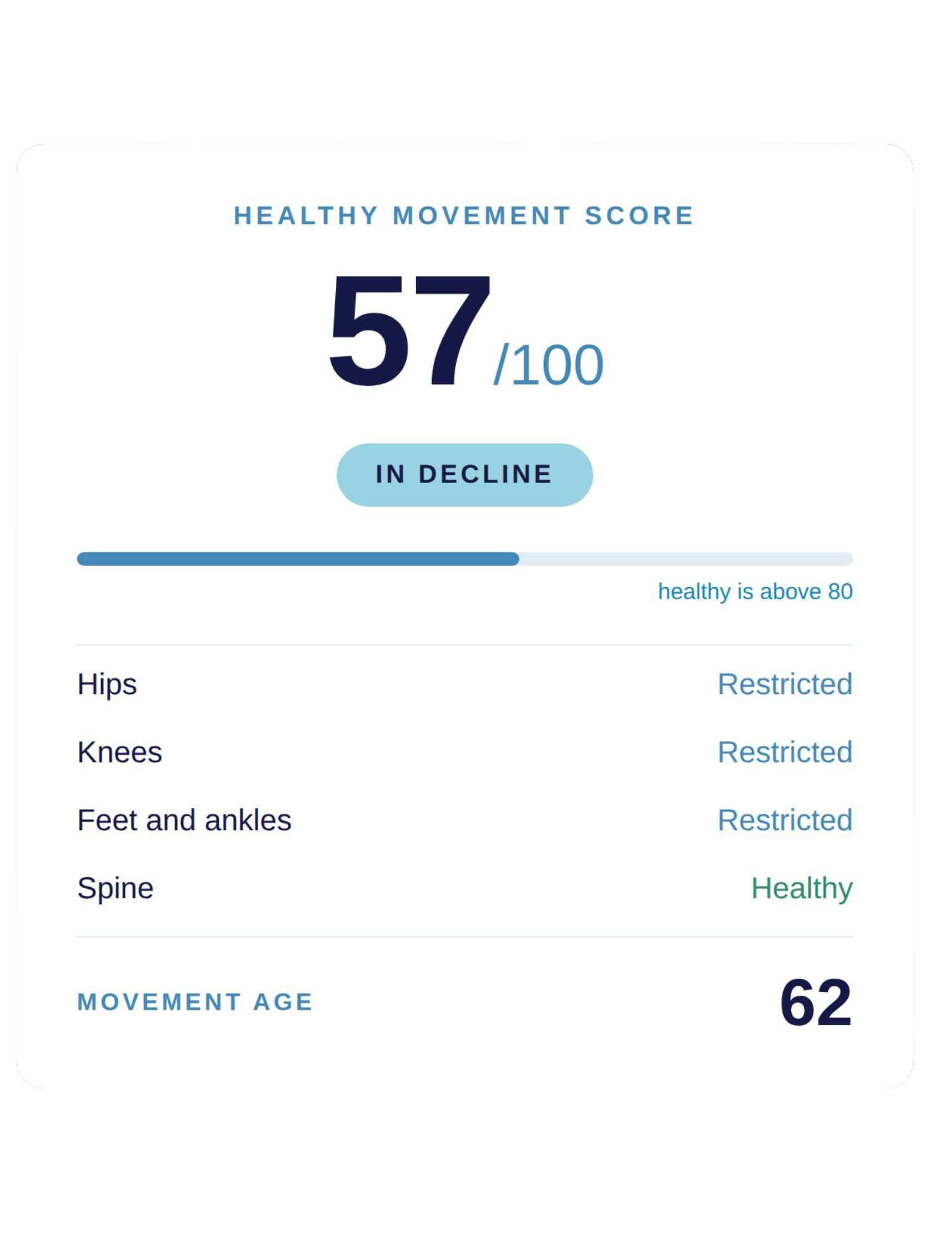
If relief is the wrong thing to measure then what is the right thing. The answer is to measure what the pill cannot change. How your joints actually move and which muscles have switched off. That is what a movement score is for. A Healthy Movement Score and a Movement Age look at how your joints move and load and put a number on it. That number lets you track your tightness at its source instead of by how you feel.
Take a muscle relaxer and your number does not move because the drug changes the feeling not the system. Free the joint and wake the deep muscle and the number climbs. That is the difference between tracking relief and tracking the truth. Once you have a number you can stop guessing about whether anything you are doing is working and start seeing it.
The bottom line
If you take a muscle relaxer know exactly what you are getting. A quieter messenger for a little while. Not an answer. There is nothing wrong with wanting relief and these decisions belong with you and your prescriber. This is simply the clear picture so you can think about your own body with better information than the bottle gives you.
If you have been chasing relief for years and still do not know how well your body actually moves then you have been guessing. There is a better way to find out. You can learn where your movement truly stands with an Unlock Healthy Joint Mobility session where your joints are tested and you receive your Healthy Movement Score and your Movement Age.
Movement health, measured
Every joint, tested by hand, in a single visit. Baseline once, retest as you go.
Healthy Movement Score Whole body
Movement Age Against your years
Your Blueprint Your plan
In studio at Beckett Ridge, West Chester OH
Not near West Chester. Start with the virtual Healthy Joint Mobility intro and get your Mobility Health Score for one area.