Your hips lock up and you blame age. You blame sitting. You blame your hormones.
But it is more complex that this: In the show I break all of this down so that you better understand what happens in your hip in midlife and what you can do to protect your movement health.
A locked up hip is not a muscle problem. It is a joint problem. And no amount of stretching will unlock a joint that has shut down.
In this episode Kim breaks down why hips lock up for women in their 50s and beyond.
You will learn what is really happening inside the joint.
You will learn why your hip flexors stay tight no matter how much you stretch them.
You will learn how sitting and stress and dropping estrogen and old injuries all stack up until one day your body says it cannot move for you anymore.
This is not about pain. It is about the quiet decline that starts in your 20s and shows up in your 50s. The Silent Shutdown Cycle.
The good news. You can catch it. You can change it. And it starts with knowing your number.
Ready to find out why your hips feel tight and stiff?
Transcript
Kim (00:00.088)
Ladies, if you are in your 50s or post-menopause or you’re in your lady late later 50s, then listen up. This is all about hips. This show is about how your hips lock up and what is happening so that you can understand what to do about it. And guys, about 50% of the people that come and walk through my studio here in Beckett Ridge, they all have one large thing in common. Their hips are not moving the way they used to. And they mostly don’t say I’m in pain. They just say my body’s not moving like it used to, or they feel like their body is falling apart, or that their hips locked up. Now this can happen from just sitting in a chair
You know, getting out of the car, you may feel pressure and physically can’t move. And this is something that needs to be addressed because if you don’t address it, then guys, there are things happening in your body that actually lead you down a path towards arthritis. Now, this lock-up, it is not a muscle problem. And no amount of stretching is going to loosen the muscle enough to unlock a joint that has been locked.
Down, okay. A muscle is just the side effect or symptom of what is going on. Now, a locked up hip is not a muscle problem, it is a joint capsule problem. And most of us have been getting signals for years from our body that something is going on in our hips, but we didn’t we didn’t know what to do. So I want to break this down so that you can understand what has happened to cause your hip to lock up or lock down.
Now the hip is a ball and socket joint, and the ball is actually at the top of your thigh bone, and the socket is the cup that’s in the inside of the pelvis. And around the bone is a thick capsule. And then there’s also some ligaments that wrap around that. And the front of the capsule is significantly stronger and stiffer than the back of the capsule.
Kim (02:06.284)
And that matters because the front of your hip capsule is the part that tightens when you sit too long, or with driving, or with desk work, or another cause is aging. Now, around the capsule is a layer of deep muscles, and these deep muscles are supposed to support what the capsule does for you. Okay. And then above that are your hip flexors.
Okay. And then you have larger muscles, and you know most of those. Those are your glutes, your quads, and your hamstrings. A healthy hip uses all of these in a certain sequence. Okay. The joint and the muscles, both the deep stabilizers and your larger muscles, fire in a certain order and do certain things for your body. And I call this the movement system.
Your capsule allows for a motion to happen without compensation. Now, compensation is where the problem is, and compensation occurs when your movement system is no longer working to do what you need it to do so that you can move freely. And that’s because your movement system is in control how you move and it predicts whether.
you are going to have a joint that is restricted or a joint that can move well. This is not an aging thing. It does happen around mid-age, no doubt, but aging is not the primary reason, reason why your hips actually lock up.
The hip locks up inside the joint where the bone goes into the pelvis, okay? And the most common cause is your front hip capsule, that tightness. That’s called the in medical terms, it’s the anterior hip capsule. It gets tight. Research shows that things like sitting, inactivity,
Kim (04:06.998)
Tightens the front of that hip joint capsule and then it shortens the hip flexors. Now the shortening of the hip flexors are secondary to the hip capsule shortening and restriction. Okay. So that hip flexor that you’re loosening, that you’re strengthening, you need to understand that that joint capsule in the front part is actually restricting. And this is causing the nervous system to actually steal more.
of your hip joint mobility because it’s trying to stabilize things for you. Now what you’re gonna feel is a pinch or that you just can’t lift your leg up and maybe cross it over the other leg. Or maybe when you go to put on your shoes, you might be avoiding putting them on in a standing position because when you do that, you you’re wobbly or you need to hold on to a wall.
Guys, what I want you to take away from this is this is not muscle tightness. It is a joint capsule limiting how the ball inside the socket moves. And in most in medical terms, this is called a restriction. Now here’s what other things are actually happening too. Your hip flexors are shortening because they’re in a holding position because the actual joint capsule doesn’t have the mobility that it’s supposed to have. So now it’s sending a message to shorten those muscles. Those hip flexors are shortening for a reason, and that is a protective response. These hip flexors are typically blamed on sitting and pulling the pelvis into an anterior pelvic tilt. And this is true. But that is the symptom portion of what is really going on. And if you just address that hip flexor tightness, you’re not you’re not addressing the root cause. Now the deep stabilizers around the joint are not getting recruited anymore. In fact, your nervous system has stopped fully recruiting them.
Kim (06:09.698)
Your larger muscles around the joint are also not working effectively because the nervous system has actually told them to tighten up and limit your joint mobility and stabilize the joint because now the joint capsule is no longer elastic and allowing for the bone to glide in there smoothly. And when it doesn’t glide in there smoothly and the deep muscles are not recruited, then other parts of the capsule become more restricted. This is the back part of the capsule, and those ligaments that are back there become restricted. And this is coming from a high higher entity. It’s coming from your nervous system. And what you’re gonna feel is a catch. You’re gonna feel that your hips are stiff, that they’re limited, that they’re not moving like
They’re supposed to. Now, that posterior capsule tightness, when it does start happening, it’s going to limit your internal rotation. And that’s where your knee turns inward. Okay. And this process is going to steal more of your joint mobility. And in midlife, you’re going to lose a lot more internal rotation. And when I test that through my mobility help scores, I can tell when you’re losing that mobility more and when you’re in accelerated decline. You are not gonna see it. You’re gonna think maybe it’s your hormones and or you’re you’re not eating good, or maybe it’s because of increased inflammation. All of those things play a role, but the joint capsule restriction is always first. After that, everything is on.
Top of that. So let’s talk about what is driving all of this. Most people assume that a hip that is locked up and not moving is just because you sit too much. And guys, sitting is one of the reasons, but there are several other things that are working together. And almost none of you are going to get a hip locked up just from sitting. Okay. Sitting is a contributing factor. So don’t go out there and tell people that I’m saying that sitting is not a cause, but because it is
Kim (08:17.738)
A cause, okay, but it’s only one thing. There are many things that cascade the decline in this joint capsule. And let’s kind of walk through what the research tells us about what is actually driving this lock up in the hip. Now, driver one is prolonged sitting and repetitive prolonged sitting postures.
We’ve lost joint mobility and then that decline is silently taking from us. And guys, what you don’t understand is once you this process starts and it starts in our 20s for many of us, then your body’s gonna consistently steal more of your joint mobility. Joint mobility does not equal range of motion. So you need to understand the difference in that because when we talk about range of motion, we really go back to the symptom, which is the muscle. Now, when you sip.
When you sit, your hip is held in a flexion, which is a hip flexion position. And the front of the joint capsule shortens because it’s it it’s not asked to lengthen. Okay. And then the hip flexors stay in a shortened position. And this puts the glutes in a elongated position and then start shutting those off so they don’t fire. And they don’t fire because when you go to step on them, then your body doesn’t recruit that part of the joint mobility anymore. So glutes don’t even have a chance to fire.
The deep stabilizers around the joint capsule actually no longer work anymore because they’re not being asked to work because this joint capsule is shortened and it’s not recruiting those other things. And this is what I call the movement system, and that your movement system is in a state of decline. Now, the other drivers are age and connective tissue changes. Aging itself can change the structure of the connective tissue in your body. And this is well documented across decades of research. Collagen is the main structural protein in your joint capsule and your ligaments and your tendons. And as you age, the collagen in these tissues develop crosslink between fibers. And research has documented that these crosslinks increase the stiffness of the tissue and reduce its ability to absorb mechanical injury. There’s another product called elastin and this is the protein that allows tissues to return to their original shape after they’re stretched out. Elastin also develops cross lengths with age. So these this elastin and this drop in collagen actually cause your your joints to become more stiff.
Now there are other things that also keeps the connective tissue in a healthy state. And I’m not going to dive into all of those things. Just know that the effects of a decline have an effect on not only the joint, not only the muscle, but also your tendons and your ligaments. And just taking oral collagen isn’t going to reverse any of that. Now it is going to do the things that you want it to do, which is replace the collagen, but there is a decline that is happening that needs to be addressed. Now, another one of these drivers is hormonal changing changes, especially in women that are menopausal and postmenopausal. And estrogen has a direct effect on connective tissue health. And research has documented that estrogen receptors in cartilage and tendons and ligaments and in the joint capsule itself. Well it does three things for the joint. It helps maintain cartilage thickness, it supports collagen synthesis, and it reduces inflammation in joint tissues. And when estrogen drops during perimenopause and menopause, those three protective effects start to go into a decline or diminish. Now 50 to 60% of paramenopausal and postmenopausal women report muscle or joint pain. Guys, if you I say this all the time: if the hot flashes don’t wake you up, those aches and pains actually wake you up. And you can feel those aches and pains with driving and all of that. And menopause, of course, is a driver, okay? But it’s not the root and the only thing that is happening. The research community now uses the term menopausal arthralgia.
Kim (13:00.948)
And it’s for the cluster of joint symptoms that emerges during the menopause menopause transition. Now, I want you to understand that each of these things plays a role in your joint tightness, but not one thing is the only cause. And many of the things that you are already doing to improve collagen, to to get those estrogen receptors so that you can address what estrogen decline is doing, doesn’t address the real decline behind that leads towards arthritis degenerative conditions and actually stenosis. So I want you to understand that that decline goes on it whether or not you choose to do oral collagen or take supplements or increase the load in the gym or add in estrogen. Okay.
Now, let’s move on and talk about another driver that causes your joints to restrict. And that driver is chronic stress and elevated cortisol. And for those of us that are menopausal, that’s all we hear about is cortisol this and cortisol that. But it is true when you’re under chronic stress, your body produces elevated cortisol. And cortisol does several things to your connective tissue. Now, research has documented that chronic cortisol elevation contributes to collagen degradation in tendons and ligaments. And this is the structural integrity of the tissue. It actually weakens. It also affects your bone, it increases bone resorption and inhibits bone formation. And this is the mechanism behind stress-related bone density loss. And when we’re looking at you know these ages of menopause and postmenopause, chronic stress and elevated
Kim (15:07.47)
prop cortisol also produces muscle tension and it the muscle tension seems to not release and your body stays in what we call a guarding pattern. Now the muscles around your hip and your low back hold tension that they would normally let go of because of this chronic stress. And over time that tension reinforces compensation patterns. And there’s that word again I use compensation because I guys I want you to understand that you can’t move your body takes joint mobility away from you. There are other things that contribute to this, but that increase compensation. And research has also linked stress system dysfunction to chronic musculoskeletal pain. And musical mut multiple studies show that there is a dysregulation that is associated with chronic pain conditions as well. And the stress and the joint problem, well, they kind of feed each other. Now, if you’re a woman and you’re in your 40s or 50s and you’re under chronic life stress, this is producing a biochemical condition that actively works against joint health for you. This is why the hip lockup.
Happens and it’s not just about your sitting, it’s also about the cortisol load in your body and about this chronic stress. Now, another driver is deconditioning, and guys, deconditioning is sort of that term that is out there, and deconditioning is you you just you don’t move like you used to, okay? The joint and the muscle are in an accelerated decline when you are deconditioned. And this is also when you’re not exercising and when you’re not moving. And once you hit those menopausal years, and if you haven’t exercised before and now you have pain, well, you’re certainly not going to exercise because of the pain and the lack of joint mobility. Now, this deconditioning and disuse, your body responds to what you ask of it. And if you stop.
Kim (17:18.824)
Asking your hip to move through its full range of motion, then that range disappears, and you’re losing muscle and you’re losing joint function. Both of those work together. It’s not just a muscle problem, okay? And actually, it’s below that muscle problem. Now, disuse is different from sitting and the what happens from sitting. Deconditioning is the loss of muscle health that you have. And it’s the loss of muscle activation that supports the joint. It is a decline that is actually happening in your muscle that causes you to lose muscle mass. But guys, I want you to know muscle mass is more than just, you know, the mass inside your muscle. It’s also how your muscle functions, the contractile.
factors in the muscles and how much mass and contractile function that you have lost. Now research on disuse atrophy, now that’s when your muscles are have lost a lot of function and your muscles are getting smaller. And when you have that and connective tissue changes then your joints are going to lose joint mobility quicker. You’re going to feel more tightness during this time because of all of this. Now, modern life gives us many reasons to not use our joint mobility. We, when we feel like we stiff, we’re probably not going to do the things that make us go into.
That lost motion because if we do, we’re fearful that we’re gonna have pain. So for us, when we’re in our mid-ages, our hip, you’re gonna notice shorter steps, you’re gonna notice bending over your more limited, you don’t jump off of surfaces, you don’t jump on surfaces, you might have some knee,
Kim (19:31.446)
kind of tightness when you go to get down to the floor. So you stop doing that too. And and most of us just say, hey, I’m not going to get down there anymore. Or maybe you don’t say you’re not going to get down there. You just avoid it. So you buy shoes that you can slip your feet in, or you avoid getting down on the floor. And then one day you get down on the floor and you can’t sit on the floor and it is uncomfortable. And deconditioning is different than just being out of shape. Okay.
You can be in great cardiovascular shape and have deeply deconditioned movement patterns and muscle atrophy. Now, another driver of this joint health and muscle health is past injuries and surgeries that were never fully.
I don’t want to say they were never fully rehabbed because you rehabbed them. You did your exercises, but no one addressed the joint underneath or the muscle decline that happened from that. And you’re left with compensation patterns that haven’t allowed you to move, but the movement that you’re supposed to use, you’re not actually using that movement because your body has taken it away. Okay. So that ankle sprain that happened 20 years ago, it creates a compensation pattern. It also has a cascade effect on the joint and the muscle. And then you’re gonna have symptoms from that loss later. And it’s going to get worse because if you have that ankle sprain when you’re, you know, eight or nine years old.
You’re going to start having a joint restriction in that area earlier. And then we’ve seen those joint restrictions lead to knee pain earlier and hip problems earlier. So your compensation patterns are there to allow you to move, and we’re thankful for that. But your ankle is still restricted, and the hip has been making up for the ankle because you sprained it so many years ago.
Kim (21:33.27)
Now, when you get all of these things that stack up together, and then you’re a 52, 53-year-old midlife woman who sits at a desk all day long, whose estrogen has been dropping for five years and you’re under chronic stress, you’re raising your kids, your aging parents, you haven’t done any deep squats or sat on the floor for maybe 15 years, you sprained your ankles a lot when you were younger, and you never really rehabilitate it. When these
All of these things stacked up on top of each other and your joint has lost mobility, your joint capsule is tight, you have all of these things going on, your body is going to hip lock that hip up and it’s going to lock it up so that you don’t move it and it’s going to pull it from the back. And if your back can no longer take that stress at L4, L5, then your system is going to shut things down.
And it’s gonna lock your hip up. So when your hip locks up, it’s actually a lot of things together contributing to the final day that your body says, I can’t do it anymore. And it’s kind of like for all of you ladies that have had children, and you know when the kids are young and you’re stressed out and you’ve told your kids every day for the past year to clean their room.
And then you walk in one day and you have just completely had it and you blow up because they haven’t cleaned their room. It isn’t the fact that they haven’t cleaned their room that you blew up. It was that you couldn’t take it anymore because everything else was piling up on you.
Your body does the same thing when you lose joint mobility. You go into a decline. When you lose estrogen, that affects the joints, the tendons, the ligaments. In this whole process, you’re losing collagen, elastin. your muscle tenses up more because of these things. Your chronic stress doesn’t change, your poor eating habits don’t change, you become deconditioned, that means your muscle.
Kim (23:51.864)
Are in a deconditioned state, your joints are in a decline for over time, and you get up one day to move and your body goes, I can’t move for you anymore. That is the compensation that has been going on for years, and now your body can no longer compensate for you, but
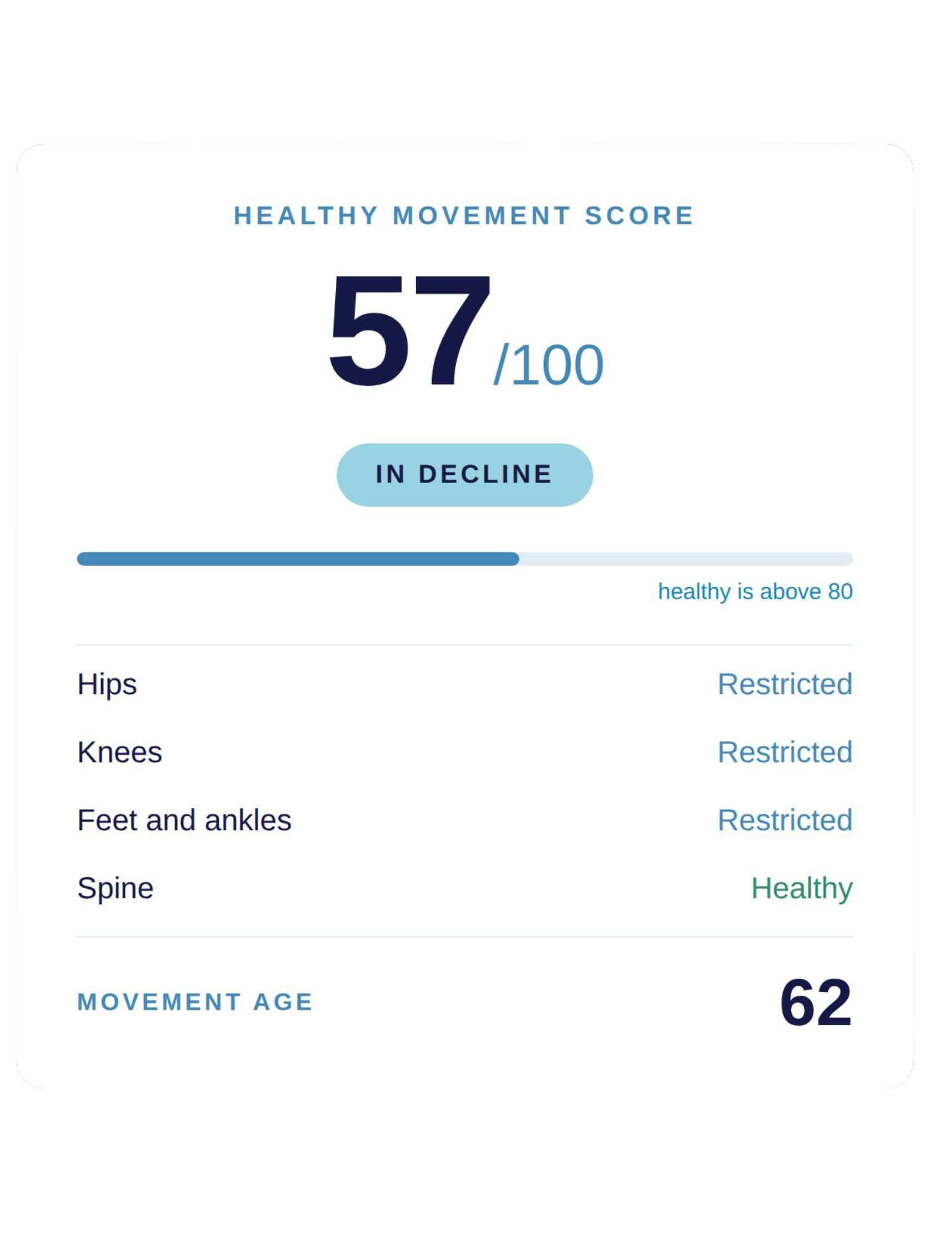
The good news is you can make small changes to be able to improve your joint mobility and address these things that have been cycling over years. And you can get results fast. But where you need to start is getting your movement health score. You need to know how much joint mobility you have, how much compensation is happening when you do movements. You need to be aware of where the movement is coming from, where it’s not coming from, the stress it is placing on your system. And then above all, that you need to learn what you need to do to be able to keep your deep muscles, your larger muscles, your nervous system, and your movement system.
Healthy. And that’s my lane. And you can do that and start with an unlock healthy joint mobility session. And in this session, I’m going to actually test your joints. I’m going to give you a mobility help score, and you’re probably not going to like it. It has nothing to do with how healthy or unhealthy you are. It’s just that your movement system has a score too, and you need to know it. Then I’m going to give you a movement age, and it’s probably going to be a lot older.
Than what you are right now. But guys, this gives us a baseline, helps us understand what we need to do, how to address things, how to unlock that hip so it doesn’t lock back again. And if you do these things and follow the healthy movement system, you can actually avoid that typical trajectory that ends up with arthritis that then moves further on.
Kim (25:42.786)
That puts you on a table for a hip replacement. So if you are a female and you are in your mid-50s and you’re in this mid-life time, and you want to better get control over your movement system and you don’t want your hip to lock up. You don’t want to grow that arthritis that then develops into a problem down the road that is going to cause you to have a hip replacement.
Then let’s get on a phone call. Let’s actually come into the studio. Let me test your joint mobility. Let me tell you where you’re compensating and do some movement testing. And let me sit down with you and draw out a plan so that you can start moving better, like you did years ago, but even better. Guys, thanks for joining me today. I hope you found this show helpful.
If you did, please share it with other females that are struggling with this because we’re all struggling and not only with hot flasses and your typical hormonal things, but also this joint decline and muscle decline that is going to cause us problems in our 60s, 70s, and beyond. And those problems are problems we don’t want. That osteoporosis, that planar flex fac fasciis, that low back pain, our hip gets thrown out, that
All of those diagnoses, guys, are downstream of our joint mobility. And your body is stealing that joint mobility away. And it starts in our early 20s. So getting tested, understanding your score gives you the power back to be able to make the change that you need to make. So thanks for joining me today. Please share this out and please follow me on social media for more tips for those of us who are going through this stage of life called menopause and postmenopause.
See you next week, guys.
Movement health, measured
Every joint, tested by hand, in a single visit. Baseline once, retest as you go.
Healthy Movement Score Whole body
Movement Age Against your years
Your Blueprint Your plan
In studio at Beckett Ridge, West Chester OH
Not near West Chester. Start with the virtual Healthy Joint Mobility intro and get your Mobility Health Score for one area.