You lift heavy. You eat your protein. You follow the program. And the orthopedic surgeon just told you that you need a joint replacement. How did this happen? In this episode, I break down what strength training does for you. What it does not do. And the silent decline running underneath every workout that is loading uneven joints and building arthritis without you knowing it. Here is what you will learn. The real benefits of strength training and why everyone should be doing it twice a week. Why hypermobile adults and adults over 40 have a gap that nobody is testing for. The difference between hypertrophy training and movement system decline. And why building muscle on a body in decline reinforces the problem. The six-stage path your joints go through that leads to arthritis. Most athletes are already past stage three before they feel anything. The story of one of my trainers. He did everything right. He still ended up at the orthopedic surgeon with bone formation and an unstable shoulder. The signs every athlete should watch for. Morning stiffness. One side feels different. A plateau you cannot break through. A joint that catches under load. Why is tightness after a workout not the same as a hard workout? It is a warning signal. And ignoring it is what builds the surgery. How is this reversible when caught early? And what to do about it. If you are a lifter and your body has started telling you something is off. This episode is for you. Share it with the athlete in your life who is hitting plateaus and blaming it on age. It is not age. It is the Silent Shutdown Cycle.
Transcript
Kim (00:01.08) Hey guys, welcome back to the Stretch Mobility Coaching Show. And today I want to break down strength training and the benefits, what is lacking, so that you have the tools to create a workout that doesn’t lead you down a direct path to surgery unexpectedly. And I’m bringing this podcast or this show to you today because, you know, many of my athletes that really are big weightlifters have found arthritis growth and are now facing a surgery that they really expected with what they were doing and following industry standards that they wouldn’t have to do. And so I want to talk about strength training, strength and conditions, the benefits, what you’re gonna get, what is missing, what you need to add to your routine, and how you can keep yourself off that surgical table. Now I’m talking about chronic problems, not acute. Okay. Surgeries, acute, all of those things, you know, that is not my wheel. My wheelhouse is musculoskeletal, way upstream of any chronic condition. So let’s start the show today with strength and conditioning. I want to talk about the benefits. So strength training is associated with lower risk of death.
From cardiovascular disease, cancer, and all causes in adults. Resistance training improves bone mineral density, lipoprotein profile, glycemic control, body composition, frailty markers, metabolic syndrome risk, and cardiovascular markers. Now, restrength strength training or resistance training can prevent BMD loss of 1 to 3% per year compared to non-exercising adults. Now, two decades of age-associated strength loss can be regained in two months of resistance exercise. So a little bit goes a long way. Now, the World Health Organization and the US Department of Health recommend at least two muscle strengthening sessions per week for adults.
Kim (02:27.394)
Now let’s talk about this gap. And first, I want to bring into this gap someone who is double-jointed, or if you have some sort of hypermobility, that means your joints are unstable and they move a lot further than what the healthcare industry’s standard is as normal. So in the population of over 40, the gap for hyper mobile adults is that your muscle mass decreases approximately three to eight percent per decade after age 30. And that rate, guys, increases after age 60 more. Strength is lost two to five times faster than muscle mass. Strength loss is more consistent risk for disability and death than the muscle mass is Muscle strength declines between 16.6 and 40.9% in adults over 40 compared to those adults under 40. Now, when we talk about hypermobility or double-jointed joints or very mobile joints, this is a spectrum disorder and it is associated with the higher risk of developing osteoarthritis at a younger age in certain joints.
Now, hypermobile or hypermobility, these individuals can experience increased joint instability as they age, which can also lead to more frequent things like pain or chronic pain. Now let’s talk about hypertrophy. And then I want to relate hypertrophy to a new term, which is movement system decline, which is what area I work in, which is the movement system and a healthy movement system is what our goal is. So hypertrophy training addresses muscle fiber size, and the movement system decline requires joint capsule mobility, the bone, how it glides inside the joint capsule. Hypertrophy training addresses force production when the movement center system decline requires deep stabilizers to activate.
Kim (04:51.544) To protect the joint. Hypertrophy training addresses work capacity. Movement system decline requires nervous system inhibition to be stopped. You’ve got to stop that cascade of muscles being turned off. Hypertrophy training addresses muscle protein synthesis, and movement system decline requires mechanoreceptor signaling to be restored and that where it’s lost in the joint capsule.
Hypertrophy training builds larger movement muscles, and that is your larger muscles like your quads, your biceps, your triceps, your hamstrings, your glutes. The movement system decline requires deeper, smaller muscles to be trained and connected. And it the movement system, we don’t allow any form of compensation because compensation is where we see that the problem is. Hypertrophy chaining increases what you can lift, and movement system decline determines how your joints move under load. So here’s a connection that you want to know. Standard rehabilitation often fails to resolve the arthritic muscle inhibition on its own in a chronic pain client. And a multidimensional framework is what they are recommending in science.
They also say that strength training alone is insufficient to resolve the neuromuscular shutdown caused by joint capsule restriction. Now let’s talk about this decline. Let’s talk about these deep stabilizers a little bit. There is a path that our joints go through when they’re in decline. And this is what leads most people to a surgery that they could have avoided. So I want you to really take notes on this.
Stage one.
Your joint capsule tightens and restricts around the bone. And when it does that, it has to take movement from other places in the body because that restriction is not going to allow the bone to go any further. Your mechanoreceptors send altered signals because they’re no longer being they’re no longer able to respond because they’re on the outside of.
Kim (07:16.748)
The joint capsule where the bone is gliding, you’ve lost that mobility because of the restriction. Stage two, your nervous system inhibits the deep stabilizing muscles that are supposed to support the joint. This is orthogenic muscle inhibition. And I have coined the phrase the silent shutdown cycle that is explaining more in a better non-medical way of what is happening in your body.
Inhibition is actually your body protecting you but turning off things. And and when it turns off things, I’m talking about it turns off your muscles, the muscles that support the joints, and everything goes into a decline. Now, once those things have gone gone and been adapted, then your larger movement muscles start to start to hold and they’re in a holding pattern. And they’re supposed to move the joint, but they’re told to tighten and hold to protect the joint. And the body is doing this so that you can feel that tightness and you will do something about it. Okay. But when this happens, because we use pain as an indicator of hey, we don’t have a problem until we have pain, then now that pain is typically that we’ve put it off so long that this tightness has gone on for so long. Now the body has to take things into its own hands.
We’re going to talk about this a little bit in these other stages. But when your larger muscles start to hold the joint and not move it, you not only lose joint mobility, you also lose range of motion in that area, and you start to compensate. Okay. So this is when you start seeing movement patterns and loss of symmetry. Now, stage four, you have compensated loading, and this creates uneven joint stress. And then this is where cartilage degradation begins. Now guys, when you’re this is the part I want you to understand this compensated loading that creates uneven joint stress. When you’re going into that squat, you’re going into the deadlift, you’re going into that push pull or you’re actually doing pull-ups or you’re actually doing overhead presses.
Kim (09:42.561) These loading when you add more strength and more weight to load these joints, it becomes uneven because the joints are in a state of decline. Okay, because the muscle has been inhibited, it no longer protects the joint. The nervous system has to protect that joint, and it does that through a restriction. That restriction blocks the movement of the bone, so your body has to pull the movement from somewhere else. So if your hips aren’t moving, it pulls it from your back. If your feet and ankles aren’t moving, it pulls it from your knees. If your thoracic spine is not moving, it’s going to pull it from your shoulders. If your shoulders are not doing what they’re supposed to, it’s going to pull it from your elbow. So I want you to kind of understand this compensated loading creates uneven joint stress. And you are placing more power and load on this, but you’re not going to feel this you’re not going to feel that you have an uneven joint stress, okay? Now, stage five, because you have lost that joint mobility, because the muscles are inhibited, because the joint has been in decline for a while, you lose centration. And this is in the shoulder and the hip, especially, but you lose.
Centration of that joint. So it’s sort of the joint capsule is sort of overstretched. It’s no longer working to protect to keep the bone in in the centered position. And when this happens over time, this pulling away, this is what they’re talking about when there’s uneven load. Your bone is now here. You’re putting load on a bone. So this space in between here that we’re talking about.
The body has to take things into its own hand. And here is when they it starts building osteophytes. Now, osteophyte formation is is bone spurring and it’s subchondral sclerosis. And this is where you get joint capsule hypertrophy. Now in stage six, so so let me go back to stage five.
Kim (12:06.914)
This is arthritis. Okay. These medical terms, this is arthritis. This means your body is building bone to protect you because you’ve not done anything about the tightness and your loss of mobility. You are now working on active things like active joint mobility. And that active joint mobility is compensating and coming from somewhere besides the joint that it’s supposed to. And because you don’t address that decline, you don’t get resolution of the deep stabilizers or the joint. Now, stage six, this last stage, this is when you can see all of it on an x-ray and it becomes detectable. So I hope you see a clear pathway there. You’re going to go into a silent decline. You’re going to be un you’re going to be completely unaware of. Okay. You’re going to the first body’s the body’s first response is to restrict the joint.
And how the bone glides inside the capsule. Then it’s going to inhibit the small muscles that protect that capsule. This is what I’m talking about: that the body goes into a defense and does things for you. And what it does is shuts things off. Okay. Shuts off the joint and locks it down. Shuts off the muscle and you lose muscle function and muscle mass. The third tier is that it sends you a response of tightness.
And we’re going talk about that tightness in just a little bit, but it sends you a response. But because that response is not pain, you don’t act, you stretch. And then after that, your body then is faced with hey, you’re going to load it. So in order to take that load, that extra weight that you’re piling on there to build hypertrophy, the body has to take things into its own hands and it has to build bone. And this bone is the arthritis that we’re finding.
on the x-rays that you know lean to that tear our rotator cuffs that tear our labrums that virtually cause our joint capsules to loosen so much and lose you know the elasticity and the and the stability that you know you’ve got the joint capsule the bones kind of down here and now there’s nothing else you can do you’ve got bony growth in here
Kim (14:30.04) You know, in between the bone and the other bone. Okay, bone grows on bone, bone on bone. You’ve heard that before. And then you’ve got your capsule that’s weakened here and in a state of decline. And then, of course, your muscles aren’t working. And the only thing holding you in place is the fact that you do strength training. And I am glad you’re doing it, but I just want you to know what is missing here. So when we’re talking about overloading that uneven joint.
Mechanical disruption of joint tissues from accumulated external forces is the primary risk factor for osteoarthritis. So this is something, guys, you’re not addressing joint decline if you’re just strength training and just stretching. Now, clients with knee osteoarthritis show measurable lower limb compensation patterns during walking, and this increases their fall risk. When we’re talking about the shoulder the anterior shoulder joint capsule. There’s a contracture that has been associated with reduced joint rotation and is implicated in the progression of glenohumoral osteoarthritis. You’ve got increased thickening of the anterior shoulder joint capsule, and it is associated with greater posterior glenoid wear and humoral head subluxation. Now let’s talk about the nervous system.
Protective mechanism that I talked about. This is the pathway to arthritis, okay? The joint capsule restriction triggers altered mechanoreceptor signaling. The spinal cord responds by inhibiting motor neurons of the deep stabilizing muscles. You develop compensation patterns because the larger muscles can’t take on the stability role and the moving role.
Uneven joint loading begins and then cartilage stress increases. So subchondrial bone remodeling occurs earlier than the cartilage destruction and early osteoarthritis. And the articular cartilage degradation, osteophyte formation, synovial hyperplasia, and capsule hypertrophy follows all of this. So let’s talk about the role in
Kim (16:53.422)
Proactive care upstream of all of this. You’re working out, you’re doing the standard loading, you know, increasing your weights, your frequency, all of those things have very great benefits. But what I want you to be aware of is if you don’t know the health of your joints and if they’re in a decline, then you’re placing yourself at risk for arthritis in those joints, and you’re not going to feel it until the last minute. And I actually have a trainer that works in my studio that
He had pain just show up out of the blue and he’s never had pain. And it was in his shoulder and he couldn’t get it to go away. And he didn’t think about asking me. So he went to the orthopedic surgeon. And by then he had all of the bone formation. And he also, when he had an x-ray with his arm out this way, you could see how the joint capsule had lost stability. So the bone bone was hanging here.
And it was far away from the actual fossa that the head of the humerus is supposed to go into. The bone was more down lower and no longer centered in there. And then he had arthritis growth that was pretty severe in this area, but it wasn’t enough that the bone there there wasn’t a problem. So his pain was from an instability in there, even though he had long larger muscles that were supporting him.
And he, you know, he eats his protein and everything. So he thought he was doing everything right. So let’s talk about proactive care, reversibility, and what you can do to protect yourself from arthritis if you are an athlete and you’re working out in the gym. Just to make sure you have everything that you need. Older adults and younger adults can rebuild muscle mass and strength loss due to aging, and they do it through resistance training.
Two decade two decades of strength loss can be regained in approximately two months. Guys, little steps, okay. Arthrogenic muscle inhibition can be addressed with targeted joint capsule assistance so that you stretch that joint capsule out, but you’ve got to immediately follow it by other forms of activation so that you get that deep stabilizer to activate again. And there’s a process that you have to go through to get all of this, and it’s all of this taken care of, but
Kim (19:16.18) It takes time, but it is doable, and it’s just the small little steps that you have to take to make sure your joints are healthy. Capsular restrictions can be addressed through targeted mobilization, and it can also be addressed with a stretch mobility coach. We use a much more gentle targeted approach. we don’t use any mobilization, but you can go to a PT and do mobilization, but they need to understand this artrogenic muscle inhibition, and they need to be able to understand the science behind that to get the actual reversal. It does show that the earlier that you do this, the better your outcomes, and the longer the joint is in a restricted state, the more embedded the shutdown becomes in the nervous system. Now, here are some signs that you should watch for, okay?
Tightness in the same area after a workout indicates your joint capsule is restricted. This is not a muscle workload. It is actually a joint inhibition. Your artrogenic muscle inhibition has started here. Okay. Tightness means that your nervous system is clenching down on that bone. Morning stiffness that takes longer to loosen indicates an active compensation cycle. So that
Kind of gives you the idea that you’re in silent decline. If you have one side feeling different than the other one, it may indicate asymmetric capsule restriction and asymmetric stabilizer recruitment. If you get strength plateaus despite consistent training, this could indicate that you’re in silent shutdown.
A joint that catches or it pinches or it clicks underload. This usually indicates altered ortho kinematics from the capsular restriction. And your stretching and your strengthening along is not going to get rid of that restriction. Reduced end range in a once mobile joint can indicate capsule fibrosis or restriction. Recovery time getting longer may indicate that your nervous system is working.
Hard to protect you and it’s not letting go. And you need to work on the movement system to get that protection to let go. You may have a fear of certain movements, and that fear creeping in can indicate the body sensing an instability, and this would happen before any pain shows up. Now, tightness after a workout when you’re strength training.
Or you’re doing cardiovascular training, it’s not the same as you just had a hard workout. So let’s get that no pain, no gain concept out of your mind. Tightness after a workout is not the same as a hard workout that you did good. Okay. Tightness is your signal. It means your joint capsule is restricted and it does not mean the workout was effective. Tightness also means that your deep stabilizers are inhibited. Your body is shutting down the muscles actively and it’s causing compensation. So you may be able to do those lifts. You may plateau with the number of reps. You may plateau with how much load you can put on it, but you’re doing that because the body is using other muscles and other joints for that action to happen. And that compensation is the problem.
Tightness means the nervous system is guarding. So tightness is that indicator that it should immediately tell you, hey, I need to get my joints checked and I need to open up space in these joints. I need to stop this silent decline because this is what’s going to progress and lead towards arthritis. Tightness means tightness means the silent shutdown cycle is active, and it does not mean the body is adapting in a positive way. And delayed onset muscle soreness is a separate phenomenon from chronic tightness. Domes resolves in 24 to 72 hours, where a chronic tightness that doesn’t go away and you feel it every day, that’s your nervous system having to work harder than it needs to, and it’s not going to do it forever. persistent tightness in the same region across across multiple workouts will indicate a joint capsule or a stabilizer issue. This is not due to a training stimuli.
Kim (23:46.466) Stretching alone does not meaningfully meaningfully enhance exercise recovery, according to a 2025 Delphi consensus of 20 international stretching researchers. So when we’re looking at strength training, there are many gains that you get. And even little amounts of strength training twice a week are going to be beneficial for bone health, cardiovascular health, and a healthy body. But when we’re talking about the silent shutdown cycle, we’re talking about tightness.
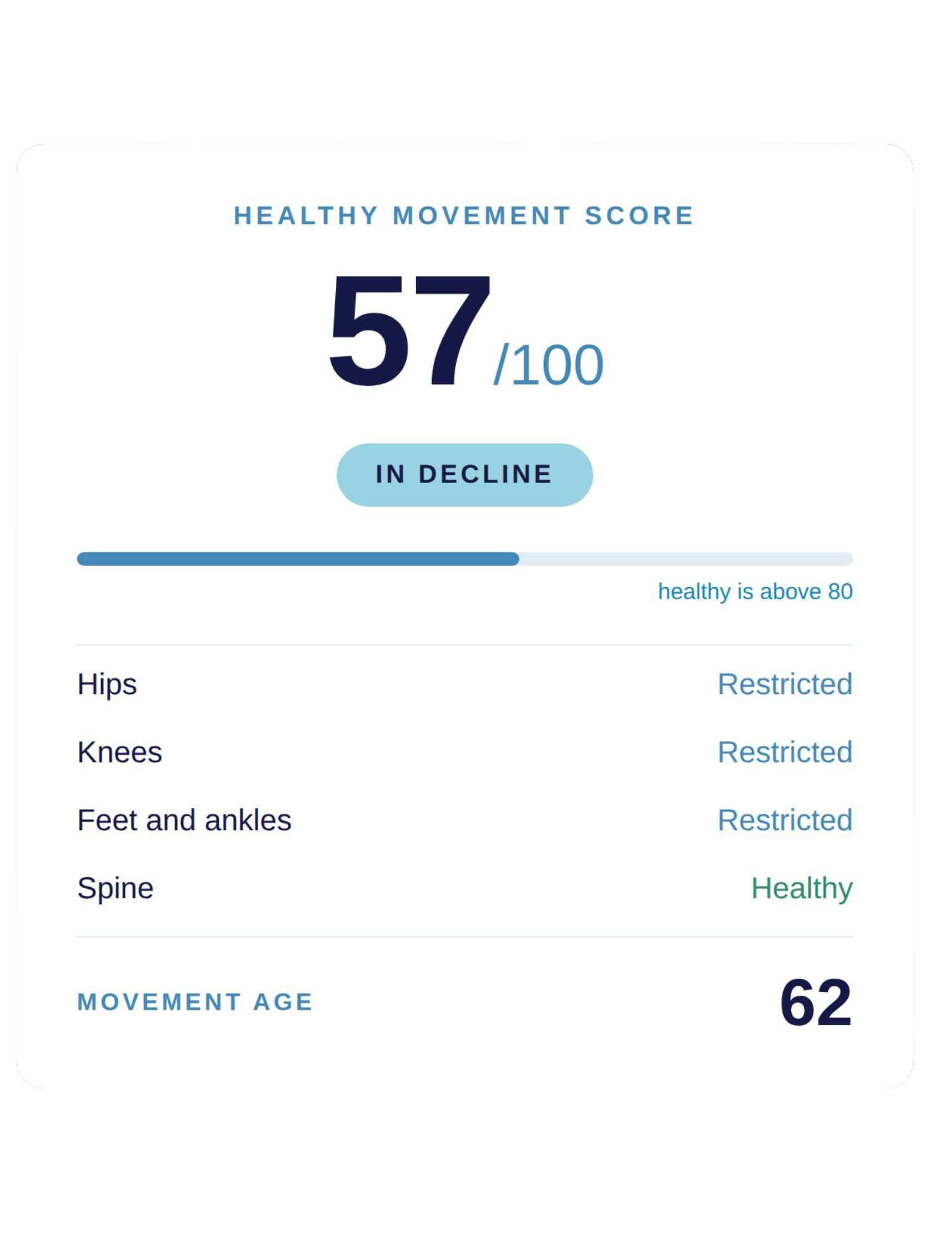
Tightness is the side effect of a system that is in decline. And you can address that system by getting your movement help score, actually your healthy movement score. You can also address that by building a program that’s going to address the movement system so that you can control how well you move and you’re not loading unevenly. And when you do this, then you’re setting yourself up to be able to build the strength and hypertrophy that you’re looking to build. So guys, I hope you found this information helpful. If you’ve got somebody who is an active strength trainer and they’re sort of hitting that plateau, they can’t do a pull up, they can’t do something as much as they used to, don’t let them blame it on age. Make sure you share this episode with them and let them know that there is something that is going on that can be reversed, preserved, and help their movement system to stay healthy throughout their lifespan. So share this out. Thanks again for for joining me today, and I hope this information was helpful. Thanks so much, and I’ll see you next week.
Movement health, measured
Every joint, tested by hand, in a single visit. Baseline once, retest as you go.
Healthy Movement Score Whole body
Movement Age Against your years
Your Blueprint Your plan
In studio at Beckett Ridge, West Chester OH
Not near West Chester. Start with the virtual Healthy Joint Mobility intro and get your Mobility Health Score for one area.