I share real stories, break down the patterns keeping us stuck in guilt and overgiving, and explain what’s actually happening in your body when you start to feel stiff, tired, and out of control. This isn’t about blame; it’s about awareness and taking your life back.
I’ll also walk you through a simple exercise to help you get clear on where your time is going and how to start making space for yourself again.
You deserve to feel strong, in control, and like you again. This is where that starts.
Hello, everyone. Welcome to the Stretch Mobility Coaching Podcast. I am Kim Nartker, and I am the founder of the Stretch Mobility Coach and the creator of the Stretch Method.
This podcast is about one thing, the science of healthy movement and why your body is not moving the way that it should. Every episode, I’m going to dig into the research on joint mobility and muscle health. I’m going to talk about what is really happening inside your body when you feel tight, stiff, and sore.
And I’m going to give you the truth about what it takes to move well for the rest of your life, every day of your life, and to feel amazing when you do. Let’s dive in, shall we? Hey guys, welcome back to the Stretch Mobility Coaching Show.
And I’m Kim Nartker, and I am so glad that you’re here today because today’s episode is one that has been sitting on my heart for a long time. It’s one for our mothers, okay? And those mothers are us, all of us females that are 50 to 60 years old.
I am talking about us. I’m talking about self-sacrifice, love, caring, generosity. We all give every day of our lives, and we never shut that down.
And now, we’re in our 50s, and our world feels very different than it used to when our kids were smaller. This happened to our mothers, and it is now happening to us. And this show today is about taking away guilt and shame, gaining control of what we have all worked so hard for.
So today, we talk about mothers. And not just any mothers, I am talking about all of us in our 50s and our 60s, all of us who have spent decades pouring everything that we have into everyone around us, our kids, our husbands, our grandkids, our parents, our jobs, our homes. And somewhere in all of that giving, we looked up one day and realized that we had nothing left in the cup for ourselves.
And if that is you, I want you to know something before we get started. You are not alone. I am in the same boat that you are in.
And today though, we are going to talk about where we are, where we thought we would be at this point in our lives and where we want to be. Then we’re going to do the work to start the work we should have started years ago. We’re going to learn to fill our tanks without feeling selfish or guilty.
And it is my hope that this show today, that all of us moms that are in this boat today, turn this boat around to start giving to ourselves unselfishly. And it’s my hope that we can help our children see how much we love and care for them and how proud we are of who they are and what they’ve become and where they are headed. It would also be great if our daughters and sons would learn the lessons we are learning right now so that they can avoid these lessons later in life, because really that’s the reason, right, that we give so much to everyone is because we don’t want them to feel hurt or alone.
So if any of you ladies are resonating, please let me know. So I, most of you don’t even know this, I was married at 18. I had no idea of the world and how things worked.
I knew I wanted something different than what my mom and dad had. But I was from a small town, from parents who had no degree, that they were in lower middle class struggling to raise three children. And I was told, you’re just a dreamer.
And I have to admit that I was. But what I have found in myself is that I am also a very hard worker. I’m dedicated, I’m genuine, and I am someone that makes things happen.
And I don’t give up on family, myself or my work. This show is not about me. It’s about my mother.
It’s about us mothers, and possibly about you. So, guys, it’s sort of like we’re looking at the vision we had of ourselves in our 50s and 60s, you know, when we were in our 20s and 30s. And of course we thought that we were old at 50.
And now we’re 50 or 60 and we don’t feel so old, but we do feel like we don’t have the same control because of the change in our lives. And I want you to think back to when you were in your 30s or maybe your late 20s. Maybe you had kids, maybe you were building something, you’re going to school, you were in college, maybe you chose a different route.
Maybe you chose to have a family or you married late in life. Maybe you were busy with life, a home and somewhere in the back of your mind, you had this image, that picture of what your 50s and beyond would look like. Maybe you imagined yourself fit and strong, doing whatever you want to do, feeling good in your body.
Maybe you imagine traveling with your husband or your girlfriends. Maybe you imagine hosting the holidays for all of your grandkids and your children, being that grandmother who is able to get down to the floor, play with her grandkids and get right back up, going to the lake, take a trip to Europe. Maybe that’s what you envisioned your 50s and 60s to be.
You worked for that vision and you worked freaking hard for that vision, and you believed in that vision of you. And now, here we are. And the mirror is telling a different story than the one you planned for.
I’m doing this podcast today because I’ve heard this in my studio. I’ve talked to many of the women that come in here over the years, and we have some pretty cool conversations, personal conversations, growth conversations. And these women that come through my door, they’re not just tight and sore.
They’re grieving, they’re sad, they’re grieving a version of themselves they thought they would be now. And on top of that grief, some of them, some of us are angry at ourselves for what we see and how we have let things go. And I want to stop this right here before you feel like this is a guilt trip or grieving or angry.
This is not what this is about, okay? I’m bringing some awareness, so stay here with me. If you’re feeling any of these things, then please just resonate with that.
I don’t feel like we’ve let ourselves go. We may have given ourselves away, and I think there’s a very big difference between those two things. And today, I want to talk about how we get back to where we thought we would be.
Let’s learn how to let go of the words. We know that we’ll hear when we stop over giving and over providing and really look at our moms, what they did in their past, and what our current situation looks like. And let’s start off with some of the stories.
And for the sake of my client’s privacy, these names are not correct, and I put a little sway in some of it too. So this first person, I’m gonna call her Dee. Dee came into my studio, she’s in her early 60s.
She is retired, and she’s finally at the place in her life where she can breathe. She has two grown independent children who travel and lead very busy lives. She wanted to take college classes since she retired, just to learn, just for her.
Can you imagine just learning for the sake and the joy of learning something you didn’t really get to take when you were in college or in school, but you have that opportunity now. And I think if you’re looking at that and you’re retired, and I’m not retired, but she is, that version of herself that she was stepping into, I think is a pretty cool place for us to be. You retired and you feel like you have this time and now, you can do some things that you enjoy.
Now, she came in to see me because of her left shoulder, her left hip, and her right groin were tight and bothering her. She wanted to be able to sit on the floor comfortably again, and that was her goal, okay? Something like that, I know for some people seems very simple, but if you haven’t experienced mobility deficits and you’re not able to get down to the floor and sit on the floor when you used to, it is pretty frustrating.
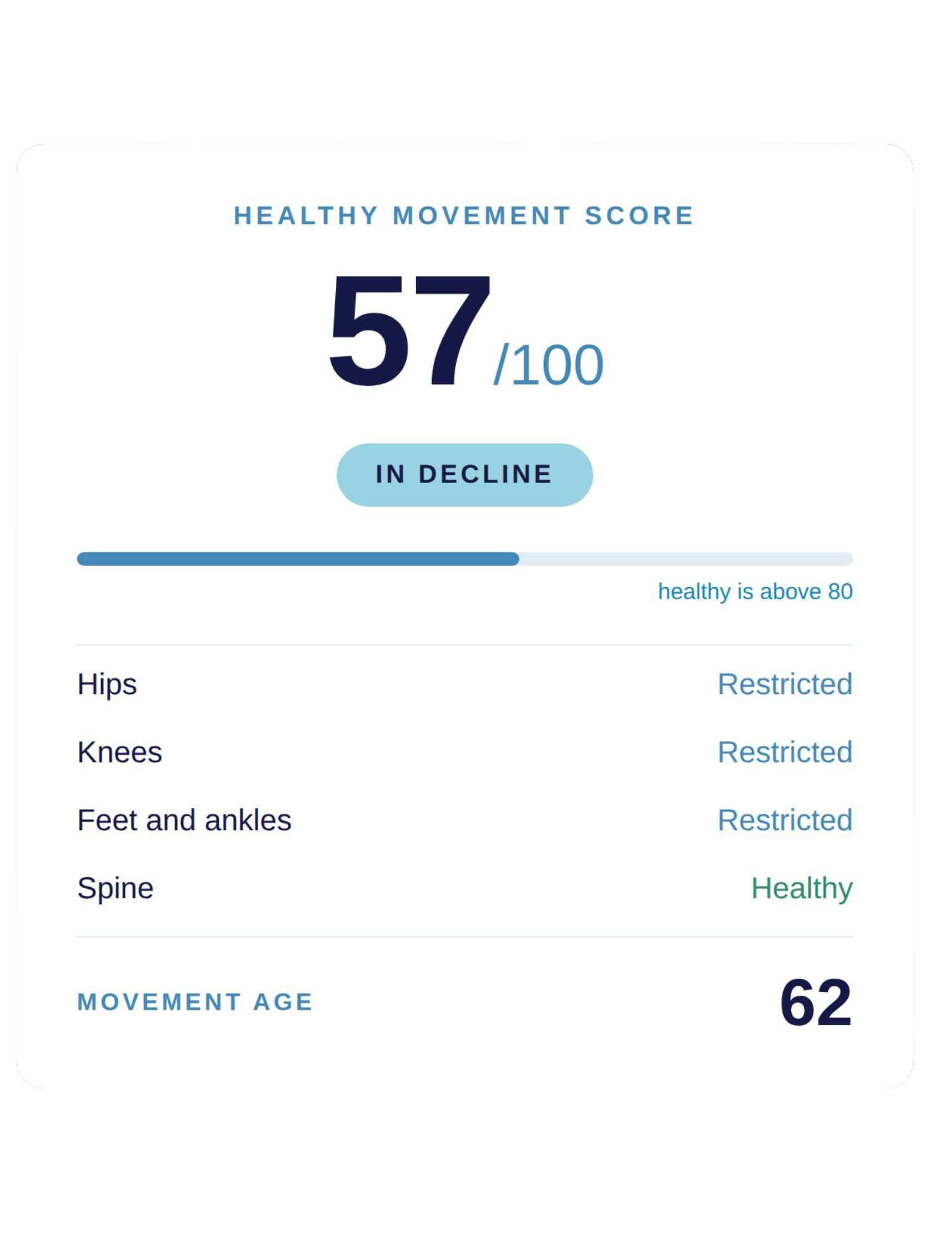
And many people try to stretch and do those sort of things, and it just doesn’t work, so they don’t do it. Now, I tested her mobility health score in January. It was a 32, and her movement age was 75.
Now, she’s 64 years old. Her body was moving like a woman 11 years older than what she was, and that number, it tells a story that most people never get to hear because nobody tests them. Nobody ever measures what the body is actually doing underneath the surface until it becomes a tightness or a pain that you can’t ignore anymore.
Now, she started working with me, and she was very consistent. She was coming in twice a week. Her joints started moving again, and she was actually getting down onto the floor, and she was able to get back up, and she was feeling more like herself.
She was close to being able to move into a membership where she could maintain and continue building. And then one of her children, I think in a conversation, and I don’t know the specific conversation, but she decided to move closer to one of her children because her children wanted her to do that. And as a mom, she said yes.
So she and her husband found a beautiful home at a great price with a lot of land, and she knew it was crazy, but they went for it. The new home was further away from the studio, and the drive didn’t make any sense to her, and the cost to move that far away meant that she was going to have to pause her membership with us. And just like that, the thing that was finally becoming hers, her taking care of her body, because she didn’t get to do that.
She said that in many of her sessions, you know, I really drove a lot with work, and I was all over the country, and I really just didn’t get to take care of my body, and I’m finally doing this. And now all of a sudden, she’s set it aside, as a mom does, to live nil her kids. And when I saw Dee again after her move, her mobility health score had dropped from 32 to 17.
Her movement age had gone from 75 to 88 in a matter of months. It had gone from improving to declining and an accelerated decline at a rate that took her backward faster than we had worked to move her forward. And her last session was last week.
And I’m not telling you this to make you sad. I’m telling you this because I want you to understand something. When your movement system that controls how your body moves is not maintained, it doesn’t just stay where it is just because you’re busy.
It actually declines and the silence shutdown cycle, that’s what I call AMI, which is Arthrogenic Muscle Inhibition. That’s what I talk about in this show. It doesn’t take a break because you got busy or your life got busy.
It keeps running and the further it runs, the harder it is to come back from it. Now Dee’s story isn’t finished. I believe that she’ll find her way back.
She comes up here several times a month and I know she’ll come back whenever she can. But I also sit with a weight of knowing that her body needed her to choose herself and the circumstances in her life made that feel impossible. And that’s a mom and that’s why I want to talk about moms here today.
Now this next person I’m going to call Mary. Mary is 59. She has three children.
One of her children is very ill and the other two are happily married and live about two hours away. And I don’t think they live near each other, but I know that they’re just two hours away from where she and her husband live. Now her husband owns a business.
Mary manages that business and she drives two hours each way to help care for her grandkids. And she does that weekly, every week. Mary is in the middle of moving to a new home.
She came in to see me because her hip locked up and she could not move. Now I’ve talked about her in another one of my series. And let me just kind of repeat that.
Her hip locked up. She literally stood up from a chair and her hip said, You’re not going to move. Completely locked up.
And I don’t know if that has ever happened to you. But guys, most of my clients, that’s what happens. That’s the nervous system kicking in and saying, I cannot compensate anymore.
So it shut down that joint so she couldn’t move. She told me it took about 30 minutes for her to walk and get into the car. She was pressing into her leg and doing all sort of things just to be able to make it to the car.
Now, at Mary’s last session, she told me something. And I’ve just heard it through all of these conversations that I’ve had here in the studio. She said she promised herself that she would not gain her weight back, that she lost.
And now here she is. She gained it back, almost all of it. And her body was getting better and moving better and she still had a ways to go.
And she looked at me and she said, how did I let myself get here? And she spoke on how angry she was with her stuff today and how she, how stuck she felt because she had people that relied on her. And what Mary said next, you know, she says, I take care of my kids.
I travel two hours away every week to take care of these kids back and forth. I’m moving to a new home that needs updating and I have to put my home on the market. And I’m managing a business and my body is falling apart.
And I do not know what I can give up because if I give something up, I am letting someone down. Now Mary was angry at herself for allowing this to happen. But also she was exhausted and she was trying to figure out what she could do to get out of the mess that she put herself in because we are so good as moms to volunteer and do stuff that we really have no business doing.
And I love that we can see this and today, I want us to all learn from our behaviors and our choices. I want us to look at our 70s and our 80s and ensure that we are where we want to be when we get to those ages. So here’s the truth about what we do as mothers.
Here’s what I know to be true after years of working with women like Dee and Mary, myself and many others who walk through my door. These two situations for these two, I’ve got 50 more. We became mothers and something shifted in us.
And we stopped seeing ourselves as a priority. And for some of us, we never knew how to be the priority. We started measuring our worth by how much we gave and how little we asked in return.
We build our identity around keeping everyone else okay, helping them avoid costly, harmful mistakes. And guys, we did this to ourselves. Me and my friends talk about this a lot.
We talk about, you know, we worked so hard with so many jobs and we raised our kids and we loved every single second of that. And I’m sure some of you can relate to this too. This feeling of wanting our children, our friends, our family to have the very best while we silently lose our mobility, our health and our sanity.
And our kids grew up watching us do that. We gave everything, money, time, help to allow our kids to live their best lives. And our kids may be far away from the lives they envision too.
And we are their biggest cheerleader. We watch them make the same mistakes and it physically and mentally hurts us to the core. But our children are leading different lives than us.
They have a larger home. Some of them have nicer cars than what we had when we started. Their cars are newer.
Many of them have college educations when many of us were not able to get that due to our family’s income and education. And the education we received, we fully paid for. I remember my husband had to go to school first because we could only afford one of us to go to school.
He had to finish. I had to work two jobs and take care of the kids while he finished his education. And then I got to go to school because if we didn’t, we wouldn’t be where we are right now.
We sacrifice those little things, nails, hair, gym, memberships, travel to give our children a better life so that they had the life that was better than ours. And many of us worked two jobs, put our kids through college, and then started going to our children’s weddings, paying for the best wedding for our children the way they envisioned it because we want our kids to be happy. And now grandkids, the most wonderful thing, the most beautiful thing in our lives, that sacrifice and all those sacrifices were worth every moment for us to see our children being able to afford a nice home, a nice car, take care of their children in ways we never able to do.
Most of our children travel, they’re building their lives with a spouse, they work out, they have bigger homes than we did, they’re doing the things they want to do because there was a component of that that we made it safe for them to do. We held a net underneath them so they could fly. That was our goal and that is what fills us as parents and moms.
We feel happy at the fact that our kids can do the things that they want to be able to do and we are so proud of them and happy for them. But somewhere, somewhere in the middle of all of that, we stopped asking the question that mothers are not supposed to ask, what do I need? How do I fill my cup?
Many of us are left with grieving our kids because they’re busy with their beautiful lives and we’re still just trying to ensure we are financially stable for the end of our lives. Today, I want to turn this around and I want to discuss for all of us, what do I need? How do I turn this around without our children, our spouses thinking we are being selfish or mean for not continuing to be the wings beneath them?
When we focus on us at the core, I think as moms, we feel our children slipping away from us. They’re busy, they have beautiful lives, but we don’t get to see them unless we’re babysitting the kids or we’re helping in some way. Many of us feel lonely and miss the relationships we once had with our kids because we love our kids to the core.
But now, we need to focus on us because it’s urgent. We are in our 50s, our 60s, and our bodies are sending us the bill for all of those years of deferred maintenance. Our hips are tight, our low backs are tight, our knees, they’re not operating the way they used to, and we move slower than we used to, and we’re bending over a little more stiffer, can you say, without pain, but just, I know that I’m not as flexible as I used to be, and going to sit on the floor, it is not as comfortable as it used to be.
Even just a year ago, we’re also gaining weight around our midsection, and we just feel like all of this feels out of control for us. We want to exercise, but our joints are not letting us feel like we’re able to do it safe, and we feel stuck, because we feel like we have priorities we give to our children, you know, we do things for our children, and all of a sudden, we’re like, well, we don’t have time to do anything but work, eat, sleep, and go back and rinse and repeat that. And, you know, when our kids need us, we’re there, and they do the same for us.
And at the top of the physical piece, there’s an emotional piece that nobody talks about, guilt. When we don’t do everything in our will that our children need, we feel guilty, and that fear that if we pull back even a little bit and say, this time is mine, we’re fearful that our children are going to see us as selfish. And some of you listening right now, you have children who have made you feel that way, and you feel that way because you feel like you are supposed to give more.
It’s not how they’re making you feel, but you are putting that burden on yourself. And some of you have given everything and still felt like it wasn’t enough, and some of you are afraid that if you finally put yourself first, the people you love will see you differently, and for some of you, that fear is not imagined. It is real and it’s painful, and it’s probably what has kept you given more than you should for a very, very long time.
I want you to know I see you, I hear you, and today we’re going to start working through this together. My goal today is for us to find ourselves and give to ourselves and stop worrying about what our kids will think of us because they’re going to be fine. We raise them.
They’re going to be totally fine. They have beautiful, busy lives and they are prioritizing their immediate family. So should we, right?
I want to know if any of you guys are resonating with this. I want you to take out a sheet of paper, grab a piece of paper, grab a pen, and if you’re driving, do this, come back to this part in the show, or you can listen to it and come back to it later. But we’re going to do something that sounds really, really simple, but it may be one of the most clarifying things we can do right now.
And we’re going to get everything out of our head and onto one piece of paper, so we can actually see it and we can make something happen. And here’s what I want you to do. In one column, I want you to do separate columns on this paper.
In one column, I want you to put, where does your time go every single day? Write it down, every role, every task, every obligation that you have, every person who has a claim on your time, whether it’s the grandkids, the business, the driving, the managing, caretaking, cooking meals, going to the grocery, your appointments, the house, write it all down and do not judge it. Just write it.
Now next to each of these items, write roughly how many hours a week that obligation takes from you. Then at the very bottom of that column, write how many hours a week you spend doing something purely for yourself, something that’s about your health or your joy or your peace. And I want you to be very, very honest with that.
And we’re not going to stay right there, okay? Column two, you’re going to put, who are you? I want you to write every role you hold, daughter, sister, wife, mother, grandmother, friend, business partner, caretaker, employee, volunteer, write them all down.
Now look at that list and circle the ones where you are giving more than you are receiving and put a star next to the roles where you feel the most guilt when you even think about pulling back. Now let’s go into the column number three. What did you expect to have by now?
This is the one that might make you cry and that’s okay. Write it down what you thought your 50s or 60s would look like. Did you feel like you should be fit, healthy, happy, traveling, financially ready to wind down, enjoying your marriage or your friendships, moving freely, feeling proud of your body?
Write the vision you had back then for where you are right now, every single piece of it. What did you feel like you’d look like right now? Now there’s a fourth column.
I want you to draw a line and in that column, I want you to put what is pulling you away from that vision of what you want to look like or what you expect it to look like. Not who, but what. Write down the patterns, the obligations that have no end, the guilt that runs your decisions, the fear of being seen as selfish, your body that has not been cared for.
You know, write down the problems that you have. You know, what’s pulling you away from, like, is it your hip and knee, you can’t exercise, you’re not fit, you know, your skin is looser than it needs to, you’ve gained that weight around the midsection, your finances don’t feel like they need to be where they’re supposed to be. Write it all down.
Don’t attach any shame or anything to it. This isn’t about blame or shame. This is literally about clarity, okay?
Now we’re going to start working towards how you need to get to where you’re happy with yourself. What would you need to start doing differently? And what I look at is if you look at that very first column where you see where your time goes every single day and you see those, you know, what can you start, you know, taking a little time away from to actually start doing the things that you want to do.
So if you, you know, drive two hours and you watch the kids, you know, for four hours and then you drive two hours back and that is eight hours in a day and you have to come back home and cook dinner and you’re exhausted, you know, is there a way for you to watch the kids for three hours instead of four hours? You know, is it better for you to spend the night over night? You know, what can you do differently so that you can do something for yourself?
And what would your schedule need to look like to achieve what you wanted to look like? So you want to be fit, you want to be happy, you want to travel, you want to be financially ready, you want to enjoy time with your husband, you know, put those in order. What is the most important to you?
For many of you that I’ve talked to, it’s fit, healthy, and lose weight around the midsection. Most people that I talk to are pretty much happy with everything else, but it’s the fit and healthy component that they’re not. We’ve got to pull that piece back to the top of this column.
So what can you take away from to do 30 minutes of a workout every day? What can you take away from to get your movement health score, to see what your movement age is, and what can you do to gain that control back? Okay?
Now, that paper that you just drew, it’s a map. You just reverse engineer the way you want to look, and truly, what do you need to do to get there? Do you need to grocery shop?
Do you need to learn a better way to eat? Do you need to learn different types of food? How much time does that take?
Do you need to go to the doctor? Do you need to get blood work? Do you need to understand what a walking program would look like if your hip is tight?
What would a workout look like if your hip was tight and your knee was tight? Those things, find out and put in a column, do I need to learn something and do something? Or am I prepared and I’m ready for it?
I just need to allot time to go to the grocery store. I need to allot time to food prep. I need to just be more of control over here.
These are the little things that I can do because if you have that time, and I’m not talking about adding on to the lack of time you have right now. I’m talking about what can you minus to be able to have time to do the things that will put your fitness and your health first. And you need to also give yourself and acknowledge that you give yourself permission that the way things are right now is not sustainable and it is not what you want it.
Now I want to talk a little bit about that guilt, that shame. I want to talk about that directly because I think it’s the one thing that keeps most of us women from making any real change. There is a belief in many of us and we absorbed it somewhere along the way that says a good mother puts everyone and everything else first.
Always, no exception. And if you ever chose yourself over your children or your grandchildren, something is wrong with you. And guys, I want to take a minute and challenge that belief today because I think it’s costing you your health and your life.
Here’s the thing, when we go on an airplane and the cabin loses pressure, the first thing they say for us to do as a mom is to make sure that we put our mask on even before we put it on our child. And every time I hear that instruction, I think, yeah, because a mother who cannot breathe cannot help anyone. And we are not helping ourselves.
Our kids are watching us decline and they don’t like it. That’s not what they want. And you can’t be the grandmother to your grandkids if your hips lock up and you can’t play with them on the floor and frustrated.
And you have to laugh it off before because you can’t get up off the floor. You can’t enjoy your marriage because you’re exhausted, you’re in pain, you’re angry at yourself, and you can’t be present for your child who is ill if your own body is in decline and taking every ounce of your energy just to get through the day. You can’t give from an empty cup.
Guys, taking care of yourself is not selfish and it is the most responsible thing that any of us can do for the people that we love. And for those of you who have children who have made you feel like your needs do not matter, for those of you who have given and given and given and still feel judged or dismissed or unseen by the very people you sacrifice for, for those of you who live with the fear that if you finally say this time that I have to do something for me, maybe you lose that relationship entirely because those children judge you for who you are and they don’t like who you are. That fear, guys, it’s totally real and it deserves compassion.
But it also is not a reason for you to continue to disappear. Our children are watching us and they are watching whether we believe in our own lives and whether we take care of ourselves. They’re watching that.
And the most important thing you can model for them is a woman who decides she is worth fighting for even when it’s hard. Now, you know, I always have to come back into the body and I want to talk about the body piece because this is where I live, right? This is what I see every single day and the tightness you’re feeling in your hips and your low back, your knees, your shoulders.
That’s not just that you’re 50 or 60, okay? What is happening, besides aging, is called the silent shutdown cycle. And it is a progressive shutdown of your movement system that controls how your body moves.
And it starts when one of your joints loses its in-range mobility and the joint capsule tightens up. The nervous system reads that tightness and starts shutting down the deep muscles that are supposed to support that joint. And the larger muscles start to compensate.
And they are put in sort of a holding position when their job is to move. And they take on a job they weren’t built for. And over time, your body starts moving in patterns that feel normal, but are actually causing your body to work harder than it needs to.
And that is a system that is in decline. And it’s not just aches and pains. This is your healthy movement system breaking down underneath you.
And it’s progressive, which means it does not stay where it is. It gets worse over time if it’s not identified and unlocked and maintained. Dee had a mobility health score of 32 when we first tested her.
And after months of not maintaining her score, that dropped down to 17. And her movement age went from 75 to 88. And her body aged faster without care than it did when she was doing something.
And Mary’s hip locked up completely. Her body stopped cooperating and it stopped cooperating because the signals that had been running for a long time before this moment, you know, she wasn’t doing anything about it. She had gone to the doctor.
She had done what she thought she needed to do until she called us. And what I want you to understand with all of this is you’re feeling changes in your body right now and you’re feeling tighter and you’re not moving the same way. This is a signal.
Kind of like your car engine light that’s saying, hey, I need oil. OK, and there is a way to identify and measure this and address it. And not through more fitness or harder workouts, because you cannot build on a broken foundation, but through testing your joint mobility and restoring what has been lost and maintaining a healthy movement score that tells you where your body actually is instead of guessing on how you feel, because how you feel is not the data you need.
The data you need is a score. And here’s what I want you to do with that piece of paper that we just wrote down. And if you haven’t done that, please, it takes five minutes.
Go through, reverse this episode and go through the steps I told you, add those columns and fill this out. This is the practical piece. If you’re in your 50s and 60s and your body is tight and stiff and sore and you feel like you’re working against yourself every time you try to move or exercise, I want you to come in and get your mobility health score and your movement age.
I want you to get your body composition, learn your skeletal muscle mass, learn how much of that muscle have you lost, learn how much of it is visceral fat around your waist. I want you to arm yourself with what you need to really make the change that you’re looking to make. And it’s going to be hard to face, but we can do hard things because we have and because we deserve to know the truth about where our body is right now, so that we can make a real plan to get it where we want it to be.
So I want you to book and unlock your Healthy Joint Mobility Session. And in that session, you’re going to get your joints tested. I’m going to give you a score.
You’re going to get your movement age. You’re going to understand why your body feels the way it feels, and you’re going to leave feeling better than you did when you came in. And after your initial session, we can build a program that will help you lose weight around your midsection and get back to moving like you did 10 years ago.
This is your first step. This is what you need to do. I am a mother, too.
I understand the pull, the guilt. I understand the way that putting yourself on this feels. Okay, I know that sometimes I feel like I can’t pull back on something, but guys, we can all do this together.
But I want you to hear me when I say this. The woman who came into my studio and finally they decide to take care of themselves, do where our body is right now, so that we can make a real plan to get it where we want it to be.
So I want you to book and unlock your Healthy Joint Mobility Session. And in that session, you’re going to get your joints tested. I’m going to give you a score.
You’re going to get your movement age. You’re going to understand why your body feels the way it feels, and you’re going to leave feeling better than you did when you came in. And after your initial session, we can build a program that will help you lose weight around your midsection and get back to moving like you did 10 years ago.
This is your first step. This is what you need to do. I am a mother, too.
I understand the pull, the guilt. I understand the way that putting yourself on this feels. Okay, I know that sometimes I feel like I can’t pull back on something, but guys, we can all do this together.
But I want you to hear me when I say this. The woman who came into my studio and finally they decide to take care of themselves, do not become less of a parent for their families. They become more present.
They show up. They can move better. They’re happier.
They have more energy. Feel like they’re in control when they stop carrying the weight of their own disappointment everywhere they go. They start to feel like themselves again.
And when they feel like themselves, they have so much more to give. That version of you that you imagined in your thirties, guys, she’s not gone. She’s waiting.
She’s been waiting for a long time for many of us. And the path back to her starts with one decision. You are worth it.
And say it, guys. I am worth it. Say it out loud if you need to.
Now pick up that piece of paper. Look at what you wrote down. Look at what is pulling you away from the life you wanted.
Look at what it would take to get it back. What do you need in a week that is realistic? And then decide that you are going to take one little step.
And if that little step this week is just that you go out for a walk, and that’s the little step, and that’s where you start. When you go out for that walk, I want you to think about, you know, is everything moving good? Is it stiff?
Is everything, you know, moving like it should? Or do you feel a little stiff and rickety, like you need some oil? Now, I’m going to put a free download in the show notes for all of you mothers.
And it’s just a starting point to changing where you are, so that this time next year, you will be who you want to be. Stop the quick fixes, because those quick fixes have not worked for you. Stop showing others that you’re strong and that you can handle everything and start choosing you.
Head down to that download, download it’s got a lot of great information. I think I’ve put a four week plan in there for you on starting to get you back out to walking, even though you have some stiffness in your body. Go ahead and do that walk.
Come on in and schedule a Mobility Health Score. I can’t wait to see you. And thanks so much for joining me on the show this week.
If you like this and you know other mothers out there, please share this show with them. If you’re a person who wants to become a Stretch Mobility Coach Practitioner, reach out to us and we’ll get you some information. And soon it’ll be on the website and updated.
And if you want to find out more about the silent shutdown cycle, the five drivers of healthy movement and why your joints are the missing link to everything you’ve been trying to do in your health, follow us on social media. We are here for you. I’m Kim Nartker and I will see you in the next episode.
Until then, take care of yourself. You’ve earned it. Thanks so much for joining me today on the show.
I appreciate you listening in and I appreciate it if you would share this and also connect with us on social media. For the latest research, insights and information on movement health, they are posted on our social media page, on our blog page, on our website, as well as on this podcast. Now, if you want to learn how you can become a Stretch Mobility Coach or how you can find a coach near you, then visit our website at thestretchmobilitycoach.com.
Now, if you want a career in Stretch Mobility Coaching, there are two opportunities for you. One is to become a coach and work for our corporate office so that we can place you at a high-end resort or independent living facility at one of our partner locations or even our Beckett Clinic. Now, if you’re looking to become a Solo Coach and you want to start your own Solo Coach profession, then you can find that information on the website as well.
Please head on over to the website to learn more about how we can help you become a coach or we can help you move better for life. Thanks so much for joining us today.
Movement health, measured
Every joint, tested by hand, in a single visit. Baseline once, retest as you go.
Healthy Movement Score Whole body
Movement Age Against your years
Your Blueprint Your plan
In studio at Beckett Ridge, West Chester OH
Not near West Chester. Start with the virtual Healthy Joint Mobility intro and get your Mobility Health Score for one area.