Why Does My Knee Feel Pressure When I Bend Down?

Why Does My Knee Feel Pressure When I Bend Down?

Why Does My Knee Feel Pressure When I Bend Down?

Understanding Knee Health To Maintain Knee Mechanics Throughout Your Lifespan

The Healthy Movement Podcast

“Knee pressure is easy to dismiss because it is not constant. It shows up only in a deep bend, and most of us are not down on the floor very often.” Kim Nartker


By Kim Nartker

Read time: about 8 minutes

In this episode Kim takes apart a knee signal almost nobody pays attention to. Your knee is not a hinge. It locks and unlocks through a rotation you have no voluntary control over, and when that mechanism stops working there is exactly one movement in an ordinary day that will tell you, because walking uses less than two thirds of the bend you have. She walks through what the research actually measured, what she finds when she tests above and below the knee, and the order that activities signal you as you lose key available motion in your joint capsule. Then she introduces three real women in their thirties, fifties and seventies who are not three different conditions but three people standing at different points on the same predictable movement decline path.

A note on the research: what Kim states as established is tied to the published literature and named in the episode. Where she goes beyond what the research has tested, including her working explanation for how hip and foot restriction connects to the knee, she says so plainly. She does not diagnose, treat, cure, or prevent any medical condition.

Subscribe on: APPLE PODCASTS I SPOTIFY I IHEART I RSS

The Signal Almost Nobody Pays Attention To, And What It Is Actually Telling You

You walk every day. You take the stairs. You get in and out of a chair without a second thought. Your knee feels completely fine with all of these activities.

Then you go down to the floor to pick something up or to play with a child, and you feel a pressure deep in the knee. Not quite pain, but enough to make you stop bending down on that knee. 

Most people blame this deep knee pressure as a normal part of aging. 

We are taught to believe that aging is the typical reason, but I have found aging to be not the reason behind this pressure at all. 

That pressure is a signal, and it is showing up in exactly one position for a reason that is measurable. Your knee has a lock and unlock mechanism that is completely outside your voluntary control. When that mechanism stops working the way it was built to work, when you bend down into a deep knee bend you will feel this pressure which is a signal most of you ignore.

A woman in her mid thirties came to my studio with no pain at all. She did not have pain with walking. She could do stairs with no problem. The only time she felt anything was going down to the floor to play with her young child. She had already decided it was knee pain and that she was getting older.

She is not overweight. She had no injury. She is in her thirties. She wanted answers and asked if she should be concerned with the pressure in her knee with bending. 

She scheduled a Unlock Healthy Joint Mobility Session to learn about her experience and this is what I found when I tested the joints in her lower body during her introductory session.

Both hips were restricted in every plane of joint movement. The hip on the side of the knee that she reported pressure in was found to be restricted into all planes of motion. Her foot on that same side was also found to have greater joint restrictions in her ankle, her forefoot, her midfoot, and her rearfoot. The opposite hip and forefoot had similar restrictions that were just as limiting. Her knee that she reported pressure with the deep bend had lost its unlock mechanism.

So when she went down to the floor to play with her child, the pressure in her knee caused her to get off that knee pretty fast. When she went down quickly, she noticed it and said out loud, my knee is getting old. 

Why We All Ignore This

We are trained to believe our movement health is fine until something hurts.

Pain is a late signal. By the time you feel it, you either have a diagnosable condition or you are close to having one. Waiting for pain is not a strategy for anyone who wants to still be moving well in the second half of life.

And knee pressure is easy to dismiss because it is not constant. It shows up only in a deep bend, and most of us are not down on the floor very often.

Here is what makes that dangerous, and it is measurable.

Researchers put sensors on the knees of twenty healthy older adults and measured how much knee bend ordinary activities actually require.

Walking on flat or sloped surfaces required less than ninety degrees. Stairs and rising from a chair required ninety to one hundred and twenty degrees. Getting into a bath tub required about one hundred and thirty five degrees.

Getting down to the floor was not even on their list.

A healthy knee bends to roughly one hundred and thirty five degrees. So walking uses less than two thirds of what you have.

You could lose a large amount of your available bend and never notice it walking. The floor is the only thing in your ordinary day that asks for all of it.

And no, this is not aging. Researchers measuring hip and knee range of motion across age groups found differences of only three to five degrees between the youngest and the oldest person tested, and concluded that at least to age seventy four, any substantial loss of joint mobility should be viewed as abnormal and not attributable to aging.

We have been taught that we are in control of our joint mobility. We have been instructed to move, stretch, eat well and use recovery tools after we exercise. But what we have not been educated on is this fact:  Our joint capsules lose accessory motion through a restriction that is out of our voluntary control. We do not get a signal of pain when this motion is lost, our muscles tighten and hold around that restricted joint.  In this case this thirty year old Mom, has already started losing key mobility in her hips, 1 knee, feet and ankles and this loss has nothing to do with her age. 

Your Knee Is Not A Hinge

Everyone calls it one. The anatomy texts do not. They call it a modified hinge joint, and that word modified is where this whole story lives.

Your knee bends and straightens like a hinge. It also rotates. And that rotation is built into the function of the bone and the joint. 

At the bottom of your thigh bone are two rounded knuckles called condyles, one on the inside of the knee and one on the outside. They are not the same size. The one on the inside has a longer surface.

So as you straighten your leg, the shorter one runs out of room first while the longer one keeps traveling. When one side stops and the other keeps going, the joint has no choice. It rotates.

In the last twenty degrees of straightening, your shin bone rotates outward about fifteen degrees. That is called the screw home mechanism, and it locks your knee. The surfaces seat into each other. The ligaments wind tight. Your knee parks itself, which is why you can stand around with straight legs and almost no muscular effort.

If rotation locks the knee, rotation has to reverse before you can bend it again. You cannot stretch out of a locked knee. It has to unlock to bend. 

There is a small triangular muscle deep behind your knee called the popliteus. The anatomy texts call it the key that unlocks the knee. Its only job is to reverse that rotation so bending can begin. When you lose the knee joint accessory motion, this deep muscle loses key activation in the process of the restriction. 

So what happens when a knee cannot fully unlock?

You would not feel it walking. You would not feel it when getting up or down from a chair. Both of those activities do not require end range joint mobility. 

You would feel it going down to the floor. Because this activity requires the knee to fully unlock. For this mom, she had a hip restriction and ankle foot restrictions that did not allow this lock out mechanism to unlock completely. Her joint was restricted and still in a locked position due to the multiple joint restrictions at the knee, above and below the knee joint. 

So when she went into that deep position, she felt a pressure that alarmed her. That is the feeling that I am hoping I can teach to people to help them gain awareness of their body when it moves. 

The Restriction Is Not Only Found In The Knee

When I test people who describe this, here is what I find.

The shin bone sitting in external rotation, which is the locked position. The knee restricted in its accessory motion, meaning those small movements between joint surfaces that you cannot produce on your own are restricted from moving. And above and below it, the same thing. Hips restricted in rotation and in accessory motion. Midfoot, rearfoot, ankle, great toe. Some of them or all of them restricted from moving. 

That is not a research finding. That is what I find when I test, and I find it often enough that when someone tells me about knee pressure, I go looking above and below the area of the pressure feeling but also look at the joints of the opposite side. 

Here is why that makes sense mechanically. When your foot is planted, to unlock the knee requires the thigh bone to rotate outward on the fixed shin. That rotation has to come from somewhere, and the joint above it is the hip. A hip that is restricted from moving does not allow that knee to unlock fully, so it stays stuck in the locked position.

Below the knee, the foot and ankle are what let the shin find the ground and adapt to it. Researchers took thirty healthy people with no history of injury and artificially restricted their ankle motion during a squat. The knee bent less, traveled inward more, and the muscle work shifted to a different muscle group in this study. When the ankle is restricted from moving the knee has to do something different. So the ankle, knee and hip all need the accessory motion in the joints to work properly to be positioned correctly with a deep knee bend position.

The Predictable Movement Decline Path

I have been working in the healthy movement space for over 30 years. I have found predictabilities that occur in every person that walks through my doors. The body tests the same predictable way and it does send us feelings or signals, but we have never been taught to understand what our bodies are telling us. 

Here is where we lose accessory motion in our joints 1st as it relates to our knees.

Kneeling down to the floor requires the most joint mobility approx. 135 degrees is needed. We lose this motion in the capsule of the knee when the screw home mechanism and that deep muscle are no longer healthy and are restricted in movement. 

We lose more motion over time through restriction and muscle inhibition making sitting on lower surfaces more difficult. 

The next activity that you will feel the knee joint restriction is descending stairs as this requires more motion loss than the previous activities.  

When you have lost more motion you will feel that loss when sitting in a chair, many people will start automatically compensating during this time, to avoid that loss of movement or pressure feeling. 

You won’t feel the restriction in the knee with walking until you have lost more than 90 degrees of motion. 

Which means by the time somebody notices it walking, an enormous amount of joint mobility and joint function are already lost to a restriction and decline. 

The larger problem that we have is that when we lose this motion, we adapt, we compensate or modify our positions to avoid the loss of motion. We stop sitting on lower surfaces, we start using our hands and stepping down 1 step when we go down stairs, we avoid positions that require that motion. 

So as you can see. Our bodies adapt and we adapt and accept this loss every day. Mostly because we can still move without pain. 

Pain is a late signal. And by the time you experience pain, you will already have a diagnosable condition.

I have watched this movement decline in people at every stage of life. A woman in her thirties with restricted movement that can still perform activities without pain. A woman in her late fifties with those same restrictions, plus muscle inhibition and a movement system that is overworking everyday to allow her to move with symptoms that waver from day to day due to these restrictions and other factors.  A woman in her seventies with all of that, plus established structural change diagnosed as Osteoarthritis, giving her joints stability while stealing the mobility in her toe, foot and midfoot joints placing her knee in a locked position at all times limiting her movement. 

Those are not three different conditions. They are not only age related. They are the same signals we have learned to ignore because we can move and we don’t have pain.  This is the predictable movement decline path. 

And the woman in her thirties has forty years to go to reach the woman in her 70’s about to have a knee replacement surgery. 

What The Research Has And Has Not Looked At

There is a study from the year two thousand that I keep coming back to. Researchers randomised eighty three people with knee osteoarthritis. Half received manual therapy plus supervised exercise, twice a week for four weeks. And the manual therapy was applied to the knee as well as to the lumbar spine, the hip and the ankle as required. The other half received a subtherapeutic ultrasound that was doing nothing.

At eight weeks the treated group had improved their walking distance and their symptom scores substantially, and at one year they still had those gains. At one year, twenty percent of the placebo group had undergone a knee replacement, against five percent of the treated group.

What I love about this study is that these people saw improvements with PT treatment and those gains lasted at least 1 year. I would love to see a study done on people that are addressing joint restrictions in every joint of their body for life to see if we can see real changes in the surgical statistics, musculoskeletal disease statistics and mobility decline statistics that causes many of you to lose mobility in the last half of your life. I may be dreaming here, but we don’t know until everyone steps up to learn more about joint restrictions and keeping the joints unlocked first then building key strength through our fitness system after. 

That study is twenty six years old. As far as I can tell, no one has done another one of these studies. In my opinion this is overdue. 

Where This Leaves You

The pressure you feel in a deep bend is telling you something has changed in your movement system. 

That is all it is telling you. It is not telling you how much change, or where the joint restrictions are, or how long it has been going on, or whether the muscles that support the joint are still doing their job. That is what my hope is. That you will see this movement decline path and see that just because you can move, and you don’t have  pain, it does not mean your movement system is not working in a healthy, efficient way. 

With this data, I speculate that just like car maintenance, dentistry, and longevity testing, you will see that testing the health of your movement system is as important as any other preventative test, and you take action to test your healthy movement system today.

As you can see in this article, your body restricts the bones moving inside the joint capsule to control and stabilize your joint. Once the body starts this process it is outside your voluntary control. This process continues to run throughout your life, but it can be identified through specific testing. I see that as good news. We track our cholesterol levels, our blood pressure levels and we should track our movement health in that same way. 

What nobody can tell you yet is what happens over twenty years if you identify the joint restrictions with testing, open up that accessory motion in the restricted joints, then restore the health of the 5 drivers of healthy movement. That study has not been done. One day I hope to see that it will. 

I have created a test that identifies these joint restrictions. I test clients in the Beckett Ridge area and provide them with a healthy movement score and movement age that allows them to track their movement health throughout their lifespan. 

If you want to know what your joints are actually doing rather than guessing from how they feel, that is what Healthy Movement Testing is for.

Once you identify the joint restrictions, you can restore and open that accessory space up and keep it open through routine sessions for life. This coaching model is not a race it is built to help you move well throughout your life and do everything you want to do without limitations of lost mobility. See you in the studio.

Movement health, measured

Every joint, tested by hand, in a single visit. Baseline once, retest as you go. 

Healthy Movement Score   Whole body

Movement Age                      Against your years

Your Blueprint                       Your plan

In studio at Beckett Ridge, West Chester OH
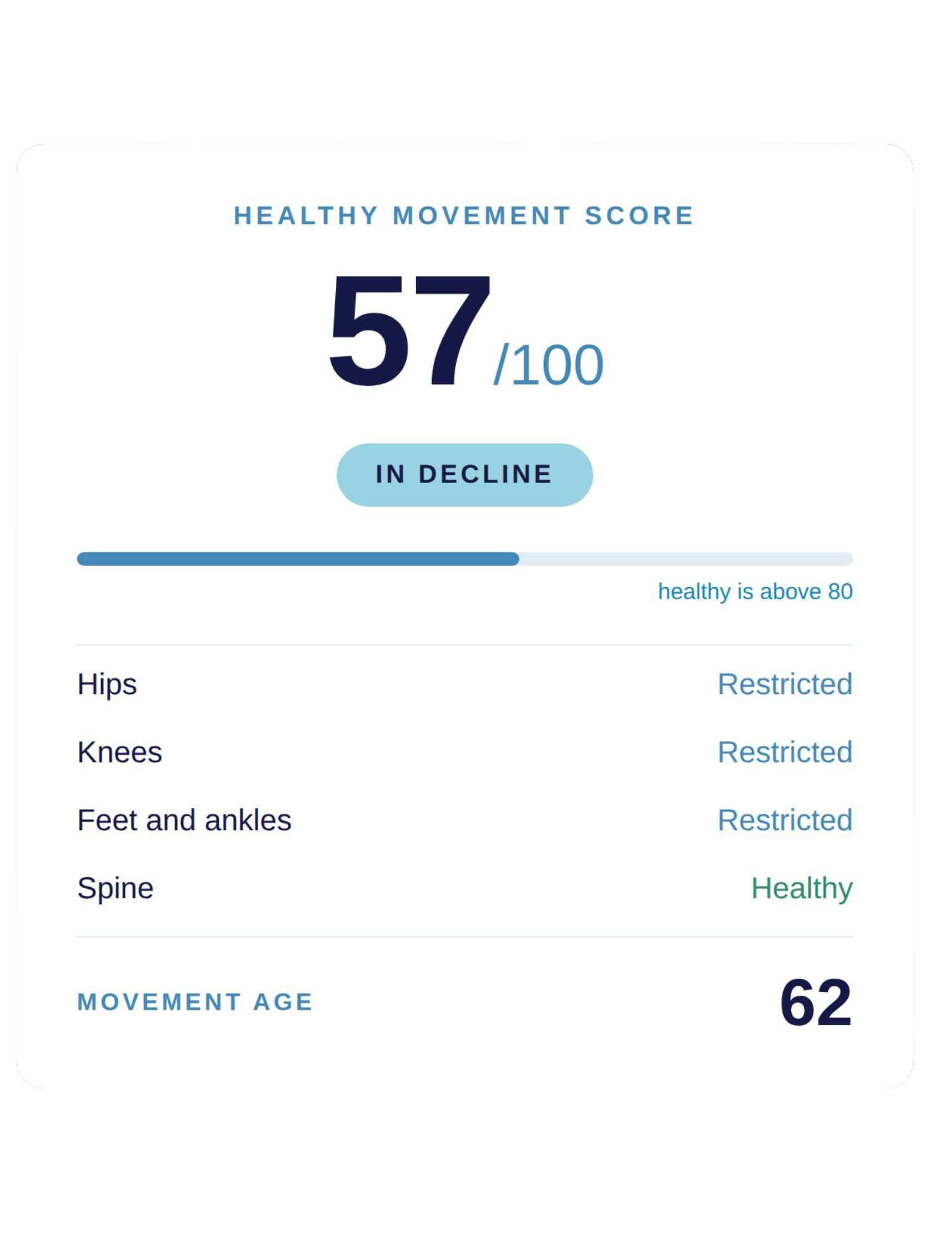
Not near West Chester. Start with the virtual Healthy Joint Mobility intro and get your Mobility Health Score for one area.
Healthy Movement 101: What You Can Control, What’s Stealing Your Movement, and the Gap Between Them

Healthy Movement 101: What You Can Control, What’s Stealing Your Movement, and the Gap Between Them

Healthy Movement 101: What You Can Control, What’s Stealing Your Movement, and the Gap Between Them

The Healthy Movement Podcast

“You can do everything right, for years — and the deeper muscular layer can still be losing motion, because the tools you’re using were never able to reach it.” —Kim Nartker

By Kim Nartker

Read time: about 8 minutes

In this foundational episode, Kim lays out the whole Healthy Movement framework in one place — the one to start with, and the one to share when someone asks what this work is about. She separates the two things people call movement (how much you move vs. how well), walks through what you can actually control and what the research says each thing does, then turns to what quietly steals movement underneath all of it: the Silent Shutdown Cycle, her name for what the research calls arthrogenic muscle inhibition. She closes on the gap — the layer where decline begins is one none of the things you control can reach.

A note on the research: what Kim states as established is tied to the published literature and named in the episode. Where she goes beyond what the research has tested — that this cycle can begin early and silently, before pain — she says so plainly. She does not treat, cure, or prevent any medical condition.

We discuss:

The two kinds of movement: how much vs. how well [00:00];

Why “how well you move” is the dimension no one tracks [04:00]; 

Capacity to Move and Function to Move Well, defined [07:00]; 

The two paths: predictable decline, or protected movement [10:00]; 

What you can control — why stillness, not sitting, is the problem [13:00]; 

Strength: the PURE study and why strength travels with health [22:00]; 

What stretching and mobility work actually change [29:00]; 

Sleep, stress, and nutrition — staying in the right lane [34:00]; 

Accessory motion: the layer you cannot control [40:00]; 

The Silent Shutdown Cycle, and what the research calls it [45:00]; 

Why you feel it as tightness, and why stretching never holds [50:00]; 

Where the path leads — the decades, the diagnoses, the 12.4 years [55:00]; 

The gap: why none of the things you control can reach it [1:05:00]; 

The question this episode leaves you with [1:12:00].

The two kinds of movement [00:00]

  • Two different things get called “movement,” and most people treat them as one
  • How much you move — steps, workouts, activity; easy to count, tracked by your watch; real research behind moving more
  • How well you move — the quality: whether the joint travels right, whether the deep muscles support it, whether motion is real or borrowed (compensation)
  • We’ve been taught to watch only the muscle layer; the layer that decides how well you move is deeper, and it’s the one no one tracks


Capacity to Move and Function to Move Well [07:00]

  • Capacity to Move — the accessory motion deep in the joint capsule; the space for the bone to glide, roll, spin; involuntary, not under your direct control
  • Function to Move Well — whether the muscular system supports and sequences that motion correctly
  • Both can be lost silently, without you ever feeling it happen

The two paths [10:00]

  • Predictable decline — how well you move erodes quietly; aging, past injuries, genetics, disease all play a role, with the Silent Shutdown Cycle underneath; the default path most people are on
  • Healthy Movement Path — one you work to stay on, with a guide, because the system controlling how well you move isn’t under your voluntary control

What you can control — stillness, not sitting [13:00]

  • It’s not sitting that harms you; it’s stillness — sustained, unchanging load on a held position
  • Ligaments and capsule are viscoelastic (part spring, part slow fluid); under sustained load they “creep” — fluid shifts, fibers stretch, support drops
  • McGill & Brown documented this in the spine at ~20 minutes; Solomonow showed creep also dulls the joint’s sensors, which quiets the reflex to the deep stabilizing muscles
  • Honest limit: the 20-min figure is spine data, some foundational work in animal models — the number belongs to the spine, the principle generalizes
  • Do this: don’t hold any one position for long stretches; change position / stand / walk every 20–30 min. The best posture is your next one

Strength [22:00]

  • PURE study (The Lancet, 2015; ~140,000 people, 17 countries): every 5 kg drop in grip strength ~16% higher all-cause mortality — a stronger predictor than blood pressure
  • Grip strength is a marker, not magic — a window into total strength, muscle mass, and neural drive; it travels with health rather than causing it
  • Muscle protects the joint underneath, keeping it centered so load lands where it should; that protection thins as muscle declines
  • Honest limit: the same study found no clear link between grip strength and fall/fracture protection — this is not a claim that strength prevents falls
  • If you commit to one demanding thing, build strength and keep it

What stretching actually changes [29:00]

  • Belief: tight = short muscle, so stretch to lengthen it. Not what the research shows
  • Weppler & Magnusson: most flexibility gains are sensory (tolerance), not structural — your nervous system allows more range, the tissue isn’t permanently longer
  • Lauersen: strength training meaningfully reduces injury risk; stretching, on its own, essentially doesn’t
  • Keep stretching and mobility work — they help how you feel and move; just be accurate that they reach the muscle and your tolerance, the layer you can control

Sleep, stress, and nutrition [34:00]

  • Kim stays general here on purpose — movement coach, not physician/dietitian/sleep specialist
  • Sleep — when the body repairs and the nervous system settles; chronic short sleep = less recovery, more bracing
  • Stress — keeps the nervous system elevated and muscles guarding, the same guarding the movement system produces when a joint loses support; it feeds the cycle
  • Nutrition — the system is built from what you eat; protein is the building block; specifics belong to a dietitian

Accessory motion — the layer you can’t control [40:00]

  • Deep in the joint, the bone must glide, roll, and spin; that internal motion is accessory motion
  • Established: it is not under voluntary control — you can’t produce, isolate, or train it; it occurs only in response to force
  • This is the line between the layer you can reach (muscle, felt range) and the one you can’t; none of the “what you can control” tools reach it
  • It’s also the layer that fails first — restriction can begin before any visible loss of range, and long before pain

The Silent Shutdown Cycle [45:00]

  • When a joint loses motion (injury, inflammation, wear, or no clear cause), the nervous system turns down the muscles that stabilize it
  • The research calls this arthrogenic muscle inhibition (Hopkins & Ingersoll, 2000; documented for decades at the knee, growing evidence at hip and elsewhere); Kim calls it the Silent Shutdown Cycle
  • Two layers: deep stabilizers inhibited (joint loses its base) ? larger muscles brace and guard ? that guarding is the tightness you feel
  • Why stretching doesn’t hold: you’re pulling a muscle the nervous system is holding on purpose; relief fades because the reason wasn’t addressed
  • Boundary stated plainly: AMI is documented after surgery/injury/pain; that it begins early and silently, before pain, is Kim’s observation from her studio, not settled science

Where the path leads [55:00]

  • 50s–early 60s: often the shoulder — rotator cuff repair is one of the fastest-growing surgeries in that group
  • 60s–70s: knee and hip — osteoarthritis and joint replacement cluster here
  • 70s+: falls — ~1 in 4 adults over 65 falls yearly; for thinned bones, a fracture can begin a decline many never fully recover from
  • Muscle loss accelerates after 60; tendinitis, bursitis, and bone spurs are described as the body’s response to abnormal loading over time
  • Boundaries: not all from the cycle alone (aging, bone health, genetics, life); Kim does not treat, cure, or prevent these conditions
  • Scale: ~12.4 years lived at end of life burdened by disability (Garmany & Terzic, JAMA Network Open 2024) — widest in the world, ~2.4 years wider for women; association, not proven cause

The gap [1:05:00]

  • Everything you can control acts on the layer you can reach — muscles and felt range
  • The decline begins in the layer you can’t reach — accessory motion, involuntary by definition
  • The two don’t fully overlap; it’s not a gap in effort — you can do everything right for years while the deeper layer keeps losing motion
  • The better question isn’t “am I doing enough?” — it’s “is anyone actually looking at the layer I can’t see?”

Movement health, measured

Every joint, tested by hand, in a single visit. Baseline once, retest as you go. 

Healthy Movement Score   Whole body

Movement Age                      Against your years

Your Blueprint                       Your plan

In studio at Beckett Ridge, West Chester OH

Not near West Chester. Start with the virtual Healthy Joint Mobility intro and get your Mobility Health Score for one area.
The Silent Shutdown Cycle: Why You Wake Up Stiff, Tight, and Sore — and What It Is Really Telling You

The Silent Shutdown Cycle: Why You Wake Up Stiff, Tight, and Sore — and What It Is Really Telling You

The Silent Shutdown Cycle: Why You Wake Up Stiff, Tight, and Sore — and What It Is Really Telling You

The Stretch Mobility Coaching Show

“At no point in this cycle are you too far along to make gains. You can make gains. You just have to do the work.” — Kim Nartker

By Kim Nartker

Read time: about 12 minutes

In this episode, Kim takes on the stiffness, tightness, and soreness that so many people over 40 start to feel — and quietly write off as aging. She introduces the Silent Shutdown Cycle, her name for a documented process in the research called arthrogenic muscle inhibition, and explains why the tightness you feel is not a short muscle but a signal coming from the joint. She walks through what happens to the two layers of your muscular system when the cycle begins, why stretching never seems to hold, and how the whole thing can run silently for years before pain ever shows up. She then shares three real case studies — three hypermobile women in their late forties and fifties — to show the pattern she keeps seeing in her studio, and closes with what you can actually do about it.

A note on the research: everything Kim states as established fact is tied to the published literature. Where she goes beyond what the research has tested — proposing that this cycle can begin early and silently, before pain — she says so plainly, and separates what is proven from what she is observing in her studio.

Subscribe on: APPLE PODCASTS I SPOTIFYI IHEARTI RSS

In this episode

  • Why “just getting older” is only part of what you feel [00:00]
  • The belief that keeps people stuck: that tightness comes from the muscle [02:25]
  • What a healthy joint is supposed to do — glide, slide, and spin [03:30]
  • Where the cycle begins: the joint as the messenger [04:44]
  • Arthrogenic muscle inhibition, defined — and where the research stands [05:30]
  • The two layers of the muscular system, and how each one fails [07:06]
  • Why stretching calms the tightness but never holds it [09:25]
  • What is established in the research, and what Kim is proposing [10:00]
  • Three case studies: hypermobile women, no injury, real gains [12:30]
  • Why a strong, fit person can be in decline and never know it [23:36]
  • Pain as the end of the decline, not the beginning [25:56]
  • Muscle mass, strength, and function are not the same thing [26:30]
  • Why movement health is a lifelong practice, not a treatment [29:00]
  • How to find out if the cycle is active in you [32:00]

The question this episode starts with

Do you wake up stiff? Do your ankles, feet, or back take a while to loosen up in the morning when you get out of bed? Do you have tightness that never fully goes away, no matter how much you stretch it — and have you told yourself that this is just what getting older feels like?


Aging is only part of what you are feeling. Underneath it is something deeper than the muscle, something that has a name in the research, and that almost no one has ever explained. There is a cycle that makes us tight, stiff, and sore, and most of us have never been introduced to it. We were only taught to watch for pain — and by the time pain arrives, the cycle has usually been running for a long time.


The belief that keeps people stuck

Most of us were taught that when something feels tight, the tightness is in the muscle, and the fix is to stretch it, foam roll it, or push through it. So we stretch. It feels better for a bit. Then the tightness comes right back, and we assume we just need to stretch more.


But that tightness is not a shortened muscle. It is much more than that. It is a signal — your body responding to something deeper, at the joint, where one bone meets another. The message is coming from the joint capsule and from the movement system underneath.

What a healthy joint is supposed to do

Inside a healthy joint, the bone is supposed to move — to glide, slide, and spin — and the capsule around it is supposed to give it room to do that. This is accessory motion, the movement underneath your range of motion. You cannot feel it or control it directly, but it is the foundation of healthy movement. When a joint loses a little of that motion, the cycle begins.

The joint is the messenger

The joint sends the first signal — often after an injury or inflammation, sometimes for no reason at all. That is the part Kim wants to talk about: the day you wake up tight or sore in a place that felt perfectly fine yesterday. In response, the nervous system does something protective — it turns the muscles down.

In the research, this has a name: arthrogenic muscle inhibition. It was defined in a foundational paper by Hopkins and Ingersoll in the Journal of Sport Rehabilitation in 2000, and has been studied at the knee for decades since, with growing evidence now at the hip and other joints. The muscle is not damaged and it is not weak in the usual sense. It is being turned down — inhibited — by the nervous system. The muscle that should support the joint stops activating, so the support has to come from somewhere else. Kim calls this the Silent Shutdown Cycle, because it shuts the muscle down and does it silently.

The two layers of the muscular system

Your muscular system has two layers. The deep layer is small, these muscles are built to stabilize the joint, hold it steady, and keep the bone centered. The larger layer is the big muscles built to move the joint and build strength.

When the Silent Shutdown Cycle begins, both layers are affected — and they adapt to working in different, unhealthy ways. The deep muscular system, when inhibited, no longer activates and maintains activation, therefore the joint loses its steady base and drifts off center. The larger muscles respond by bracing, falling into a guarded holding pattern to protect a joint that has lost its support underneath. That guarding, that bracing, is the tightness, stiffness, and soreness you feel.

So when you stretch that tight muscle, you are pulling on a muscle the nervous system is asking to hold. The stretch will calm things for a while, but the reason it was tight has not changed — so it comes back. That is why stretching never seems to hold for you. We feel the instant relief and miss that we keep getting tighter over time.

What is established, and what Kim is proposing

Arthrogenic muscle inhibition is well documented — but it is almost always studied after something obvious has happened: after a surgery, an injury, or a joint that already hurts. That part is established.


What she proposes, based on what she sees in her studio, is that the same cycle can begin much earlier and much more silently— from nothing more than a small loss of joint motion, long before there is any pain, often with no nameable trigger at all. That part is not settled science. From there, the cycle follows a cascade — a predictable path through the decades of 

Three case studies

Kim shares three real clients — women aged 49, 56, and 57, all hypermobile as children, all with different lives and different symptoms, all having cycled in and out of pain. She is direct that these are real people, that results vary from person to person, and that she is showing the pattern she keeps seeing, not promising an outcome.

The 57-year-old could put her legs behind her head as a child. After 40, things began to tighten in her hips and back, and she spent 17 years in and out of pain — gadgets, pills, physical therapy, chiropractic, specialists, surgeons recommending two total hip replacements. She could not get off the floor, needed a pillow to prop herself at a table because her hips and spine were shifted in opposite directions, and it took an hour of stretching just to move in the morning, just to get out of bed. In testing, her lower back was in accelerated decline, her hips essentially locked down, and her spine showed only a fraction of the accessory motion Kim would expect to see in the low back. Through a healthy movement jumpstart, she stood straighter after the first session, could stand from a 22-inch surface by the second, felt her core re-engage by the third, and by the sixth had moved her spine into a healthy range and could get to the floor — with more work still ahead.

The 56-year-old had spent years chasing the relief of chiropractic pops without ever gaining stability. She came in with a knee locked up and could hardly bear weight, though. Testing showed her lower body in accelerated decline — some motion in the left knee, almost none in the hips and symptomatic knee — and the locked knee traced back to an ankle and foot with no accessory motion and a hip locked down on the same side. A few sessions in, her joints were moving well enough that she could reduce her frequency.

The 49-year-old had fascial bands like vice grips through her hips and thoracic spine and could not remember ever not being tight. She could not bend over to touch her toes, A full-body test showed accelerated decline across more than 80 percent of her joints. Over about six months — a jumpstart, then weekly, now twice a month — her testing moved out of the accelerated, symptom-chasing range into a much better place. Still in a decline, but no longer chasing symptoms.

All three entered menopause or post-menopause, all were hypermobile, and all developed this from no injury — waking one day with pain after feeling fine the day before. Each one followed all the medical and fitness advice available today and lost more ability to move.

Why a strong person can be in decline and never know

Strength hides the silent shutdown cycle. The muscular system is an expert at compensating for this cycle — it will reroute your movement around a restricted joint for years, and you will not feel it doing so. You keep moving, keep functioning, nothing hurts, so you have no reason to think anything is wrong. That is what makes the cycle so aggressive. Pain is not the beginning of the problem. Pain is the end of a long, silent decline — the moment the body finally runs out of ways to compensate. By the time it takes you to the doctor, the cycle has often been running for years and now you will be able to see possible structural changes on imaging. 

Mass, strength, and function are not the same

You can maintain muscle mass and muscle strength, but muscle function — whether the muscle activates and fires when it should — is lost differently and comes back more slowly. Wait until pain, and the muscle may already be in an atrophic process, losing strength and mass on top of function. Test and identify early, and you reduce how much function the inhibition takes away. No point in the cycle is too far along to make gains — it just takes identification, work, and time.

Movement health is a lifestyle practice, not a treatment

The cycle can switch on for no reason, and a physical symptom can follow within about two weeks. So caring for the movement system is not a one-time treatment — it is lifelong, like the maintenance schedule for a car, done more often as we age and when symptomatic, less often when things test as healthy. And it means looking at the layer most care never examines: not just strength and range of motion, but the joint’s capacity to move and the muscle’s function underneath.

What you can do

If you have tightness, stiffness, soreness, or achiness that shows up without a real reason and lingers, the Silent Shutdown Cycle may be active — and it may be silently stealing your mobility along a predictable path. Because we tend to equate “no pain” with “fine,” the only way to know is to test: to identify whether the cycle is active, how much function you have lost, and how much capacity remains in the joint to allow movement.

Kim offers virtual and in-person testing sessions to find out whether this cycle is active in your joints and muscles. The goal is simple — that in the last half of your life, you can still do the things you want to do, and not caught off guard one day when your body completely locks down and you think, maybe I should go see a surgeon.

Movement health, measured

Every joint, tested by hand, in a single visit. Baseline once, retest as you go. 

Healthy Movement Score   Whole body

Movement Age                      Against your years

Your Blueprint                       Your plan

In studio at Beckett Ridge, West Chester OH

Not near West Chester. Start with the virtual Healthy Joint Mobility intro and get your Mobility Health Score for one area.
Understanding Muscle Relaxers: How Well Do They Work for Tightness, Stiffness and Soreness?

Understanding Muscle Relaxers: How Well Do They Work for Tightness, Stiffness and Soreness?

A closer look at what the data tells us. The absence of pain is not the best predictor of movement health.

Muscle relaxers are one of the first things people reach for when they feel tight stiff and sore. The bottle promises relief and for a few hours it usually delivers. So the real question is not whether a muscle relaxer can make you feel looser tonight. The real question is whether it does the thing you are actually hoping it will do. Resolve the tightness. Restore the movement. Get you back to feeling like yourself.

Underneath that hope sits an assumption. The assumption is that tightness is a muscle problem and that a muscle relaxer relaxes the muscle. That single assumption is the whole problem. Because when you look closely at what these drugs do and at what the research actually measures the story is very different from what most people believe when they swallow the pill.

This is a closer look at what the data tells us about how well muscle relaxers work for tightness stiffness and soreness. And it leads to a bigger idea that changes how you should think about your own body. The absence of pain is not the best predictor of movement health.

Feeling looser and moving better are two different outcomes. A muscle relaxer is built for the first one. It was never built for the second.

What tightness actually is

You cannot judge what a muscle relaxer does until you understand what tightness really is. Tightness is not a short muscle that needs to be lengthened. Tightness is a signal and it begins at the joint. When a joint stops gliding the way it should your nervous system reads that joint as unsafe and it responds in a protective way. It switches off the deep muscle that supports the joint. Switched off is the accurate term. The nervous system simply stops recruiting that muscle the way you turn off a light. In the research this is called arthrogenic muscle inhibition. I call it the Silent Shutdown Cycle because it runs without you feeling a thing.

Once the deep muscle goes quiet the body still has to hold that joint. So the larger muscles on top grip and brace to cover the gap. That bracing is the tightness you feel. This is the part most people never hear. The tightness is not the broken part. It is the larger muscle working overtime to manage a joint that is no longer moving and a deep muscle that is no longer firing. There are two muscle states happening at the same time. One has gone too quiet. One is working too hard. And you can only feel the one that is working too hard.

Your tightness is information. It is your body pointing at a joint that has stopped moving and a deep muscle that has switched off. The feeling is the smoke. The inhibition is the fire.

So are muscle relaxers relaxing your muscles?

Here is what would surprise most people holding the bottle. The common muscle relaxers do not act on the muscle at all. They are not designed to. They are centrally acting which means they work in the brainstem and the spinal cord. They turn down the overall signal traffic running through your whole nervous system. The loose calm feeling is real but it is not your tight muscle being released. It is your entire system being quieted.

That is also why these drugs make you drowsy. A medication that targeted one muscle would not put you to sleep. A medication that lowers the drive across your whole nervous system does. The drowsiness is the clue to what is really happening. The pill is not finding the knot in your neck or your back and untying it. It is dialing down everything at once and you are reading that whole body sedation as relief.

And because it lowers the drive everywhere it reaches every muscle including the deep one that the inhibition already switched off. That deep muscle is the one that can least afford to be turned down further. The shutdown already pulled its signal down. The relaxer pulls the whole system down more. The pill and the original problem push in the same direction. Meanwhile the joint that started all of this is never touched. The bone still does not glide. The reason your body started guarding is still sitting there.

How well do they work? A closer look at the data

When you go looking in the research for evidence that muscle relaxers resolve tightness or restore movement the picture is thin. National recommendations generally limit these drugs to about three weeks because they have not been shown to work for muscle spasms beyond that window. One of the epidemiologists who studies them stated plainly that muscle relaxants may be no more effective for pain than medications like Tylenol or Advil. And on the long term there is very little to stand on. Researchers note there are few studies on the short term safety of these drugs and almost no data on their long term effects.

Then there is the inhibition itself. If tightness is driven by an inhibited deep muscle the obvious question is whether a muscle relaxer helps reverse that inhibition. It does not appear anywhere in that research. The interventions with evidence for waking an inhibited muscle are things like cryotherapy electrical stimulation and targeted exercise. Reversing inhibition requires an excitatory signal. It requires feedback that wakes the muscle up. A muscle relaxer is the opposite of that. It is a damper. So by its own mechanism it works against the very thing that would resolve your tightness.

WHAT THE DATA SHOWS   Recommendations generally cap muscle relaxers at about three weeks because they have not been shown to work beyond that. Researchers report almost no data on their long term effects. And in one analysis they were no more effective for pain than over the counter options.

The bigger risk nobody names. Tightness that is never resolved

There is a risk here that has nothing to do with the pill and everything to do with what the pill hides. When tightness goes unresolved the cycle underneath keeps running. The joint keeps loading unevenly because it never got its glide back. Bone is living tissue and it remodels based on the load that travels through it. So a joint that loads unevenly for years builds extra bone where the load concentrates. The cartilage wears unevenly. The joint space narrows. Bone spurs form at the margins. Those changes are what define osteoarthritis on a scan.

That is the real path of unaddressed tightness. It is quiet and slow and by the time it finally shows up as pain the decline has been building for years. So hold the two things side by side. Tightness is the early signal of that entire path. And a muscle relaxer quiets the signal while the path keeps moving underneath.

Why the absence of pain is not the best predictor of movement health

We have been trained to wait for pain. Pain is the alarm we trust and the moment we decide to act. But tightness comes before pain. In the research the people who reported higher muscle tension were the ones who went on to develop pain. Tightness precedes pain and pain precedes disability. So tightness is the earliest moment you can catch this.

This is why the absence of pain is not the best predictor of movement health. You can feel no pain and still be deep in the cycle. The joint can be restricted and the deep muscle can be switched off long before anything hurts. When a muscle relaxer mutes the early signal of tightness it does not stop the cycle. It removes your ability to notice it. You feel calmer so you assume the problem stopped. It did not. It kept running while you stopped paying attention. That is how people end up surprised by pain years later. They were measuring relief the entire time instead of measuring movement.

Pain is a late signal. By the time it arrives the decline has been running for years. The early signals are tightness, stiffness and soreness. Those are the moments worth measuring.

A better way to measure your movement health

If relief is the wrong thing to measure then what is the right thing. The answer is to measure what the pill cannot change. How your joints actually move and which muscles have switched off. That is what a movement score is for. A Healthy Movement Score and a Movement Age look at how your joints move and load and put a number on it. That number lets you track your tightness at its source instead of by how you feel.

Take a muscle relaxer and your number does not move because the drug changes the feeling not the system. Free the joint and wake the deep muscle and the number climbs. That is the difference between tracking relief and tracking the truth. Once you have a number you can stop guessing about whether anything you are doing is working and start seeing it.

The bottom line

If you take a muscle relaxer know exactly what you are getting. A quieter messenger for a little while. Not an answer. There is nothing wrong with wanting relief and these decisions belong with you and your prescriber. This is simply the clear picture so you can think about your own body with better information than the bottle gives you.

If you have been chasing relief for years and still do not know how well your body actually moves then you have been guessing. There is a better way to find out. You can learn where your movement truly stands with an Unlock Healthy Joint Mobility session where your joints are tested and you receive your Healthy Movement Score and your Movement Age.

Movement health, measured

Every joint, tested by hand, in a single visit. Baseline once, retest as you go. 

Healthy Movement Score   Whole body

Movement Age                      Against your years

Your Blueprint                       Your plan

In studio at Beckett Ridge, West Chester OH

Not near West Chester. Start with the virtual Healthy Joint Mobility intro and get your Mobility Health Score for one area.

Uneven Loading With Strength Training: How It Causes Arthritis

Uneven Loading With Strength Training: How It Causes Arthritis

You lift heavy. You eat your protein. You follow the program. And the orthopedic surgeon just told you that you need a joint replacement. How did this happen? In this episode, I break down what strength training does for you. What it does not do. And the silent decline running underneath every workout that is loading uneven joints and building arthritis without you knowing it. Here is what you will learn. The real benefits of strength training and why everyone should be doing it twice a week. Why hypermobile adults and adults over 40 have a gap that nobody is testing for. The difference between hypertrophy training and movement system decline. And why building muscle on a body in decline reinforces the problem. The six-stage path your joints go through that leads to arthritis. Most athletes are already past stage three before they feel anything. The story of one of my trainers. He did everything right. He still ended up at the orthopedic surgeon with bone formation and an unstable shoulder. The signs every athlete should watch for. Morning stiffness. One side feels different. A plateau you cannot break through. A joint that catches under load. Why is tightness after a workout not the same as a hard workout? It is a warning signal. And ignoring it is what builds the surgery. How is this reversible when caught early? And what to do about it. If you are a lifter and your body has started telling you something is off. This episode is for you. Share it with the athlete in your life who is hitting plateaus and blaming it on age. It is not age. It is the Silent Shutdown Cycle.

Transcript


Kim (00:01.08) Hey guys, welcome back to the Stretch Mobility Coaching Show. And today I want to break down strength training and the benefits, what is lacking, so that you have the tools to create a workout that doesn’t lead you down a direct path to surgery unexpectedly. And I’m bringing this podcast or this show to you today because, you know, many of my athletes that really are big weightlifters have found arthritis growth and are now facing a surgery that they really expected with what they were doing and following industry standards that they wouldn’t have to do. And so I want to talk about strength training, strength and conditions, the benefits, what you’re gonna get, what is missing, what you need to add to your routine, and how you can keep yourself off that surgical table. Now I’m talking about chronic problems, not acute. Okay. Surgeries, acute, all of those things, you know, that is not my wheel. My wheelhouse is musculoskeletal, way upstream of any chronic condition. So let’s start the show today with strength and conditioning. I want to talk about the benefits. So strength training is associated with lower risk of death.

From cardiovascular disease, cancer, and all causes in adults. Resistance training improves bone mineral density, lipoprotein profile, glycemic control, body composition, frailty markers, metabolic syndrome risk, and cardiovascular markers. Now, restrength strength training or resistance training can prevent BMD loss of 1 to 3% per year compared to non-exercising adults. Now, two decades of age-associated strength loss can be regained in two months of resistance exercise. So a little bit goes a long way. Now, the World Health Organization and the US Department of Health recommend at least two muscle strengthening sessions per week for adults.

Kim (02:27.394)

Now let’s talk about this gap. And first, I want to bring into this gap someone who is double-jointed, or if you have some sort of hypermobility, that means your joints are unstable and they move a lot further than what the healthcare industry’s standard is as normal. So in the population of over 40, the gap for hyper mobile adults is that your muscle mass decreases approximately three to eight percent per decade after age 30. And that rate, guys, increases after age 60 more. Strength is lost two to five times faster than muscle mass. Strength loss is more consistent risk for disability and death than the muscle mass is Muscle strength declines between 16.6 and 40.9% in adults over 40 compared to those adults under 40. Now, when we talk about hypermobility or double-jointed joints or very mobile joints, this is a spectrum disorder and it is associated with the higher risk of developing osteoarthritis at a younger age in certain joints. 

Now, hypermobile or hypermobility, these individuals can experience increased joint instability as they age, which can also lead to more frequent things like pain or chronic pain. Now let’s talk about hypertrophy. And then I want to relate hypertrophy to a new term, which is movement system decline, which is what area I work in, which is the movement system and a healthy movement system is what our goal is. So hypertrophy training addresses muscle fiber size, and the movement system decline requires joint capsule mobility, the bone, how it glides inside the joint capsule. Hypertrophy training addresses force production when the movement center system decline requires deep stabilizers to activate.

Kim (04:51.544) To protect the joint. Hypertrophy training addresses work capacity. Movement system decline requires nervous system inhibition to be stopped. You’ve got to stop that cascade of muscles being turned off. Hypertrophy training addresses muscle protein synthesis, and movement system decline requires mechanoreceptor signaling to be restored and that where it’s lost in the joint capsule.

Hypertrophy training builds larger movement muscles, and that is your larger muscles like your quads, your biceps, your triceps, your hamstrings, your glutes. The movement system decline requires deeper, smaller muscles to be trained and connected. And it the movement system, we don’t allow any form of compensation because compensation is where we see that the problem is. Hypertrophy chaining increases what you can lift, and movement system decline determines how your joints move under load. So here’s a connection that you want to know. Standard rehabilitation often fails to resolve the arthritic muscle inhibition on its own in a chronic pain client. And a multidimensional framework is what they are recommending in science.

 They also say that strength training alone is insufficient to resolve the neuromuscular shutdown caused by joint capsule restriction. Now let’s talk about this decline. Let’s talk about these deep stabilizers a little bit. There is a path that our joints go through when they’re in decline. And this is what leads most people to a surgery that they could have avoided. So I want you to really take notes on this.

 Stage one.

Your joint capsule tightens and restricts around the bone. And when it does that, it has to take movement from other places in the body because that restriction is not going to allow the bone to go any further. Your mechanoreceptors send altered signals because they’re no longer being they’re no longer able to respond because they’re on the outside of.

Kim (07:16.748)

The joint capsule where the bone is gliding, you’ve lost that mobility because of the restriction. Stage two, your nervous system inhibits the deep stabilizing muscles that are supposed to support the joint. This is orthogenic muscle inhibition. And I have coined the phrase the silent shutdown cycle that is explaining more in a better non-medical way of what is happening in your body.

Inhibition is actually your body protecting you but turning off things. And and when it turns off things, I’m talking about it turns off your muscles, the muscles that support the joints, and everything goes into a decline. Now, once those things have gone gone and been adapted, then your larger movement muscles start to start to hold and they’re in a holding pattern. And they’re supposed to move the joint, but they’re told to tighten and hold to protect the joint. And the body is doing this so that you can feel that tightness and you will do something about it. Okay. But when this happens, because we use pain as an indicator of hey, we don’t have a problem until we have pain, then now that pain is typically that we’ve put it off so long that this tightness has gone on for so long. Now the body has to take things into its own hands. 

We’re going to talk about this a little bit in these other stages. But when your larger muscles start to hold the joint and not move it, you not only lose joint mobility, you also lose range of motion in that area, and you start to compensate. Okay. So this is when you start seeing movement patterns and loss of symmetry. Now, stage four, you have compensated loading, and this creates uneven joint stress. And then this is where cartilage degradation begins. Now guys, when you’re this is the part I want you to understand this compensated loading that creates uneven joint stress. When you’re going into that squat, you’re going into the deadlift, you’re going into that push pull or you’re actually doing pull-ups or you’re actually doing overhead presses. 

Kim (09:42.561) These loading when you add more strength and more weight to load these joints, it becomes uneven because the joints are in a state of decline. Okay, because the muscle has been inhibited, it no longer protects the joint. The nervous system has to protect that joint, and it does that through a restriction. That restriction blocks the movement of the bone, so your body has to pull the movement from somewhere else. So if your hips aren’t moving, it pulls it from your back. If your feet and ankles aren’t moving, it pulls it from your knees. If your thoracic spine is not moving, it’s going to pull it from your shoulders. If your shoulders are not doing what they’re supposed to, it’s going to pull it from your elbow. So I want you to kind of understand this compensated loading creates uneven joint stress. And you are placing more power and load on this, but you’re not going to feel this you’re not going to feel that you have an uneven joint stress, okay? Now, stage five, because you have lost that joint mobility, because the muscles are inhibited, because the joint has been in decline for a while, you lose centration. And this is in the shoulder and the hip, especially, but you lose.

Centration of that joint. So it’s sort of the joint capsule is sort of overstretched. It’s no longer working to protect to keep the bone in in the centered position. And when this happens over time, this pulling away, this is what they’re talking about when there’s uneven load. Your bone is now here. You’re putting load on a bone. So this space in between here that we’re talking about.

The body has to take things into its own hand. And here is when they it starts building osteophytes. Now, osteophyte formation is is bone spurring and it’s subchondral sclerosis. And this is where you get joint capsule hypertrophy. Now in stage six, so so let me go back to stage five.

Kim (12:06.914)

This is arthritis. Okay. These medical terms, this is arthritis. This means your body is building bone to protect you because you’ve not done anything about the tightness and your loss of mobility. You are now working on active things like active joint mobility. And that active joint mobility is compensating and coming from somewhere besides the joint that it’s supposed to. And because you don’t address that decline, you don’t get resolution of the deep stabilizers or the joint. Now, stage six, this last stage, this is when you can see all of it on an x-ray and it becomes detectable. So I hope you see a clear pathway there. You’re going to go into a silent decline. You’re going to be un you’re going to be completely unaware of. Okay. You’re going to the first body’s the body’s first response is to restrict the joint.

And how the bone glides inside the capsule. Then it’s going to inhibit the small muscles that protect that capsule. This is what I’m talking about: that the body goes into a defense and does things for you. And what it does is shuts things off. Okay. Shuts off the joint and locks it down. Shuts off the muscle and you lose muscle function and muscle mass. The third tier is that it sends you a response of tightness. 

And we’re going talk about that tightness in just a little bit, but it sends you a response. But because that response is not pain, you don’t act, you stretch. And then after that, your body then is faced with hey, you’re going to load it. So in order to take that load, that extra weight that you’re piling on there to build hypertrophy, the body has to take things into its own hands and it has to build bone. And this bone is the arthritis that we’re finding.


on the x-rays that you know lean to that tear our rotator cuffs that tear our labrums that virtually cause our joint capsules to loosen so much and lose you know the elasticity and the and the stability that you know you’ve got the joint capsule the bones kind of down here and now there’s nothing else you can do you’ve got bony growth in here

Kim (14:30.04) You know, in between the bone and the other bone. Okay, bone grows on bone, bone on bone. You’ve heard that before. And then you’ve got your capsule that’s weakened here and in a state of decline. And then, of course, your muscles aren’t working. And the only thing holding you in place is the fact that you do strength training. And I am glad you’re doing it, but I just want you to know what is missing here. So when we’re talking about overloading that uneven joint.

Mechanical disruption of joint tissues from accumulated external forces is the primary risk factor for osteoarthritis. So this is something, guys, you’re not addressing joint decline if you’re just strength training and just stretching. Now, clients with knee osteoarthritis show measurable lower limb compensation patterns during walking, and this increases their fall risk. When we’re talking about the shoulder the anterior shoulder joint capsule. There’s a contracture that has been associated with reduced joint rotation and is implicated in the progression of glenohumoral osteoarthritis. You’ve got increased thickening of the anterior shoulder joint capsule, and it is associated with greater posterior glenoid wear and humoral head subluxation. Now let’s talk about the nervous system.

Protective mechanism that I talked about. This is the pathway to arthritis, okay? The joint capsule restriction triggers altered mechanoreceptor signaling. The spinal cord responds by inhibiting motor neurons of the deep stabilizing muscles. You develop compensation patterns because the larger muscles can’t take on the stability role and the moving role.

Uneven joint loading begins and then cartilage stress increases. So subchondrial bone remodeling occurs earlier than the cartilage destruction and early osteoarthritis. And the articular cartilage degradation, osteophyte formation, synovial hyperplasia, and capsule hypertrophy follows all of this. So let’s talk about the role in

 Kim (16:53.422)

Proactive care upstream of all of this. You’re working out, you’re doing the standard loading, you know, increasing your weights, your frequency, all of those things have very great benefits. But what I want you to be aware of is if you don’t know the health of your joints and if they’re in a decline, then you’re placing yourself at risk for arthritis in those joints, and you’re not going to feel it until the last minute. And I actually have a trainer that works in my studio that 

He had pain just show up out of the blue and he’s never had pain. And it was in his shoulder and he couldn’t get it to go away. And he didn’t think about asking me. So he went to the orthopedic surgeon. And by then he had all of the bone formation. And he also, when he had an x-ray with his arm out this way, you could see how the joint capsule had lost stability. So the bone bone was hanging here.

And it was far away from the actual fossa that the head of the humerus is supposed to go into. The bone was more down lower and no longer centered in there. And then he had arthritis growth that was pretty severe in this area, but it wasn’t enough that the bone there there wasn’t a problem. So his pain was from an instability in there, even though he had long larger muscles that were supporting him.

And he, you know, he eats his protein and everything. So he thought he was doing everything right. So let’s talk about proactive care, reversibility, and what you can do to protect yourself from arthritis if you are an athlete and you’re working out in the gym. Just to make sure you have everything that you need. Older adults and younger adults can rebuild muscle mass and strength loss due to aging, and they do it through resistance training.

Two decade two decades of strength loss can be regained in approximately two months. Guys, little steps, okay. Arthrogenic muscle inhibition can be addressed with targeted joint capsule assistance so that you stretch that joint capsule out, but you’ve got to immediately follow it by other forms of activation so that you get that deep stabilizer to activate again. And there’s a process that you have to go through to get all of this, and it’s all of this taken care of, but

Kim (19:16.18) It takes time, but it is doable, and it’s just the small little steps that you have to take to make sure your joints are healthy. Capsular restrictions can be addressed through targeted mobilization, and it can also be addressed with a stretch mobility coach. We use a much more gentle targeted approach. we don’t use any mobilization, but you can go to a PT and do mobilization, but they need to understand this artrogenic muscle inhibition, and they need to be able to understand the science behind that to get the actual reversal. It does show that the earlier that you do this, the better your outcomes, and the longer the joint is in a restricted state, the more embedded the shutdown becomes in the nervous system. Now, here are some signs that you should watch for, okay? 

Tightness in the same area after a workout indicates your joint capsule is restricted. This is not a muscle workload. It is actually a joint inhibition. Your artrogenic muscle inhibition has started here. Okay. Tightness means that your nervous system is clenching down on that bone. Morning stiffness that takes longer to loosen indicates an active compensation cycle. So that

Kind of gives you the idea that you’re in silent decline. If you have one side feeling different than the other one, it may indicate asymmetric capsule restriction and asymmetric stabilizer recruitment. If you get strength plateaus despite consistent training, this could indicate that you’re in silent shutdown.

A joint that catches or it pinches or it clicks underload. This usually indicates altered ortho kinematics from the capsular restriction. And your stretching and your strengthening along is not going to get rid of that restriction. Reduced end range in a once mobile joint can indicate capsule fibrosis or restriction. Recovery time getting longer may indicate that your nervous system is working.

Hard to protect you and it’s not letting go. And you need to work on the movement system to get that protection to let go. You may have a fear of certain movements, and that fear creeping in can indicate the body sensing an instability, and this would happen before any pain shows up. Now, tightness after a workout when you’re strength training.

Or you’re doing cardiovascular training, it’s not the same as you just had a hard workout. So let’s get that no pain, no gain concept out of your mind. Tightness after a workout is not the same as a hard workout that you did good. Okay. Tightness is your signal. It means your joint capsule is restricted and it does not mean the workout was effective. Tightness also means that your deep stabilizers are inhibited. Your body is shutting down the muscles actively and it’s causing compensation. So you may be able to do those lifts. You may plateau with the number of reps. You may plateau with how much load you can put on it, but you’re doing that because the body is using other muscles and other joints for that action to happen. And that compensation is the problem.

Tightness means the nervous system is guarding. So tightness is that indicator that it should immediately tell you, hey, I need to get my joints checked and I need to open up space in these joints. I need to stop this silent decline because this is what’s going to progress and lead towards arthritis. Tightness means tightness means the silent shutdown cycle is active, and it does not mean the body is adapting in a positive way. And delayed onset muscle soreness is a separate phenomenon from chronic tightness. Domes resolves in 24 to 72 hours, where a chronic tightness that doesn’t go away and you feel it every day, that’s your nervous system having to work harder than it needs to, and it’s not going to do it forever. persistent tightness in the same region across across multiple workouts will indicate a joint capsule or a stabilizer issue. This is not due to a training stimuli.

Kim (23:46.466) Stretching alone does not meaningfully meaningfully enhance exercise recovery, according to a 2025 Delphi consensus of 20 international stretching researchers. So when we’re looking at strength training, there are many gains that you get. And even little amounts of strength training twice a week are going to be beneficial for bone health, cardiovascular health, and a healthy body. But when we’re talking about the silent shutdown cycle, we’re talking about tightness.

Tightness is the side effect of a system that is in decline. And you can address that system by getting your movement help score, actually your healthy movement score. You can also address that by building a program that’s going to address the movement system so that you can control how well you move and you’re not loading unevenly. And when you do this, then you’re setting yourself up to be able to build the strength and hypertrophy that you’re looking to build. So guys, I hope you found this information helpful. If you’ve got somebody who is an active strength trainer and they’re sort of hitting that plateau, they can’t do a pull up, they can’t do something as much as they used to, don’t let them blame it on age. Make sure you share this episode with them and let them know that there is something that is going on that can be reversed, preserved, and help their movement system to stay healthy throughout their lifespan. So share this out. Thanks again for for joining me today, and I hope this information was helpful. Thanks so much, and I’ll see you next week.

Movement health, measured

Every joint, tested by hand, in a single visit. Baseline once, retest as you go. 

Healthy Movement Score   Whole body

Movement Age                      Against your years

Your Blueprint                       Your plan

In studio at Beckett Ridge, West Chester OH

Not near West Chester. Start with the virtual Healthy Joint Mobility intro and get your Mobility Health Score for one area.